The 40 acres at the Learning Center seemed to extend as far as the eye could see. To regenerate that much land would have ordinarily cost millions of dollars. Here was an opportunity for us to demonstrate our fundamental philosophy: when a few dedicated people join their hearts and minds as one, miracles take place.
The team decided that the first step was to collect rainwater. The best and most economical way was to create a lake. Engineers on the team identified the location where the water from the rest of the land would flow. Immediate action was taken before the monsoons. Bulldozers were hired and a large man-made lake appeared almost overnight. It started to fill up as the monsoon rains came. Those passing by stopped in their tracks. People came from all around the area to see this new marvel. I took walks on the banks of the lake and stood in silent admiration. A $4,000 investment had created an instant landmark.
At the same time, a truckload of vetiver grass was ordered and planted wherever the water was flowing after the rain. Vetiver grass sends roots six feet deep, and its stock grows fast because cattle don’t eat its razor-sharp blades. The vetiver did its job. Soil started to build up and other grasses started to sprout. We saw signs of small wildlife emerging near where the vetiver grass was planted. That in itself was worth celebrating.
Simultaneously, we had thousands of hardy trees planted on the land. We made sure that, in between those trees, wild fruit trees were also planted to attract and provide food for the wildlife that was so important to rejuvenating the land.
In the evening after the tour of the desolate land at Bird Village, my thought was: We like the land, but are the changes that will follow also the will of the land?
The next day I announced that I would have to ask permission from the land before proceeding.
“What would it take to get permission?” they asked.
“I have to fast and meditate in silence on the land for five days and five nights,” I told them.
The people from Bird Village would not agree to any of it. They were adamant. Later, one of the men took me aside and explained to me that they had recently killed a cobra in the same place where I planned to meditate. He stretched his hands above his head to tell me that the cobra was six feet long.
“That means I must go ask the widow of the cobra if it’s OK that we come,” I said. “This is their land. We cannot just go kill them on their own land and expect to succeed. Unless we have that permission, I cannot proceed. We have to be in tune with nature.”
Finally, the villagers consented on the condition that, since snakes do not like to crawl over sand, the people would put a six-foot wide, thick ring of sand around the space where I would meditate, and one of the villagers would keep watch over me as long as I was there.
For the next five days and five nights, I meditated in a partially-finished room with brick walls that were not yet plastered. There were no windows or doors. It was a small medical dispensary under construction by my doctor friend in Des Moines. One person took the responsibility to bring me a simple fare of rice and lentils once a day.
The temperature was above 115 degrees, but it felt much higher in the confines of the small brick room. It was like being in an oven. I could not wear any clothes, except for my underwear. The sun came out early in the morning and even the nights were hot.
On my last night, feeling the need to stretch my legs, I ventured out around 10 p.m. I was dressed only in my underwear because it was still extremely hot. I did not expect anyone to see me at that late hour. Since time and distance were of no concern, I must have walked quite a long way. At one place, I saw two villagers sitting in the dark outside their straw hut.
“Who is that?” I overheard one of them asking. He was obviously surprised to see a stranger at that hour of the night.
“He’s an American Baba,” the other man responded.
In the total darkness and from a distance, I was struck by that one word, Baba. To these villagers, that meant a holy person. Why are they considering me a holy person?
I realized that the fact I was there for five days and five nights in that intense heat had something to do with it. They had intuited that, as an American, I must have many comforts—clothes, shoes, air conditioning, television, and cars. Yet, I had given up all of that to be there with them.
Selfless sacrifice is what makes a person holy! The thought struck me as a thunderbolt. Other insights followed in quick succession:
· People follow holy people because they inspire through their selflessness.
· Fundamental change takes place in human behavior because of inspiration, not information.
Thank you! Thank you! Thank you! I cried to myself, looking up at the sky. The land had given me permission. The cobra’s spouse had given me the secret. I tried to digest the formula and repeat it so that I would not forget the insight.
Development is about inspiration, not information!
Heart over brain.
I was having the Eureka experience of Archimedes. I was ready to commit myself to that God-forsaken 40 acres.
By now, many hundreds of people were excited and involved. The genie had been unleashed from its bottle. Dozens of newspapers in India had featured the story, and our committee members had been interviewed on the radio. The director of a Sambalpur radio station joined our team and ran several feature stories. Long, lively meetings were held among the villagers and committees to discuss what needed to be done and the best way to do it. The process was democratic. One person might suggest, “Hey, contact this guy. He’ll be good for the job.” And someone else at the meeting would pipe up, “No, not him. I know this other guy who can do it better.”
Much of the land in the area was marginal, and people needed to learn how to make that land productive to earn a living. They needed to learn how to capture and conserve scarce water. They had depended upon nature for centuries. Their land was exhausted and people were tired. We needed to demonstrate how some simple scientific methods could make a substantial difference in their lives.
A team of people volunteered to find a place where a learning center could be established. Seeing is believing. Telling is not enough.
They asked around and identified 40 acres of land five miles from Mulbar. It was called Chidigoan, the Bird Village, because hundreds of years ago it had been lush with trees and flocks of nesting birds. The villagers still sang the songs of those birds, but now the land was desolate. One village leader told us that nothing had grown there for as many as 500 years.
A caravan of cars took 18 of us to see the land. Once there, I knelt and kissed the ground. A vibration went through my spine. It was as if I were connected to some electrical current. That, to me, was a signal. This is the place. I was in a state of awe. With my eyes closed, I silently said to the land, “You called me and I have responded from halfway around the world. You have stood barren for all this time for a reason. I come here as your servant to do your will. I do not have any idea what you have in mind. Command me. Guide me. These beautiful people are your children. I am here to serve.”
When I opened my eyes, I saw them all looking at me in silence. No one moved. People realized this was the place.
We took a tour. The land was as barren as the moon, pockmarked with big potholes. The topsoil was covered with nodules of iron pyrite, which prevented any grass from growing. There were only two trees on the 40 acres. One was a magnificent banyan tree; the other was a small and ancient tree that was twisted like an old body. Those trees stood solitary and distant, reminding the universe that nothing new had grown there for a long time. There was no title to the land. No one cared about it, not even the government.
During the tour, I slipped on the iron pyrite and hurt my knee and elbow, blood seeping out from both places. I had to be rushed to the nearest medical dispensary eight miles away and had to replace my shirt and trousers with a new set of Indian clothes. I took both the blood and the new clothes as a good omen. Blood represented sacrifice and new clothes represented a new beginning.
Following my first visit to Mulbar and Sambalpur, I had returned to Allahabad to check on all the tree planting activities happening there and then intended to go to New Delhi and return to the U.S. But my heart was pumping, full of love, and soon I felt drawn to go back to Sambalpur.
I called Munshi Sahu, the brother of my doctor friend in Des Moines, and told him I was coming to Sambalpur the next day. He invited a couple of friends to meet me for breakfast, and they invited a couple of others. Organically, a perfect combination of people came together: a banker, a prominent businessman, an ecologist, a college professor, and a wise older gentleman.
These men were moved by the prospects of improving the quality of poor peasants’ lives by simply helping them plant high-quality fruit trees on their marginal, spare land.
Their unanimous response: “You have come all this way to bring this to our attention. Now it is our job to take it forward. We will do it.”
The wise older gentleman was nominated as chairman, the businessman became the chief executive and spokesperson, and the banker became the treasurer. The doctor’s brother became the secretary, as well as the person responsible to coordinate the committee itself.
The committee went to work immediately.
The monsoon was around the corner. The best time to plant fruit trees was just as the rains started, when the trees would have ample water. Two thousand assorted fruit trees were ordered immediately. They consisted of high-quality mango, jackfruit, guava, papaya, lemon, and coconut trees. I promised to send the necessary funds as soon as I returned to New Delhi. The committee would be responsible for disbursing and accounting for the money.
Although I was initially the guiding spirit who had set out to unleash the potential in the villagers, it was the dedicated volunteers on this committee who did all the work from the beginning. The businessman became a very forceful executor, knowing how much money it would take to do what needed to be done, and who to get for the job. Under his leadership, the committee took strong hold of the reins, managed the details of the projects, and made sure the work was done. As the project evolved, many others enlisted to help.
Everything went as planned. Five hundred families in Mulbar and the surrounding villages planted those trees. In each village where the trees were planted, committees were formed and training was provided on how to plant and take care of the trees.
A few months later, I went back to the village. The trees had been planted and the people were delighted to have such high-quality saplings. Now they wanted to protect their saplings against the coming dry season.
They asked me once again, “How will we provide water for the trees when we don’t have enough water to drink?”
We were meeting in the yard of an extremely poor farmer, just on the outskirts of the village. He did not even have a decent straw hut to live in. At that instant, I had an inspired hunch. It was a flash of intuition, and I acted on it immediately.
“Dig a water well right where I am standing, and you will have water,” I said, stomping firmly on the ground under my feet. “Right here!”
It was a wild claim. There were no deep water wells within a 100-mile radius. It was a widely- held belief that groundwater didn’t exist here.
The crowd gave me a blank look. They could not afford to take such a risk on the claim of a stranger. I went on to assure them I would underwrite the entire risk of the venture. If the water came, they would pay for the digging. If the hole proved to be dry, I would pay. They had nothing to lose. The committee members who were with me assured them they had my funds in hand to back my bet.
The poor farmer on whose grounds we were meeting decided to accept my challenge. It was a gutsy decision. I doubted he had one dollar’s worth of savings to his name. Typical of the active involvement of the Trees for Life committee, the banker from Sambalpur accompanied the farmer to the small local bank, where he vouched for the farmer, agreeing on Trees for Life’s behalf to underwrite a loan of $1,500 to dig the well. The banker told the bank Mr. Mathur had promised to make good on the loan if necessary.
The businessman on the committee then hired the driller and paid him directly out of the loan money.
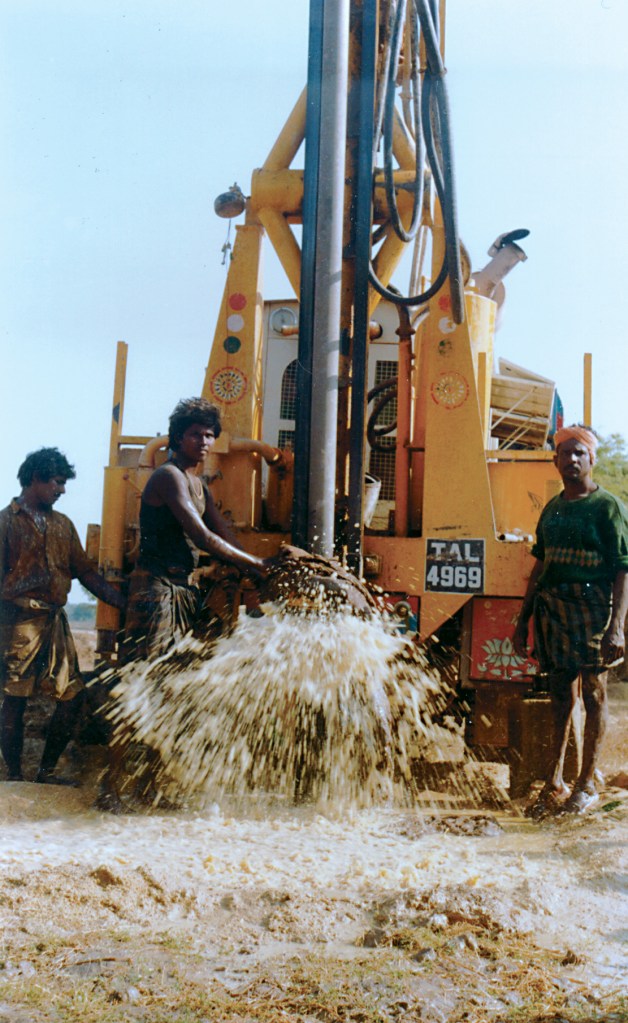
I was back in the U.S. by the time drilling started on the hole. When I visited the village a few months later, people described to me the tremendous force and height of the water that gushed on the first day of digging. Residents of the village had rushed to see this miraculous event. Word spread and soon people from the adjoining villages also came running.
The man who borrowed the money to dig that first well eventually became one of the most prosperous people in the village. He had no education, but it turned out he was a man who was interested in learning to do things scientifically. He became an inspiration to the village.
A well being drilled in Mulbar.
One successful well was good evidence, but not enough to drown out centuries of beliefs and a government report dating back to British colonial times certifying there was no ground water in the area. To challenge this entrenched belief, members of the committee decided to hire experts from an adjoining state to assess the situation. The new study concluded: Yes, there was water under the ground.
Even with the new report and one gushing well, I still had to coax five more farmers to dig wells, promising them incentives if they took the risk. Very quickly after that, everyone wanted wells dug in their villages.
In 1988, I was invited for dinner at a physician’s home in Des Moines, Iowa. During the evening, he told me that he had grown up in Mulbar, a small village in the western part of the state of Orissa, India. This physician, Saheb Sahu, had been impressed with the Trees for Life movement and wondered if I could take that concept to his home village. I was going to be in India the following month, and I agreed to visit the village.
“How do I get to Mulbar?” I asked.
“From New Delhi, you fly to Bhubaneswar, and from there you will need to go to Sambalpur by car. In Sambalpur, my brother will receive you and take you to Mulbar the following day,” he told me. “I will write to my brother to expect your call.” He gave me the contact information for his brother.
When I arrived in New Delhi the next month, unfortunately I left my briefcase in a taxi. So, when I reached Bhubaneswar, I did not possess any of the information I needed — not Dr. Saheb Sahu’s phone number in Des Moines; not his brother’s name, address, or phone number; nor the name of or directions to the village where I was to go.
In Bhubaneswar, I stayed with my friend Anang, whose father had been the chief minister of Orissa (comparable to a governor in the U.S.). After dinner, I asked him to name some villages in the hopes of sparking my memory.
“What do you mean?” he asked. “There are thousands of villages in Orissa.”
Realizing the impossibility of naming the village, I asked him to name some of the major cities in Orissa. When he named Sambalpur, I stopped him.
“Yes!” I said, “that’s where I need to go. The village is somewhere close to Sambalpur. How do I get there?”
He offered to loan me his jeep, but it came with one caveat — it was an open jeep with only a canvas top and no doors. That might have been fine for local travel, but this was to be a 240-mile drive during the month of May when temperatures climb to 115 degrees. I had no other choice and accepted his offer.
My friend’s nephew, Som Raj, was visiting his uncle for summer vacation and was given the task of driving me to Sambalpur. My friend said, “It will give him something to do, and he will get to see a part of Orissa.” His nephew was from Benares, 600 miles northwest of Orissa.
Our journey began at 4 a.m. so we could cover as much territory as possible before the worst of the heat. Som did not know the way to Sambalpur, so his uncle gave him these directions: “Take the highway which runs in front of our house, and it will take you directly to Sambalpur.”
That highway turned out to be a narrow, two-lane road that was being converted into a state highway, so there was construction all along the way. Every mile or two there was a detour, often onto dirt roads full of potholes. At several detours, we asked the road crews which way to go, but the laborers did not speak Hindi and neither Som nor I spoke the native language, so the workers could not guide us.
We did not know where we were going. We would come to a crossing and Som would ask in frustration, “Which way?” And I would say, guessing, “Let’s take that road.” We kept driving like that in the heat of the day, feeling exhausted.
After 10 hours of driving and not knowing where we were, we stopped the jeep in a small village. About a dozen villagers surrounded us. I told them we wanted to get to Sambalpur. Some villagers understood enough Hindi to tell us that Sambalpur was almost 50 miles in a different direction.
After a few minutes of silence, I said, “We are really trying to go to a village where a doctor grew up and later moved to America.”
“Yes! Yes! He’s Doctor Sahu from Mulbar,” someone said.
“How do we get there?” I asked.
They pointed and said, “You go in that direction.”
“Where is the road that will take us there?” I asked.
“There is no road to Mulbar,” the villagers said.
“Is there a path on which people go from here to there?” I asked.
Silently they shook their heads to say, “No.”
“Then how do you go from here to Mulbar?”
They looked at each other as if wondering to themselves, How DO we get to Mulbar?
“No one intentionally travels to Mulbar,” one person remarked sarcastically, as he turned his face toward the crowd. Everyone laughed nervously.
I laughed with them in agreement, as if the joke was on me. Slowly, I looked into the eyes of each man. “Would it be possible for one of you to ride with us in our jeep and take us there?” I asked.
“No,” they said, shaking their heads in unison.
“Why?” I asked.
“It is more than five miles away, and we would have to walk back in this heat.”
Finally, I offered a young man a full day’s wage to ride along and direct us to Mulbar. The rest of the villagers encouraged him to do so. Half-heartedly, the young man agreed to go with us just halfway, and from there he would point us in the right direction to the village.
We drove through unmarked fields and crossed a dry riverbed. If it had been the rainy season, the river would have been impassable and the village cut off.
We reached the village in the late afternoon when the equator sun was about to drop out of sight. We were covered in dust from head to toe. My face looked white from the dust. My hair was standing straight up. Even my eyelids were caked with dirt.
I wondered how in the world the universe had taken us right where we needed to go when we hadn’t even known the name of the village.
Part 2: “Ami Korbo!” (We Shall Overcome!)
We decided to park the jeep just outside the village. Som was exhausted beyond words and decided to rest in the jeep, while I went to explore. There was no one in the narrow streets. People must have been resting in their mud-built homes. There was no movement. Even the air was still. No life. Only silence.
As I stood in the center of the village, one curious soul ventured towards me. He was adjusting his shirt, indicating he had been awakened from his rest. I told him I was a friend of Doctor Sahu in Des Moines, USA, and I had come at his request.
He looked around to see if there was someone else with me.
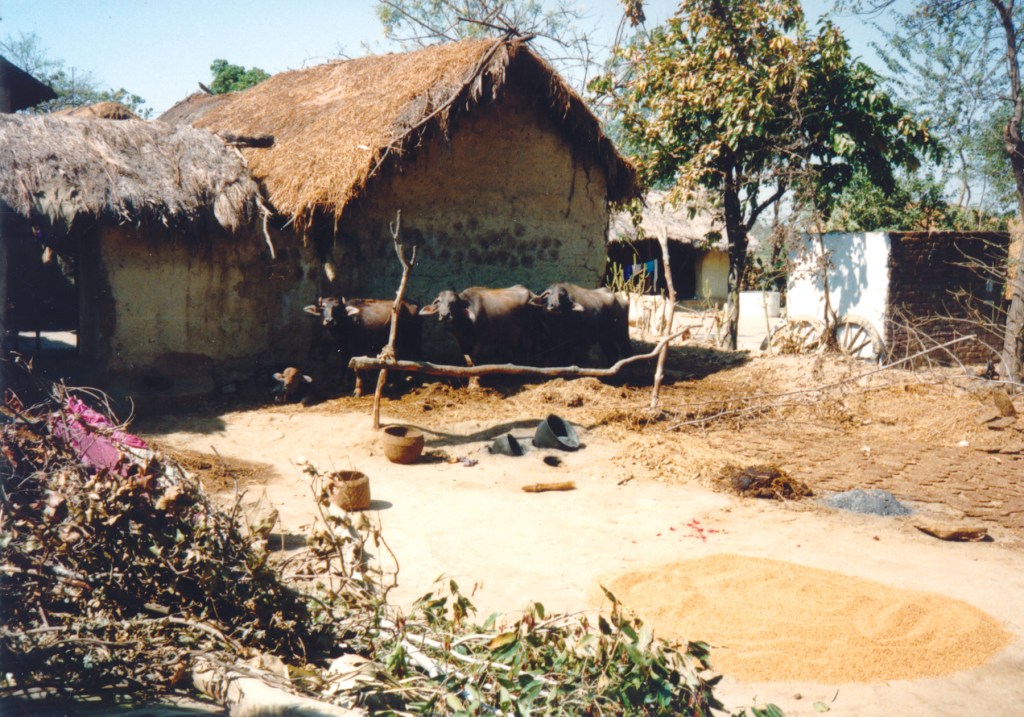
The village of Mulbar
“Did Munshi Babu bring you here?” he asked.
“No, I do not know Munshi Babu,” I replied.
“He is the doctor’s brother in Sambalpur. You mean he did not bring you here? How could you find your way here? It is impossible.”
It was obvious that he did not believe me. Briefly, I told him about our trip from Bhubaneswar, and how the folks from the nearby village guided us. He said the doctor was a legend in this area, and everyone knew and respected him.
Soon many of the villagers joined us. As usual, I engaged the people by asking several questions, including their names. However, they were more interested in who I was and what had brought me here. I told them I had emigrated to the United States many years before to discover the secret of what makes some people rich and powerful and others poor and powerless.
I also told them that Dr. Sahu had asked me to come to the village to tell them about Trees for Life. I requested one of the villagers to ask Som to come and join us. As is customary in these small villages, they brought us chai to drink, and we began to share our stories.
They told us the village depended on dry-land farming. During three months of monsoon rains, there is lots of water, but it drains off. This is followed by a period when there is hardly any water. The land, they said, produced very little food, and the cows barely gave any milk. As the population had grown over the years, the land surrounding the village had been stripped of trees. Farmers in the area grew rice and also a few vegetables during the rainy season.
I told them how our Trees for Life movement helped people in villages just like theirs to plant fruit trees.
“But we don’t even have enough water to drink! How can we take care of trees?” one man shouted from the back of the crowd.
“That is why I am here. You will soon see how it works,” I said.
“My great, great grandparents were born in a village much like yours. Many people helped them break out of poverty, and now I am helping to repay that debt by sharing a simple formula for what makes people powerful and prosperous.”
“What is that formula?” one person asked.
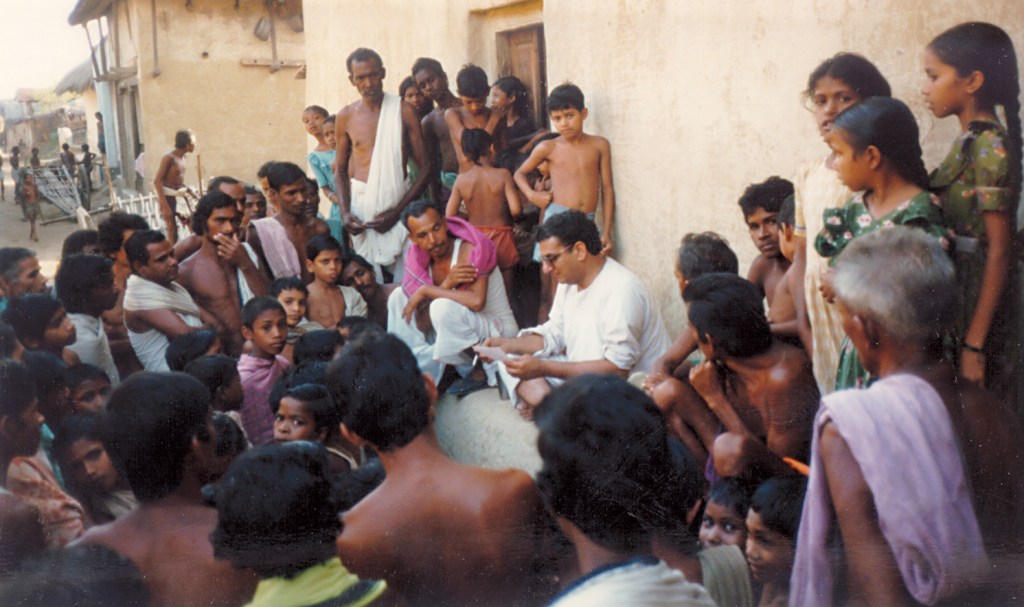
On May 4, 1988, villagers in Mulbar gathered around the “dust-covered stranger” and learned about the Trees for Life formula.
There was a deep silence on my part. Many villagers thought I had not heard or understood the question. So, they repeated the question again several times.
Slowly, I said, “Lakshmi, the goddess of prosperity, comes and dances in the courtyards of those where people are prepared. Just like rice will grow only where first the field has been prepared, there are three steps necessary for this preparation:
“Step 1: There must be a strong determination and commitment.
“Step 2: We must learn the science behind whatever we do.
“Step 3: We must have the discipline and the stamina to follow through.”
There was complete silence in the group. They were listening to me very intently. I asked them several times to repeat the steps back to me.
I said, “Let us start with step one. When the desire of a group becomes so strong that people are willing to pay this price for Lakshmi’s dance, then Lakshmi appears unbidden. Everyone can have a desire, but that is not enough. Desire has to become commitment and determination. So, the people I share this formula with are those who exhibit the determination to dance with prosperity.”
“We are determined,” someone said. Some people nodded their heads in silence.
“If there are a few determined people who can agree to work together and meld their hearts and minds together for a cause, then no force can stop them,” I continued. “This force is called Ekta — when many become one. Where there is Ekta, miracles come unbidden. Even problems that seem totally unsolvable are solved. If water is a problem, and you follow the formula, then water will appear. I do not know how, but I can guarantee you that it will.”
I asked, “Are there some people in this village who are willing to work as one mind and body, so that the entire village can experience such a miracle?”
A murmur went through the crowd. Dr. Sahu’s cousin was the first to volunteer. Then, six others volunteered.
“That’s enough. Let us start with a very small group,” I said. “Just like a mighty tree needs a small seed to start, in the same way, a mighty shift needs a few people to help it get started.
“The question is, will the rest of you help and support these few people, or will you oppose them and create friction among yourselves?”
“We will support them!” they shouted several times.
One young man raised his right fist above the crowd and shouted, “Ami korbo!” which means “We shall overcome!” I looked at that person. He was leaning on a bamboo stick, and I realized that he had a lame leg. A current went through my body, and I quietly started to look over the entire crowd from left to right. The people began to chant quietly, “Ami korbo, Ami korbo, Ami korbo.” The chant became louder.
I could feel the current go through the entire crowd and a shiver go through my body.
Part 3: The Wrong Road
After the meeting with the villagers, Som drove us almost 50 miles in the pitch dark, dodging potholes all the way to Sambalpur to meet Dr. Sahu’s brother.
As Som was parking the car across the street, I went into the Sahu Pharmacy.
“How may I help you?” Manaswi Sahu asked, as he looked up at me through his bifocals from behind the pharmacy counter.
When I introduced myself and Som, Mr. Sahu did a quick double-take. He was expecting an American, and here I was, an Indian in local clothing, covered from head to toe in dust. He took off his glasses, rubbed his eyes, and stared at me.
Munshi Babu, which is what all the local people called him, had a peculiar look on his face. I could not tell if he was laughing, amazed, or angry — perhaps all three.
I apologized and explained about losing my briefcase with the contact information for him and his brother, Dr. Sahu, in Des Moines; the long and bizarre trip that amazingly had taken us to Mulbar; and the meeting with the villagers.
“But you were supposed to have called me from Bhubaneswar, then come here to Sambalpur, and I was to accompany you to Mulbar the next day,” he said. “Now you’re telling me that you have already been to Mulbar, formed a committee, and started the work?!” He was miffed.
Then, finally understanding the situation, Munshi said, “You guys must be very tired. Let’s find accommodations where you can wash up and then we can take you to my home so you can get something to eat.” As he started to lock up his pharmacy for the night, he told me that he had been ready to close when we walked in. If we had come even 10 minutes later, he’d have been gone and his house would have been impossible for us to find.
He took us to the best hotel in town, where only one room remained for the two of us. We were too exhausted from the long day in the blazing heat to eat. The nighttime temperature was still above 100 degrees Fahrenheit. Since there was no air conditioning, we opened all the windows and had the ceiling fan going full blast. Normally, it would have been impossible to sleep in that heat, but both Som and I slept 12 hours in our skivvies.
When I awoke the next morning, I was still exhausted and could only imagine Som’s condition, after driving so many hours filled with detours, potholes, and playing “chicken” with a barrage of oncoming vehicles. He had not complained once. A feeling of admiration and love poured over me like warm syrup on pancakes.
Mr. Sahu picked us up and took us to meet his family. Munshi Babu and his younger brother lived in a joint family with their spouses and children in one house. We met everyone and exchanged our stories, then started back to Bhubaneswar.
The road to Bhubaneswar turned out to be a well-paved highway, without any construction and with fast-moving traffic. Within five or six hours, we were back in Bhubaneswar. That evening during dinner, we shared our adventure with my friend and his family. As we started to describe all the detours we encountered trying to get to Sambalpur, my friend looked puzzled and asked Som, “What road did you take?”
Som pointed in the direction of the road we had started out on at 4 a.m. the day before.
His uncle exclaimed, “Oh, no! You took the wrong road!”
We had taken the road behind the house, not the one in frontof the house!
We all laughed and marveled that even though we did not know the name of the village nor its location, and despite all the detours, the Universe had taken us where we really needed to go. What had seemed like the wrong road was really the right road after all. I shook my head in bewilderment.
As I walked in the villages, I felt like a young man in love. I felt as if I were walking on air and could lift off and fly. Vibrations ran through my body, as if I were a flute. I had no idea who was playing that flute, or what tune would be played, or when or how. I didn’t care. I felt the strength of ten men and, yet, a sublime lightness. I was dancing with my soul. What more could one want?
It was during one of my trips to India that we were invited to visit a remote village near Allahabad, where our team had helped villagers plant fruit trees. There were about a dozen people in our group, including three American visitors.
At the outskirts of the village, our party was greeted by a large group of people under a homemade banner. Children placed flower garlands around our necks and sang welcoming songs as we were introduced to the village elders. Then they eagerly took us on a walking tour of the village to show us the fruit trees they had planted.
Knowing that foreign visitors were a rare occurrence in such remote places, and that many children would be face-to-face with an American for the first time, I wanted our foreign visitors to be the center of attention. As our little procession snaked through the narrow streets, I fell behind to the tail end of the group and was talking to a handful of villagers.
I noticed an old woman walking briskly toward us. She had obviously missed the reception and was trying to catch up with the rest of the villagers.
Upon reaching our group she said without hesitation, “Tell me, who started all this?”
Dressed in my native Indian clothes, I was indistinguishable from the local Trees for Life volunteers. She could not have guessed that I had also traveled from America.
“Started what?” I asked her politely.
“All this,” she said as she pointed at the trees around us.
“Everyone here,” I said. “Each one of you started this.”
The old woman reached over and grabbed hold of my left arm.
“No,” she pleaded. “Who started it?” Even though her hands were small, her grip was firm and there was urgency in her voice.
I looked up at the sky and pointed upward.
“I know everything starts there,” she said. “But to manifest that spirit, someone had to take the leadership. Who is that person?” Her grip tightened as she spoke.
She had put me on the spot, and I was embarrassed. My eyes focused on the ground, and my foot was nervously digging at the soil.
“I was handed that responsibility,” I confessed.
She let go of my arm. Sensing my uneasiness, she moved back to create a comfortable space between us. There was a pregnant silence before our eyes met again.
“Why is that so important to you?” I asked. Her eyes were full of fire.
“This is selfless work in a very selfish world,” she said with intensity. “It requires courage. You will need great strength to withstand human frailties. Don’t give up. Selfless work is the only salvation for our world. May Shakti guide you and give you all the power you need.”
Her body and voice were animated as she expanded on her message. She quoted examples from ancient Indian mythology. It was evident she was not pleading—she was charging me with a mission and holding me responsible.
I looked at her. Her soiled white clothes indicated that she was a poor widow. She was probably not as old as the harshness of life made her appear. Perhaps surviving that harshness had given her wisdom and integrity.
After conveying her message, she clasped her hands and bowed gently, as if asking the spirit to bless me. Her eyes moistened. Then, as briskly as she had joined us, she walked away into the crowd.
A critical moment for Trees for Life came in 1988. This one moment could easily have unraveled the efforts of hundreds of people.
Plans for the Trees for Life guava tree giveaway were in full swing during my illness with dengue fever. Once again, the city of Allahabad was the site for the Kumbh Mela religious festival. It had been 12 years since I had attended the last festival in Allahabad. In January 1989, authorities were expecting more than ten million devout pilgrims from all over the world.
Allahabad is well known for its excellent guava fruit. That’s one reason we had decided to distribute 300,000 guava tree saplings to the pilgrims as a form of communion called prasad.
It was taken for granted that these prized saplings would be well taken care of by the pilgrims because they were blessed by the holy men at the Mela as communion. The recipients would continue to share fruits and seeds from their trees with others for years to come.
Implementing this project was a huge task. We had to contract with dozens of tree nurseries, arrange transportation, have the saplings blessed by the spiritual leaders, build distribution booths, obtain permission from the local authorities, and publicize the event.
The work started a year in advance of the Kumbh Mela. We anticipated that the most difficult task would be to enlist the help of the hundreds of volunteers needed to make all this happen. But long before the event, service clubs, youth groups, organizations, businesses, and individuals started to volunteer. It was obvious that the vision had caught the hearts and minds of the people. Magically, all the pieces of the puzzle started to come together by themselves. It was an experience to behold.
Then, the unthinkable happened.
Three months before the event, a key government officer was transferred to a new position. His replacement, Mr. Gopal, did not approve of the sapling distribution that we had been planning. He canceled the permission given by his predecessor. His orders were final. He dismissed all appeals made by Trees for Life representatives. It was a crushing blow to the volunteers who had poured their hearts and souls into this effort.
As a last resort, I was asked to come to Allahabad from New Delhi to see what might be done. A delegation of the key leaders met me at the railroad station, and we went straight to a meeting that included 20 of the “who’s who” of Allahabad. The meeting lasted several hours. The situation seemed hopeless. The group commissioned me to approach Mr. Gopal by myself.
That evening, I went to see Mr. Gopal at his home. As he opened the door, he said, “I know who you are and why you have come.” It was obvious that he was expecting me and wanted to squash any hopes I might have brought with me.
He offered me a seat and then started to recite a litany of reasons why he had ordered the cancellation.
“Mr. Mathur,” he said, “trees are being cut down all over India at an incredible rate. We are likely headed toward a major disaster. Your distribution of a few hundred thousand guava saplings would only create the false impression that a large number of trees are being planted. It would close people’s eyes to the fact that millions of trees are being destroyed.”
Mr. Gopal quoted several examples of how society ignores its problems and distracts people with nice, palatable messages. He asked me to stop this cheap publicity stunt and better utilize our time and resources to focus on the grave dangers of the widespread destruction of trees in India.
When he finished, he sat back in his chair, having settled his case.
After a long pause, I said, “Mr. Gopal, I did not come here to change your mind. I simply came to exchange perspectives. Let me share my perspective. My mother is old and quite sick. I do not know how much longer she may live. But suppose she was on her deathbed and asked me to give her a sip of water. Am I to refuse her that sip of water because I know she is going to die?
“Just as I know that my mother is sick, I am also well aware of the destruction of trees—not only in India, but all over the world. Giving a sip of water to a person even on their deathbed is simply an act of love. It may do more for the person who offers the water than for the recipient. For us, planting trees is not about statistics. It is an act of love—an act of worship—that kindles the hearts of those involved.”
My brief statement was followed by a long, uncomfortable silence.
After what seemed a long time, I noticed a small tear in Mr. Gopal’s left eye. Then one appeared in his right eye. Soon tears were running down both his cheeks. He let the tears flow and did not wipe them away. Finally, he got up and walked into an adjoining room and closed the door behind him. I heard the click of a steel cabinet opening and closing. He came back in and without a word, he handed me a sizable stash of money … the largest contribution we had received up to that date.
Tears welled up in my eyes. We parted in silence. He only broke the silence to humbly request that his gift be kept anonymous.
“No one should know I contributed . . . ” his voice trailed off.
Mr. Gopal became one of the most active volunteers of Trees for Life. Before sunrise, he was out in his jeep inspecting the nurseries and exhorting people to support the event.
Thanks to the tender and caring heart of Mr. Gopal, the distribution of the 300,000 guava trees became a great success. But equally important, he helped me define what Trees for Life was all about . . . A simple act of love.
During long stays in India, I could only call home every two weeks because of the expense of long-distance calls. The first thing Treva always asked was, “How are you feeling?”
“Fine,” I always said.
“Please be honest with me,” she would say, because she knew from experience that I was likely to have a bout with stomach problems.
In the beginning, when I was with the villagers, I knew if I were to be in tune with them, I would have to eat what they ate and drink what they drank. I was not walking in as an American with bottled water. Invariably, I would get sick, but that was part of the deal. I would go through one of those bouts for 24-48 hours and then be back on my feet, going at full speed.
However, that was not the case in 1988 when I came down with dengue fever, which is sometimes called “bone-breaking disease.” I had traveled to India planning to keep my typical hectic schedule, including overseeing the planning of a Trees for Life tree distribution at the 1989 Kumbh Mela where we planned to distribute 300,000 guava saplings as an act of communion.
The dengue fever lasted three months. My body burned and shivered. My back and joints ached. I could hardly eat or drink. This torture left me completely drained.
Lying on my sickbed day after day, the hours became long and heavy. An awful darkness filled my mind and body. I longed for the tender, loving touch of my wife and the company of my children. Unable to focus on anything, doubts began to fill my mind.
Somewhere in the depth of my being, I heard a dark, sinister voice of doubt chiding me: “How long are you going to keep exposing yourself to such diseases?” it asked. “Ha, what an ego!” It taunted me. “The problem of hunger is so great, and you are so small. If what you are doing is right, then why isn’t everyone else doing it?”
It was depression at its very worst. Life seemed so bleak, so hopeless.
I was suffering through this long tyranny when the houseboy in my relative’s home came to inform me that I had some visitors.
“Send them in,” I said.
The houseboy shook his head, indicating by his hesitation that the visitors should not be allowed inside the house. My state of health did not permit me to meet someone at the gate. However, mustering all my strength, I decided to go out and meet these strangers. I walked out wondering why I was putting myself through this torture.
There in front of me stood two lepers. I did not recognize them. One of them mustered enough courage to speak. He swallowed hard and said, “Sir, four years ago you helped us plant 60 guava trees at our colony. We have brought you some . . . ” His voice trailed away, and with his stubby-fingered hand he pointed to a cardboard box of guava fruits they had brought with them.
There was a mixture of pride and embarrassment on the disheveled faces of my two visitors. Pride because, four years ago, I had challenged them, in spite of their condition, to help themselves. Embarrassment because they believed that even their best offering was inadequate for this occasion.
In the box were nine of the largest, most beautiful green guavas I had ever seen. I was touched beyond words, and tears rolled down my cheeks. I had not labored in vain. What I had done in the previous five years did have meaning. It mattered.
I tried to thank them, but the words stuck in my throat. Words, however, were not necessary for them. They knew I was thanking them for something more than the guavas.
“How did you know I was in New Delhi?” I inquired.
They had traveled 25 miles, though they had no way of knowing that I was even in India. From the look they gave each other, it was evident they had not thought of that. One of them shrugged his shoulders, while the other tried to step back. The startled look on his face said it all. Their visit had been an act of faith. They did not even have the fare to get home. I could feel my doubts of the past weeks melt away. There was light in my life! Even in my weakened state, I could have jumped for joy!
I do not know what is within the human soul that makes it reach out and touch someone so unerringly at the right time and the right place.
* * *
A few days later I awoke in the middle of the night. Lying there in the dark, I witnessed a scene. It was as if I were seeing an image projected on a screen in a darkened theater. It was not a dream. I realized I was in a trance-like state.
In the scene, people were dancing in a large circle, holding each other around the waist and moving in a counter-clockwise direction. They wore colorful attire and were moving at a very fast pace. Their speed was so rapid that the colors blended into a beautiful hue. Somehow, I was part of the circle dancing and, at the same time, I was outside the circle watching the dance from my bed.
Then another figure appeared on the scene and the circle of dancers came to a standstill. This person was frail and dressed in white. As it joined the other dancers, it was difficult to tell if the figure was male or female.
“Are you a healer?” I asked the newcomer.
My question seemed to embarrass the person. “No, I am the one who was healed.” The answer came shyly as the figure tried to meld into the circle.
The dancing began again and soon reached the same crescendo. Another figure appeared, wishing to join. The dancing stopped again.
I asked the same question, “Are you a healer?” and received the same answer. This scenario repeated itself nine times. Then the circle melted away.
Why nine? I wondered to myself, lying in bed. Then I noticed a figure on my right. Somehow, I knew it was Jesus. He was silently conveying something to me.
Of the ten lepers he had healed, one had come back to thank him. That one then transcended our known universe. The other nine had remained to heal others in the same way they had been healed.
“The healed is the healer,” Jesus said gently. There was conviction and finality in his message.
At that moment everything seemed so clear to me.
It was evident that in the process of healing others we are healed. The one perceived to be the sufferer bonds with the one perceived to be the healer. In this linkage, both are healed simultaneously. Thus, is the universe healed.
I was overcome with the same joy I had felt when my two visitors had come to my home.
“Oh, Jesus, the same lepers you healed came to heal me,” I confided to him. “Thank you for healing them.”
Almost from the beginning our message to the villagers was, “One teaches two.”
The essence of what we were doing was very simple: We went to the villages. We worked with people and taught a few at a time how to plant fruit trees in their kitchen gardens. These trees were household names and people were familiar with some of the nutritional benefits of their fruits. We started with trees such as moringa, lemon, banana, papaya, guava, and amala. These trees produced fruits in a relatively short time, took very few skills to plant, and grew without too much care. We obtained the highest-quality saplings because these were to be the “mother trees,” which allowed people to generate additional trees through seeds or cuttings.
We provided more than just tree saplings. We were not horticulturists. We were social scientists and social marketers. Our reason for planting these trees was about more than providing nutritional benefits. For us, these trees were the tools to ignite a social movement for people to empower themselves for something much bigger. Thus, our message had to be simple and straightforward:
What you learn, teach two others.
Share two saplings with two others from each tree you receive.
It was not just a statement or a pledge for the tree recipients to sign. This was the core message of the program, and we invested a considerable amount of time and energy in projecting this idea. I would share with them the magic of the nuclear chain reaction. One energized atom sparks two others, and those two in turn spark two more. The cumulative results create a massive energy beyond imagination. And all of this takes place in a blink of time. Such synergy is not limited to atoms. It applies to everything. It is a universal law.
In one newspaper article about the “One Teaches Two” approach, I gave an example showing the amazing accumulation that happened when this law was applied to planting trees. Suppose one person were to give me a high-quality banana tree that produced fruit as well as five suckers (shoots that grow at the base of a banana tree and can be planted to grow a new tree). I would enjoy the benefits of having my own bananas and, from my surplus of five suckers, I could give one banana sucker each to two of my friends and they, in turn, could repeat the process. By the time the process is repeated only 32 times, 8,589,934,591 banana trees have been produced, which was more than sufficient to meet the banana needs of the entire world.
The important part of our message was for each person to realize they were not mere recipients; they were givers also. I would share a story about Buddha:
Buddha was traveling through a city. A hungry beggar asked Buddha for the leftover food in his dish. Buddha told the beggar that he would gladly give her the leftovers if she first went through the ritual of refusing the food when offered.
The beggar said that this was impossible. Her family had trained her to ask and not refuse. She had been hungry for several days and could not risk her refusal being taken seriously. Buddha gently told the beggar that the offer was firm, but only if she would refuse when offered the food. With a lump in her throat, mustering all her courage, she agreed. At that, Buddha offered her the food. But when the beggar refused, there was firmness in her voice. It was not a mere ritual. She went on to say that, once she acquired the courage to say “No,” she was no longer a beggar. She became one of Buddha’s disciples and great teachers.
I shared with the villagers that, in order to get out of the vicious clutches of chronic poverty, they had to change their perceptions of themselves as receivers and begin to see themselves as givers. From beggars to kings. To make this point, I would cup my hands together and extend them forward, as if asking for something, then turn my palms down, as if giving something.
Sharing was the key because it sparked responsibility. Parents share with their children because they feel the responsibility. The king shares with his subjects because he feels a sense of responsibility. Responsibility and success go hand in hand. I invited people to give me more examples, and they would.
They could share with two others the training they received from us, as well as the seeds or saplings from the mother trees that they received. All of this was within their capabilities.
That intellectual understanding was followed by a physical drill. I would raise two fingers high and ask the crowd, “How many do we have to teach?” In unison they would reply, “Two!”
“And when do we share our knowledge and skills with others?” I would ask. There was silence. I stomped my foot, one finger pointing to the ground. “Now!” I said, emphatically.
I used the drill over and over, until it became ridiculous and funny. People would shout “Two!” when my hand went up, and “Now!” when my hand went down.
I explained to them the importance of sharing immediately, rather than waiting for some uncertain future. All races were won by people who acted with immediacy.
That became my trademark. When people saw me at any place, they would automatically raise their hands and say, “Two!” then drop their hands down to say, “Now!”
The message was taking root.
Word of our work spread quickly from village to village. Sometimes the extent of the network being created surprised me.
Once, a friend and I had to cross the Ganges River by boat. We knew what the normal rate per person was for the crossing, but the boatman, knowing that a foreigner was present, was asking for ten times the going rate. Boatmen get so little from the regulars that they have to take advantage of any unsuspecting outsider. My friend negotiated a price with the boatman at about four times the regular price.
In the middle of the stream, the boatman asked, “What takes you to the other side?”
“We are going to Sacha Baba’s ashram,” my friend said.
The boatman became excited. “Oh, my! Sacha Baba is such a powerful man,” he said. “There is a man who came to visit him from America. Then this man had a dream to plant trees. He started to do that and as a result, now people are planting trees all over.”
My friend pointed to me. The boatman realized I was the man he was talking about. When we got to the other shore, the boatman stood there, with folded hands. He refused to accept any payment.
Despite the excitement among the villagers, the formula “One Teaches Two” had its skeptics. One of our volunteers told me in the beginning, “They are not going to tell two people.”
Eight years after Trees for Life planted its first trees, we saw proof of just how powerful the formula was.
At our camp in a village in Orissa, considered to be one of the most impoverished states in India, an unfamiliar man showed up one day. He had traveled by bike from his village 40 kilometers away. He proudly showed us dog-eared photos of lemon trees that Trees for Life had helped him plant a few years before, starting with the best lemon tree saplings.
At his request, we traveled to his home to see his trees. What once had been four acres of marginal, water-logged land had been turned into acreage lush with lemon trees planted in beds two feet above ground to avoid waterlogging. And in between the trees, vegetable gardens were being cultivated. He said his income had increased eightfold in the previous three years.
A crowd of villagers started to gather. The man proudly introduced people to us by saying, “I trained him . . . I trained him and him . . . .” It was clear he had not only taught two, but many more than that. He had given them seedlings, taught them how to plant and care for the trees, and also taught them accounting, a skill he had learned by himself and considered of utmost importance.
“I must have taught more than a hundred others by now,” he told us.
For me, this man’s story answered a nagging question: Do people really fulfill the Trees for Life commitment of helping and teaching two others? His life was living proof. I realized that giving was not only in the souls of these villagers, it was in the souls of all people.
When I finally let go of the last sliver, the fear of being poor left me for good. I no longer needed the security of money. Money lost its power over me.
After that, my work with Trees for Life became a dance that attracted people to join. The universe knew what was needed. The new energy of each person brought the right resources at the right time. Nothing more. Nothing less. I did not have to worry or plan or direct it. I was a free man.
I came to realize: Trees for Life was not about planting trees. It was about demonstrating how everything works in sync, and the power that this created. The same was true for my life and had been ever since childhood.
One example that my blockage had been removed came when a friend asked me to call upon his friend, a doctor, to tell him about Trees for Life. At the appointed time, I reached the doctor’s office and found him putting on his jacket. He told me he would have to leave soon and asked if I could tell him briefly about my cause. He stood beside the door, indicating his desire to escape. After I had spent a few minutes with him, he took his jacket off and told his secretary to call the person he was meeting to say he would be late. Then he sat down and told me I reminded him of a prophet from the Bible, whose bones cried with what he believed. He said he was fascinated and wanted to know more about me.
A few days later, he invited me to lunch and wanted to make sure I would bring Treva. On the way, Treva tried to coach me.
“I know you don’t like to ask for money, but please ask for money,” she said. “The thing we need is money.”
“Sweetheart, the one who is going to give us money knows when we need money and when we don’t,” I told her.
She understood the one I was referring to was not the doctor.
“Please, you know how desperate our situation is,” she pleaded.
Treva and I were already seated when the doctor arrived. Without speaking any words, he reached into his pocket, pulled out a check for $5,000 written to Trees for Life, and laid it on the table.
“This is not for planting trees,” he said. “This is to make sure you and Treva have money to live on because, if you don’t, Trees for Life cannot survive.”
Later, I found out from others that before our lunch, he had contacted half-a-dozen people to find out more about me.
This doctor became one of our staunchest supporters, giving additional substantial gifts when we needed them. He also raised significant amounts of money from his family and friends.
He joined our board and argued that Treva and I should be given a salary. Until then, we had drawn less than $10,000 during each of the first seven years of Trees for Life.
“The emphasis is wrong to say money goes for work first,” the doctor told the board. “These people have to survive. We have to take care of them first and then other people will give money for our programs. Until that happens, nothing else can be done.”
The board approved modest salaries for both Treva and me.
This journey into the unknown had brought us the realization that any work becomes meaningful if it is sacred. And sacrifice is what makes things sacred. This journey was our cleansing to be worthy of the vision.
The poor became my Master: I had to feel their pain to serve them effectively. Service, not pain, was the joy. Trees for Life was never about money. It was a spiritual experience.
Early on this journey, I gained further clarity from the writings of the philosopher Huston Smith. Paraphrasing Smith, there are three eternal and universal questions humans ask:
How do I make a living?
How do I get along with people?
What is my place in the universe?
I internalized the third point as, Who the hell am I? and What the hell am I doing on this Earth? I chose to make it my guiding star because if my relationship with the universe was clear, the other two relationships would fall into place.
I saw myself as a visitor to this planet for a short time, just as I might visit Disneyland. I could enjoy it while I was here, but I could not take anything with me. That is why, throughout all my years with Trees for Life, I took even less for my annual salary than the original amount approved by the board.
This action produced very practical results. We attracted volunteers and staff members who were of the same mindset. Over the years, more than 50 youth and adults from all over the United States and several foreign countries volunteered to work with us for $45 a month, plus room, board, and health care. Phil and Kathy Miller gave up their professional careers, Phil as a bank vice-president and Kathy as a social worker, and sold their home to live in a single room, just as other volunteers did. They served in India for several years. David Kimble left his management career and served as a volunteer for several years before joining the staff and becoming the executive director of our organization. Two volunteers, Scott Garvey and Jeffrey Faus, came to us in different years through Brethren Volunteer Service. Both had planned short-term stints as volunteers but kept extending their commitment for several more years. They eventually became long-time staff members. Staff members’ salaries were similar to mine.
We were like a modern-day monastery, demonstrating that the world did not revolve on the twin axis of money and money alone, but also on love and devotion.
Several times, when the board suggested raising my salary, I refused.
When Treva and I were nearing retirement, a few board members told me they wanted to propose that Treva and I be given a pension.
“Why?” I asked. “Treva and I have talked about this subject and we feel our Social Security is ample to take care of us.”
“The cost of food is rising,” one member said.
“We eat rice, lentils, and vegetables,” I said. “How much can they go up?”
For both Treva and me, our relationship to money had changed fundamentally. The dark abyss I thought I had jumped into turned out to be a mine of shining diamonds. Life spent in its glow made me the richest man on the planet.

 balbirmathur.com