
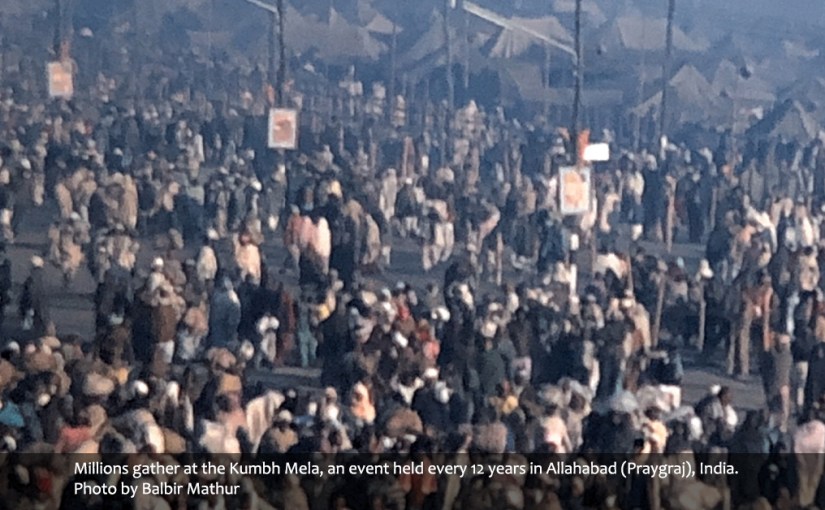
The biggest news at the Mela was the presence of a saint reputed to be 350 years old. Even though the name of Devraha Baba was on everyone’s lips, I simply refused to give him any credence. When I needed to be polite to people, I simply ignored the topic and walked away. To others, I was curt. With some, like my mother, I would question their sanity. But the brunt of my anger was reserved for a monk I met on the night of January 18.
It had been a long day. I had gotten up at four in the morning at the behest of a Dutch photojournalist who told me the best photographs are taken at dawn, even before the first sun rays hit the ground. That night, I was exhausted as I walked back to my tent hotel room. The hotel office was near the gate, and I peeked inside.
That was my undoing.
A Hindu monk was sitting there, literally twiddling his thumbs, as if waiting for someone. The way he had wrapped his long, cotton, ochre-colored dhoti (a type of sarong) suggested he was from the state of Gujarat in western India. He engaged me in conversation regarding the Mela, which was of interest to me. I found out he was called Shanti Bhai (shanti means “peace,” and bhai means “brother”). He asked why I was at the Mela, and then asked more questions about National Geographic.
After several minutes of such talk, I begged leave of Shanti and started toward my tent. He followed and politely stayed outside, but continued to talk.
I told him I had had a long day, and I reminded him that tomorrow was the biggest day of the Mela and I needed some precious rest. I would be glad to see him some other day. But, skillfully, he kept me engaged in conversation.
Somewhat sternly, I told him again to come back the next day. He said the next day was Mauni Amavasya, so this may be our only opportunity. “This sanjog (coincidence of the stars) may never appear again,” he told me. “Have you met Devraha Baba, the 350-year-old saint?”
That did it. I unleashed all my pent-up anger on him. My diatribe was sprinkled with profanity. I asserted that scientists in the U.S. had done all sorts of studies on longevity, and if there was anyone of that age they would have studied him a thousand times over. I guaranteed that there was no one in the world who was that old. The very notion of someone being 350 years old was absolutely preposterous. I blamed Hindus like him who circulated this type of nonsense. It made a mockery of the religion and only spread illiteracy and ignorance.
“India is underdeveloped and poor because of people like you!” I concluded. I wanted the intruder out of there.
The calm smile never left Shanti’s face, which made me even angrier. “What type of journalist are you?” he asked. “This is the biggest news of the Mela, and you have discarded the information without even checking it. Rejection without investigation.”
That statement touched a raw nerve and stopped my harangue. I needed to cool down. I took a short walk around the campsite, while he stayed outside my tent.
This man is right, I thought. I am not a journalist. I am a businessman acting like a journalist. What would I say about the presence of this allegedly 350-year-old man in my article? Would I simply ignore the whole thing? Would I say that even though tens of thousands of devotees flocked to be in his presence, I never investigated it? Am I being objective, or am I just bogged down with my own prejudices? Am I doing justice to my assignment, or am I a phony who gets by doing the very minimum?
I felt as if I were in a boxing match and had been winning every round until my opponent knocked me out with one punch in the last round. This punch was below the belt.
Upon my return, I apologized to Shanti and asked where Devraha Baba was camped.
“Just around the corner, only a few minutes’ walk,” he replied. “You will be back in no time.”
I corrected him, because I knew this was not true. Devraha Baba was in Jhusi, across the river and several miles from where we were located.
“Yes, that is where he was earlier, but he moved to be near the Mela tomorrow,” he assured me. “His new location has naturally not been made public. I know where he is, and I can take you to him.”
“But it is too late,” I protested.
“No, not at all,” he asserted. “Most of his devotees come to visit him only at night. That is when he gives his darshan (the blessing of seeing a holy person).” I was not convinced, so I looked straight into his eyes. He did not even blink.
I grabbed my camera and left with him to find Devraha Baba.
Shanti was in his early 30s, lean, and of slight build. He was a brisk walker and invariably stayed about ten steps ahead of me. While I was dressed in multiple layers of warm clothing, including my topcoat, Shanti was dressed only in his dhoti.
Every half mile or so, I would stop and bark, “Where in the hell is this damn place?!”
He would turn around, smile, and say, “Just around the corner,” and then promptly race forward again.
A few times, he looked back to make sure I was still following him. That gave me the notion of just giving him the slip—it would teach him a lesson! But what if the Baba was indeed nearby now? I tried to engage the monk in conversation, but he kept moving, avoiding any verbal contact. I was getting angrier by the minute.
As we started to cross the Ganges River on a pontoon bridge, it became evident that, indeed, we were going to Jhusi. It was too late for me to turn around. Even after crossing the river, it was a long walk farther. The lights and humdrum noise of the Mela receded behind us.
This long walk in the dark took me back a few years to an incident when I fell into the clutches of a con man in Rome, Italy. It was the same pattern. A stranger takes you into their confidence. You are invited to go to a nearby destination, which turns into a long distance. Your inquiries are met with statements like “just around the corner.” In the end, you find yourself in a dark, isolated place where you are helpless.
My sense of adventure had kicked in once again to override good judgment. In Rome, it had taken all my presence of mind and all my wits to come out of the trap alive and in one piece.
I would soon learn that on this trip, my wits would be of no value.
We finally reached Devraha Baba’s hut, which turned out to be on the shore of the Ganges and built on top of four wooden stilts at least ten feet tall. The top half of the tower was covered with mist floating over the banks of the river. It looked surreal in the glimmering moonlight. Adding to the effect was the warm glow of the festival lights on the distant horizon. I felt like I was lightyears away from the Mela, on a different planet.
We approached the tower slowly and cautiously, with the monk leading the way. There was one person sitting on the ground between the stilts under the hut. We had not been able to make him out there in the shadows from a distance, but he had been able to see all of our movements.
The whole setup surprised me. I had expected a big encampment with dozens of tents full of people surrounding the Baba, along with the necessary security arrangements. Here, the most renowned personality of the Mela was practically by himself.
The man sitting under the hut turned out to be a well-known chemistry professor at the University of Allahabad. Even I recognized his name after all these years, having earned my Master’s degree there in 1956. With prayer beads in his right hand, he was keeping warm under a solitary blanket. In a gentle whisper, Shanti introduced me as “the great Indian journalist from America representing National Geographic.”
The professor recognized the name of National Geographic, but his eyebrows went up at hearing that I was a great Indian journalist. Of course he had never heard of me.
He put a finger to his lips to make sure we would not wake up Baba. In a soft whisper intermingled with gestures, he conveyed that Baba was resting, and we would need to come back during the day.
“But this man is a devotee of Baba who has come all this way solely to have his darshan and to write about him,” Shanti asserted.
The professor was not impressed.
“He is leaving in the morning!” the monk lied once again. “That is why we are here at this late hour.”
With sternness, the professor motioned for us to leave.
The ease with which Shanti doled out his brazen lies disgusted and embarrassed me. I did not want any part of it. It was not my idea to see the old man. I was not a devotee. I was not leaving in the morning. Angry, I stood a few feet away with my head half-turned away from them.
Shanti looked at me and shrugged his shoulders in resignation, as if to say, “Well, we did our best.”
That would teach this SOB a lesson, I thought. I felt an ironic sense of justice.
Just as we started to walk away, a voice came from the hut above. “Who is there? What is going on?”
It was the Baba.
Shanti rushed to reply before the professor could intervene. “There is a journalist from National Geographic who would like to write about you, Baba!” he shouted quickly.
“National Geographic…” Baba replied in a loud voice. “National Geographic is not going to print the article. This man is here for something totally different. I will see him,” Baba’s voice seemed to boom in an otherwise silent and still space.
Is he predicting that my article will not be printed? I did not want to even hear such a thought. I regretted being there. I felt as if someone had hit me in the pit of my stomach.
Another doubt arose in me. His voice was loud, clear, and authoritative—even youthful. He sounded like an 18-year-old. Never having heard a 350-year-old man speak, I did not know what to expect, but this was positively not it. It seemed to me the con game was thickening. The image of Dorothy’s Wizard crossed my mind.
Shanti’s gratitude burst forth: “He is your devotee, Baba! Just a few minutes will do.”
Oh, I wish he had not said that, I thought. I am not one of Baba’s devotees!
The professor, who was now standing outside the stilts, turned towards me. A wide and knowing smile covered his face, and he nodded gently. He seemed to acknowledge that something significant must be taking place if Baba would actually come out in the middle of the night, and that he was fortunate to be there to witness it. His eyes were dancing.
There was a rustle inside Baba’s hut on top of the tower and then some brief chatter as his assistant helped him get up. Baba’s body was unsteady as he came out, like a 90-year-old man who had been awakened from a deep slumber. He was short, and had long, matted hair. He was not wearing any clothes at all in that cold air.
My camera was ready, and I immediately started to shoot pictures. Even though the camera flashes were piercing, Baba just stood there gracefully, holding onto the railing of the platform, without protest. A few times he tried to protect his eyes with his skinny hands. I kept shooting.
After I had shot a dozen or so photos, the professor said, “That’s enough.” But I kept shooting.
After a few minutes, Shanti cried out, “Mr. Mathur, please, stop!” But I ignored him and still kept shooting, until my whole roll of 36 slides was emptied.
“Is it over now?” Baba asked.
“Yes, Baba. Thank you,” I replied, standing in front of him under the tower.
Baba went inside and then called out to the professor, “Give the child some prasad (holy food, similar to communion).” The professor got a small bowl made of leaves and started putting food in it for me.
Baba’s voice came again: “Make sure you also give him charnamrit (blessed water).” The professor brought me a small earthen cup.
Exhausted from our long walk, I sat down on the cold sand facing Baba’s hut. Shanti joined me, and we sat there in silence, each lost in our own world.
I was trying to digest what had just taken place. Baba’s youthful voice and the smooth, firm skin of his face belied even the seeming age of his 90-year-old-looking body. Granted, he could be 90 years old, but there was no way he could be 350 years old—or even half that age! What had I come all the way here for?
Then remorse hit me. It was not appropriate for me to shoot that many flashes at any man in the middle of the night without his permission—not to speak of an elderly man like him. Why had I been so rude? What had come over me?
A drop of cold water landed on my forehead, right between my eyebrows, and brought me to my senses. It felt like coming back from some distant land where I had been lost. I felt drowsy. I must have dozed off, I thought.
I became aware that my hands were absent-mindedly sifting through the cold sand at my sides. I pulled one hand free to look at my wristwatch. It was exactly midnight. It was now January 19—the auspicious moment of the start of the Mauni Amavasya.
Then I looked up to find the source of that falling droplet. A bird, perhaps? I wondered.
What I saw sent a shiver through my spine.
The sky was covered with thick, dark clouds. They were rolling in fast, like a well-trained army moving silently and swiftly to besiege a town under cover of darkness. The clouds had already gobbled up the full moon that had provided such a luminous ambiance only a little while ago.
Did I doze off for a long time, or did those clouds appear in an instant? I wondered. I could not remember seeing a single cloud all day long. Then I realized that it had been pitch-dark as we were walking up to the Baba’s camp. The moon must have come out of the clouds only for a few moments when we arrived.
For the huge masses of people gathered at the Mela with little or no shelter, rain would be a disaster. “Oh, God, no,” I said out loud. “Millions of your children are camped out in the cold. Spare them, please! They have come to experience You. They may be stupid, but they are your children. You are called merciful, so show your mercy! God, forgive these children of yours. They do not know what they are doing, but they mean well.”
I was praying in earnest, and I did not know what to think of that. I did not even believe in God. If I had heard these words from someone else, I would have been ready to argue and chastise them. And yet, here I was praying and using such words. It was preposterous.
 balbirmathur.com
Such an opportunity to start the life you are leading and have lived.