Swept Up by the Current

A few weeks after I met the barefoot messenger in Bird Village, one of my associates and I flew to Hyderabad in south India to meet with a group of scientists at the Nutrition Foundation of India. As we entered the building, I saw a large cloth banner reading:

“Moringa leaves contain ten times more beta carotene than carrots.”

This information hit me as if someone had slammed a two-by-four squarely between my eyes. I was stunned. I knew that beta carotene was the precursor of vitamin A, and that diets deficient in vitamin A were the cause of millions of children around the world going blind each year. I did not know that moringa leaves contained such great amounts of beta carotene. They could save millions of innocent young children from the clutches of blindness.

My friend who had traveled with me could not understand why I was standing there with dazed eyes in front of this banner. He pulled me by my arm and reminded me that people were waiting for us inside. We had rushed through the maddening traffic of Hyderabad to get there, and now I was wasting valuable time right in front of our destination.

I stood there in disbelief. The barefoot messenger who had traveled to Bird Village was right. It can’t be, I thought. Not only was he right about moringa, he was also right about the information reaching the scientists. How could he have known?

As a result, the meeting with the scientists took a different turn than originally planned. I was no longer interested in other fruit trees. I pelted them with questions about the moringa tree. Were the moringa leaves digestible after cooking? Was the beta carotene digestible? Was vitamin A lost in cooking? What were the side effects? On and on my questions went.

My partner was disgusted with me for having changed the agenda of the meeting without notice. It was as if we had been floating together on a river and, all of a sudden, an undercurrent had caught hold of me.

After that, information about moringa started to pour in from all sources. There was ample information about the vitamin A in moringa, but it was locked in the Ivory Towers. It had not trickled down to the grassroots.

Trees for Life decided to do a social marketing test to see how this message could be delivered to the masses, where it was needed. As we were strategizing, a grant from Opportunities for Micro-Nutrient Interventions (OMNI) Research fell into our lap. Amazingly, the grant opportunity was specifically for testing social communications for micronutrients, which was OMNI’s focus. The timing of the coincidence was uncanny.

With the support of the grant, five of us from Wichita went to Orissa in 1995-1996 to conduct a five-month test campaign in 20 isolated villages, with Bird Village and the Learning Center as our base.

Message from a Barefoot Man

A barefoot man showed up while I was at Bird Village in Orissa. Upon learning that a group of people were helping villagers plant fruit trees, he had come to share an important message with their leader. The message: “The leaves of the moringa tree prevent 300 diseases.”

He was a Vaidya, the practitioner of India’s ancient medicinal arts, and he lived in a remote hinterland more than 100 miles away from Bird Village. It had taken him four days to travel by foot and bus. He was neatly dressed in white, native clothes, with a gray handlebar mustache. He carried no luggage and wore no shoes. He said he was 80 years old, but he looked much younger. 

I treated him with due respect, as I did all of the visitors to the villagers, but I did not believe his preposterous claim about the moringa tree.

“If this tree is so good, why hasn’t it been recognized in the Western medicinal literature?” I asked him.

“It shall happen,” he said gently, but with great confidence.

That is what is wrong with India, I thought to myself. Here is a poor man living in the poorest part of India, which has been frozen in time for millennia. He has never seen other parts of India, nor does he know anything about Western medicine. Yet he dares to predict what Western medicine will do. It is this arrogant weight of the dead past that has kept India in darkness.

The man stayed with us that night at the camp and talked freely, with great dignity and authority, yet never repeated the message he gave me upon his arrival. That night, he washed his clothes and hung them up to dry. They were his only possessions. Realizing that this trip was sacrificial for him, I offered to cover his travel expenses, but he did not want any part of that. 

The next day, I saw him leave. He did not look back as he strode on that dusty path. It seemed to make no difference to him that I did not give credence to the message he had delivered. It was as if he had been waiting to deliver the message and now his job was done.

I felt that since his message was not important, he was not important. I did not think it necessary to get his name or the name of his village. I saw him fade back into the ancient past from whence he had emerged.

People of the Mist

I had awakened in the middle of the night and was lying in bed when I saw two figures. It took a brief moment for my eyes to adjust to the dark. Not wanting to draw their attention, I lay there motionless. Quietly, they walked straight toward me and stopped next to my bed.

Since I was lying on my side, I had a clear view. There were two boys; in front was a boy perhaps eight years old, the other boy was taller, perhaps in his late teens. I thought his looks were deceptive because he seemed older than he looked. 

They each had on only a pair of white cotton shorts, which were soiled with dirt. From their dark, bare bodies, I could make out that they were from rural India. Both boys were blind. They were each holding one end of a bamboo stick. Having grown up in India, I had often seen the “blind leading the blind” this way.

Without any formalities, the older one spoke: “You have to help us.”

His face and eyes were focused on me. I understood exactly what he meant. They were not seeking personal help. They wanted me to help the blind.

“I cannot help.” The words rushed out of me. I sounded abrupt and tactless, even to me. 

The younger boy looked back at his companion, as if he had been told to expect a different answer. The older boy just stood there, silently looking at me as if he had expected that answer. 

“I am not trying to get out of helping you, but I don’t know what to do,” I explained. The two boys just stood there without saying a word.

“I have no means by which to help you,” I continued to explain. 

“When you make up your mind, you will find a way,” said the older boy. There was an expression of irritation and disappointment on his face, as if he expected me to know that much.

At that moment, I realized we were not talking in words but communicating thoughts to each other. 

“I will,” I said. I will.

Immediately, I regretted my statement. A realization swept over me that I had just bought an extra load of work I did not need. I could not tell whether I had made that promise to console these two visitors or to experience a new adventure. But whatever the reason, it was going to be a heavy burden and a long road. 

I looked at the older boy. His eyelids had closed over his blind eyes. A thought crossed my mind: They are allowing me to change my mind, if I want to. The two boys just stood there. I could feel their deep silence. 

Use your reason, I heard a part of me argue. You do not have to take the load. You can still say no.

I refused to agree with that idea. For whatever reason, I had made a commitment and was going to keep it, irrespective of the cost. There was no going back. 

Again, I looked at the older boy and this time I saw a glow coming through his peaceful face. Then both of them started to melt into the dark. They were made of mist—tiny white particles that started to slowly dissipate in front of my eyes—as if blowing away, even without a breeze. 

I turned over and saw Treva in deep sleep. After a moment, I reached out and touched her gently, making sure not to wake her. I needed to find my bearings, in more ways than one. 

Lying there, I was very confident of what I had experienced, but unsure of what had happened. Was it a dream, or a vision? My eyes were wide open, and the two boys could not have been more real. Someone, something, had stood next to me. I had seen them coming from a distance, but my bed was hardly six feet from the wall. Was I really in my bed, or was I someplace else when I experienced this? It was a peculiar mixture of certainty and uncertainty. I could not go back to sleep, but I was unwilling or incapable of getting out of bed. My mind was racing a hundred miles an hour. Something was repeating itself, like a broken record. I could not decipher what it was, but it was heavy and grating. I started to fall into a dark vacuum, and when I woke up again, it was late morning. 

Treva had long since left for the office, leaving my chai and toast on the kitchen counter.            

“I love you, Sweetheart!” I shouted at the top of my lungs to fill the empty house.

Quite often after this experience, without notice, the image of those two blind boys would pop up in my mind.

“I will. I will,” I would assure them each time. It was my way of telling them that my mind was made up, but I still had not found the way. But I knew better. This was my excuse to hide my inertia.

I knew the two blind boys were from India. I decided to find ways to help the blind in India. I talked to anyone who knew something about blindness. A friend told me about a library in Kansas City wanting to get rid of some Braille books. Immediately, I acquired the entire set of 150 books and shipped them to the Red Cross in New Delhi. A friend in Chicago learned of my interest in the blind and donated a Braille machine. I hand carried it to India as my private luggage and Pan Am Airways allowed me to take the extra bag without charge. I investigated the price of a computer that could print Braille books. It was $25,000 at that time, and I was determined to get it funded. 

I was learning something every day, talking to people and doing whatever I could. I was walking on an unknown trail, without knowing where it went.

Pulling Out of Bird Village

At Bird Village, there was a local saying about mythological people whose feet face backward—even as they are facing you, they lead you in the opposite direction. This sounds horrible, but the saying was reserved for people whom they connected with and trusted to take them out of their miseries. The villagers believed that the very step of such a person unraveled their problems. Behind my back, they started to use that phrase for me. That became the myth of me and I saw the danger signs. People would not remember the formula for power or the essence of development. They would just remember the man.

For that reason, I felt it was necessary to leave Bird Village. Activities were at the peak and much was happening. It was a way to bring home to the people that positive changes were happening because of their efforts, because of the power within them individually and collectively, not because of Trees for Life. They had learned what they needed to do and they were doing it without direction from me. The flame had ignited the candle and should now leave.

I discussed the idea with our Trees for Life staff in Wichita. There was a great uproar. The entire group met without me and decided I needed to reconsider my decision. We had invested so much time, effort, and money that it would be foolish to change course now. After that, they met with me. I explained to them we were setting a pace not just for the Bird Village project. We were setting an example for the process of development. We had to demonstrate that people could do things by themselves rather than being dependent on others. And, for us, if we were to serve people, we had to be caring, but not emotionally attached. We, as a group, had to learn and practice that. 

The team in Bird Village reacted as though they were being abandoned at the height of their glory and fame. They asked me what they had done wrong and what they could do to keep us there. I assured them of our love and caring for them. I was leaving not because they were lacking anything, but because they were doing very well. It was time for them to fly solo, to use the lessons they had learned. It was time for them to be the leaders of their communities and spread the idea that they could lift themselves up.

Practically everyone predicted a collapse. 

Over the years, things worked out very well. The state government realized we had made that 40 acres of land highly productive and took over the management of the area. As a result, the tree nursery was expanded and started to provide between 300,000 and 400,000 saplings annually. The area that had looked like a moonscape was now full of greenery. The lake was taken over by the fisheries department. The village developed a fish hatchery there and other villages dug their own lakes and produced fish for their meals and to sell. Schools and colleges were built, some specifically for women. Tens of thousands of water wells were dug where there previously were none. The income of the farmers increased many-fold. People who had been living in grass and mud huts were now living in brick houses. 

We did not do all of that. The people did it themselves. And they knew it.

The Phenomenon

Bird Village, where the Learning Center was located, was one of the remotest of remote villages. The living conditions were such that it seemed Jesus might have walked there only yesterday. 

This is where I must dig in to learn what I need to learn, I thought. It was the perfect lab for me to figure out how to help the poor, something I couldn’t do while sitting in America.

I called a friend in Allahabad and requested him to acquire one of the large tents used to house the spiritual pilgrims at the Kumbh Mela. His grandson delivered the tent. 

I stayed at the village for five months. A team of five people from Wichita and several local volunteers joined me. After that, I was there sometimes twice in a month for the next three or four years.

It was not easy camping. In the beginning, we had to travel eight miles to use the phone, which cost $3 a minute in cash to call the United States. We could rack up a huge bill in a very short time. There were no credit cards. Quite often, it could take several attempts and hours to connect. It was a frustrating experience for our families. Later, a line was provided at our campsite, but we could only make or receive calls through a private telephone contractor. We had a large laptop, but there was no Internet.

We decided not to have a car at our disposal for two reasons: First, we wanted to experience life as the people there lived it—and they did not have cars. Second, it was important that the people understood we were not superior to them, so we used public transportation—open jeeps, surplus from World War II. The fare was only a few cents because 12 or more passengers would squeeze in and hang by the doors as those jeeps plied slowly, but daringly, over the deep potholes. 

A few curiosity seekers started to drop in. They included a doctor from a village that was five miles away. He asked if he could be of any help. I suggested he come and examine patients on Tuesday evenings for a couple of hours. A small clinic was established at the campsite.

The news started to spread, and the crowds multiplied. People would arrive the night before and camp out. In the mornings, there might be 100 people sleeping on the ground, so we had to construct an outhouse. A medical assistant was hired to help the doctor. A dozen young people from nearby towns volunteered to take blood pressure, give shots, keep records, and help patients in other ways. Instead of a few hours, the doctor had to be there all day long, working late into the evenings. Soon the doctor reported that his practice was going down because even his regular patients were coming to the campsite, rather than to his office. They believed the campsite was holy ground and that healing took place there, irrespective of the doctor. The doctor did not seem unhappy about this because he also believed it to be true and may have been one of the instigators of the story.

Word spread that I was a saint who had arrived from America, along with my followers. It started when water gushed from the spot where I had stood and challenged the villagers to dig the first well. They believed water appeared because I had been standing on that spot. Stories began circulating of healing and miracles. Some even said, “God has arrived. If he touches you, you will be healed.” I worried that when these rumors were not sustained by facts, eventually there would be letdown and disappointment. At every step, I tried to squelch the rumors, which proved impossible. Local friends advised me that where medicine was not available, faith played an important role, and I should not try to crush that.

The camp was full of activity. It was run like an ashram, with many dedicated people working hard and living simply. At 5 a.m. every day, I went on a brisk five-mile walk. Sometimes, my associates joined me. At 7 a.m., we ate breakfast under the tent. People started to arrive at that time. Lunch was at 1 p.m. and many people joined us. The meal was kept very simple: Indian flat bread (chapati), lentils, one vegetable dish, a piece of lemon, and salt on the side. Dinner was at 7 p.m.—rice, lentils, and one vegetable, mostly for people living at the camp. 

The operation of the camp was made possible because a businessman from a town about 50 miles away took charge of the finances and the management. Very efficiently, he staffed the camp, hired cars when needed, and visited the camp on a regular basis. He sent his personal cook to cook for us. The cook was unflappable, no matter how many extra people showed up for a meal at the last minute. Somehow, magically, he would have the necessary food. He worked day and night, and single-handedly made sure the kitchen was well-managed. Because of him, our team didn’t have to worry about these details.

My main job was to meet the people and to direct the action. I was like the captain on a ship. The ship was being run by many people, who would not let me do anything. I was presiding and not pitching tents, managing the crowds, serving food, or any of those things, because the team and volunteers refused to let me. They took those jobs away from me out of affection. 

A good part of my days was spent visiting other villages. It was easy for people to figure out which road I would be coming back on. They would stand for hours on the roadside to stop me when our car passed, asking me to visit their village. They would not let me go by. 

“You have to come to our village,” they said.

“I have nothing to offer you,” I would answer. “Just come to Bird Village.”

“We are not asking you for anything,” they insisted. “Just you stepping into our village would be ample.”

It was the same story in village after village. 

Most of the time, I had to take a raincheck, which I made sure to keep. I would walk to some of the villages close by, and bike or go by rented car to the most distant villages. 

I realized that if the villagers were going to move into the modern era, they needed to change their perception of time. In that centuries-old culture, where the movement of people and goods was practically non-existent, appointments were made by season. For example, they would say, “I will see you next summer.” I made punctuality the starting point for changing this perception. It was like the needle through which the injection is given.

I insisted that if they wanted to see me, they had to be exactly on time. They had to learn to respect time, and they had to pay attention not just to the month, week, and the day, but also to the minutes. In the beginning, they found it very hard, but when they realized I would not meet after the scheduled time, people started being prompt. Once, we organized a conference of practitioners of native medicine. People came from as far away as 150 miles. Instead of being hours late, as was the tradition, everyone was there 30 minutes early. They requested that the meeting start earlier than scheduled because all of the participants were there. The needle hurt, but the injection was working.

I made another point about the magic of perception. I told them honestly that I did not have anything to give them. I would turn my pockets inside out to make the point. I told them they had all the ingredients to succeed. I was there to provide a slight twist in perception that would do the magic. I would use the example of a candle, which had all it needed to create light except for the spark of fire from an outside source. I was there to help provide that little spark so they could light themselves and provide the light for others. People related to that example and listened raptly.

Several volunteers from the U.S. and Europe visited while I was there. Volunteers came by the dozens from towns near and far. These volunteers brought information to the people on water harvesting, mulching, beekeeping, medicinal plants, and fuel-efficient stoves.

One biochemist on our team told us he had learned about a process through which the land could be regenerated by introducing microbes into the soil. At almost the same time, a journalist in California wrote an article in SPAN magazine about Trees for Life. This excellent magazine, published by the American Embassy in India, was read by the chairman of a large agrochemical company who sought me out and came to meet me. He told me that his company’s scientists had identified and isolated the bacteria culture that is in the guts of cows when they give birth. It is this primordial bacterium that enables cows to eat common grass and, within 24 hours, convert it into nutritious milk. This bacterium is what makes cow dung good for the land and highly valued by Indian farmers.

I made a trip to the industrial complex of this agrochemical company in Bombay where they

extracted this bacterium. Impressed, several other members of the team also visited the company. The agrochemical company was willing to share with us the bacteria culture that could spark life back into the land. They had simplified the process so it could be done by any farmer for use on his fields. 

The process required digging a slurry pit to which was added the bacteria culture, water, a certain quantity of starches, such as sugar cane or sweet potatoes, and plenty of cow dung. Within a few days, the bacteria multiplied billions of times, and the life-giving slurry was ready to spray on any organic material, such as grass clippings, leaves, or food leftovers. After two or three days, the organic material needed to be turned over, and after a week it turned into high-quality fertilizer. When spread on fields, it increased a farmer’s harvest many-fold. 

We were only able to create this organic fertilizer at the Learning Center on a limited scale because villagers need to use cow dung for fuel, so there was not enough to put into the slurry. We shared the slurry-making process with farmers in the surrounding area. Some were able to create the fertilizer and significantly improved their crop yields.

With the guidance of an enlightened forest officer, all native medicinal trees from that area were identified and planted to safeguard the stock (germplasm) for posterity. It was the only such garden in the state of Orissa. And adjacent to the big lake, a tree nursery was established with the potential of producing hundreds of thousands of saplings. The seed of change started to sprout. A huge amount of collaboration started to take place and things began to improve. People just woke up.

From this experiment I learned several lessons and saw many others reinforced. We experienced repeatedly that empowerment does not come from goods and giveaways. Empowerment is the result of changes in perception. In one village, a young man argued with me that his village needed a television set to view a popular television series. I told him that I would invest the same amount of money as the cost of a television set to spur development in his village, so that each villager could one day have their own television set. Six years later I visited the same village. I was told by the village head that their income had increased 15-fold in that short span of time. The village was awash in television sets, including one for the young man.

I also saw again and again proof that everything is interconnected. When one thing is done and done well, that leads to another development and another and another. When one person showed up, others followed. That interconnectedness manifested itself in mysterious ways.

At the conference of practitioners of native medicine, the group of 100 or more people agreed there was a need for a tractor if they were to make the improvements we had talked about. There was no tractor in the area. I told the group that when we identify our problems and focus on them as one body, something miraculous takes place. After the meeting, everyone joined hands and formed a large, wide circle. In their native language they sang, “We shall overcome.” People sang at the top of their voices. There was pathos, a plea, and power in their voices. At the end, a shudder went through the circle. Everyone felt it—something had changed.

They all just looked at me. No one wanted to break the circle. Within five minutes, I was told I had received a call from New Delhi with a request for me to call back. The phone was a 15-minute walk away, so I ran. The call was from the president of a tractor company. He said they were donating a tractor to us. The company was 700 miles away. 

“How are we going to get the tractor?” I asked, assuming it would take six months.

“Someone will leave tomorrow to drive it to your place,” he answered.

In five days, we had the tractor.

A Spark of Life

The 40 acres at the Learning Center seemed to extend as far as the eye could see. To regenerate that much land would have ordinarily cost millions of dollars. Here was an opportunity for us to demonstrate our fundamental philosophy: when a few dedicated people join their hearts and minds as one, miracles take place. 

The team decided that the first step was to collect rainwater. The best and most economical way was to create a lake. Engineers on the team identified the location where the water from the rest of the land would flow. Immediate action was taken before the monsoons. Bulldozers were hired and a large man-made lake appeared almost overnight. It started to fill up as the monsoon rains came. Those passing by stopped in their tracks. People came from all around the area to see this new marvel. I took walks on the banks of the lake and stood in silent admiration. A $4,000 investment had created an instant landmark. 

At the same time, a truckload of vetiver grass was ordered and planted wherever the water was flowing after the rain. Vetiver grass sends roots six feet deep, and its stock grows fast because cattle don’t eat its razor-sharp blades. The vetiver did its job. Soil started to build up and other grasses started to sprout. We saw signs of small wildlife emerging near where the vetiver grass was planted. That in itself was worth celebrating. 

Simultaneously, we had thousands of hardy trees planted on the land. We made sure that, in between those trees, wild fruit trees were also planted to attract and provide food for the wildlife that was so important to rejuvenating the land.

 The 40 acres began making its comeback.

A Voice in the Dark

In the evening after the tour of the desolate land at Bird Village, my thought was: We like the land, but are the changes that will follow also the will of the land? 

The next day I announced that I would have to ask permission from the land before proceeding. 

“What would it take to get permission?” they asked.

“I have to fast and meditate in silence on the land for five days and five nights,” I told them.

The people from Bird Village would not agree to any of it. They were adamant. Later, one of the men took me aside and explained to me that they had recently killed a cobra in the same place where I planned to meditate. He stretched his hands above his head to tell me that the cobra was six feet long.

“That means I must go ask the widow of the cobra if it’s OK that we come,” I said. “This is their land. We cannot just go kill them on their own land and expect to succeed. Unless we have that permission, I cannot proceed. We have to be in tune with nature.”

Finally, the villagers consented on the condition that, since snakes do not like to crawl over sand, the people would put a six-foot wide, thick ring of sand around the space where I would meditate, and one of the villagers would keep watch over me as long as I was there. 

For the next five days and five nights, I meditated in a partially-finished room with brick walls that were not yet plastered. There were no windows or doors. It was a small medical dispensary under construction by my doctor friend in Des Moines. One person took the responsibility to bring me a simple fare of rice and lentils once a day.

The temperature was above 115 degrees, but it felt much higher in the confines of the small brick room. It was like being in an oven. I could not wear any clothes, except for my underwear. The sun came out early in the morning and even the nights were hot.

On my last night, feeling the need to stretch my legs, I ventured out around 10 p.m. I was dressed only in my underwear because it was still extremely hot. I did not expect anyone to see me at that late hour. Since time and distance were of no concern, I must have walked quite a long way. At one place, I saw two villagers sitting in the dark outside their straw hut. 

“Who is that?” I overheard one of them asking. He was obviously surprised to see a stranger at that hour of the night.

 “He’s an American Baba,” the other man responded.

In the total darkness and from a distance, I was struck by that one word, Baba. To these villagers, that meant a holy person. Why are they considering me a holy person?

I realized that the fact I was there for five days and five nights in that intense heat had something to do with it. They had intuited that, as an American, I must have many comforts—clothes, shoes, air conditioning, television, and cars. Yet, I had given up all of that to be there with them.

Selfless sacrifice is what makes a person holy! The thought struck me as a thunderbolt. Other insights followed in quick succession:

·       People follow holy people because they inspire through their selflessness.

·       Fundamental change takes place in human behavior because of inspiration, not information. 

Thank you! Thank you! Thank you! I cried to myself, looking up at the sky. The land had given me permission. The cobra’s spouse had given me the secret. I tried to digest the formula and repeat it so that I would not forget the insight. 

Development is about inspiration, not information! 

Heart over brain. 

I was having the Eureka experience of Archimedes. I was ready to commit myself to that God-forsaken 40 acres.

40 Acres of Moonscape

By now, many hundreds of people were excited and involved. The genie had been unleashed from its bottle. Dozens of newspapers in India had featured the story, and our committee members had been interviewed on the radio. The director of a Sambalpur radio station joined our team and ran several feature stories. Long, lively meetings were held among the villagers and committees to discuss what needed to be done and the best way to do it. The process was democratic. One person might suggest, “Hey, contact this guy. He’ll be good for the job.” And someone else at the meeting would pipe up, “No, not him. I know this other guy who can do it better.”

Much of the land in the area was marginal, and people needed to learn how to make that land productive to earn a living. They needed to learn how to capture and conserve scarce water. They had depended upon nature for centuries. Their land was exhausted and people were tired. We needed to demonstrate how some simple scientific methods could make a substantial difference in their lives.

A team of people volunteered to find a place where a learning center could be established. Seeing is believing. Telling is not enough.

They asked around and identified 40 acres of land five miles from Mulbar. It was called Chidigoan, the Bird Village, because hundreds of years ago it had been lush with trees and flocks of nesting birds. The villagers still sang the songs of those birds, but now the land was desolate. One village leader told us that nothing had grown there for as many as 500 years.

A caravan of cars took 18 of us to see the land. Once there, I knelt and kissed the ground.  A vibration went through my spine. It was as if I were connected to some electrical current. That, to me, was a signal. This is the place. I was in a state of awe. With my eyes closed, I silently said to the land, “You called me and I have responded from halfway around the world. You have stood barren for all this time for a reason. I come here as your servant to do your will. I do not have any idea what you have in mind. Command me. Guide me. These beautiful people are your children. I am here to serve.”

When I opened my eyes, I saw them all looking at me in silence. No one moved. People realized this was the place.

We took a tour. The land was as barren as the moon, pockmarked with big potholes. The topsoil was covered with nodules of iron pyrite, which prevented any grass from growing. There were only two trees on the 40 acres. One was a magnificent banyan tree; the other was a small and ancient tree that was twisted like an old body. Those trees stood solitary and distant, reminding the universe that nothing new had grown there for a long time. There was no title to the land. No one cared about it, not even the government.

During the tour, I slipped on the iron pyrite and hurt my knee and elbow, blood seeping out from both places. I had to be rushed to the nearest medical dispensary eight miles away and had to replace my shirt and trousers with a new set of Indian clothes. I took both the blood and the new clothes as a good omen. Blood represented sacrifice and new clothes represented a new beginning.

When the Water Gushed

Following my first visit to Mulbar and Sambalpur, I had returned to Allahabad to check on all the tree planting activities happening there and then intended to go to New Delhi and return to the U.S.  But my heart was pumping, full of love, and soon I felt drawn to go back to Sambalpur.

I called Munshi Sahu, the brother of my doctor friend in Des Moines, and told him I was coming to Sambalpur the next day. He invited a couple of friends to meet me for breakfast, and they invited a couple of others. Organically, a perfect combination of people came together: a banker, a prominent businessman, an ecologist, a college professor, and a wise older gentleman. 

These men were moved by the prospects of improving the quality of poor peasants’ lives by simply helping them plant high-quality fruit trees on their marginal, spare land. 

Their unanimous response: “You have come all this way to bring this to our attention. Now it is our job to take it forward. We will do it.”  

The wise older gentleman was nominated as chairman, the businessman became the chief executive and spokesperson, and the banker became the treasurer. The doctor’s brother became the secretary, as well as the person responsible to coordinate the committee itself. 

The committee went to work immediately. 

The monsoon was around the corner. The best time to plant fruit trees was just as the rains started, when the trees would have ample water. Two thousand assorted fruit trees were ordered immediately. They consisted of high-quality mango, jackfruit, guava, papaya, lemon, and coconut trees. I promised to send the necessary funds as soon as I returned to New Delhi. The committee would be responsible for disbursing and accounting for the money. 

Although I was initially the guiding spirit who had set out to unleash the potential in the villagers, it was the dedicated volunteers on this committee who did all the work from the beginning. The businessman became a very forceful executor, knowing how much money it would take to do what needed to be done, and who to get for the job. Under his leadership, the committee took strong hold of the reins, managed the details of the projects, and made sure the work was done. As the project evolved, many others enlisted to help.

Everything went as planned. Five hundred families in Mulbar and the surrounding villages planted those trees. In each village where the trees were planted, committees were formed and training was provided on how to plant and take care of the trees. 

A few months later, I went back to the village. The trees had been planted and the people were delighted to have such high-quality saplings. Now they wanted to protect their saplings against the coming dry season.

They asked me once again, “How will we provide water for the trees when we don’t have enough water to drink?”

We were meeting in the yard of an extremely poor farmer, just on the outskirts of the village. He did not even have a decent straw hut to live in. At that instant, I had an inspired hunch. It was a flash of intuition, and I acted on it immediately.

“Dig a water well right where I am standing, and you will have water,” I said, stomping firmly on the ground under my feet. “Right here!” 

It was a wild claim. There were no deep water wells within a 100-mile radius. It was a widely- held belief that groundwater didn’t exist here.

The crowd gave me a blank look. They could not afford to take such a risk on the claim of a stranger. I went on to assure them I would underwrite the entire risk of the venture. If the water came, they would pay for the digging. If the hole proved to be dry, I would pay. They had nothing to lose. The committee members who were with me assured them they had my funds in hand to back my bet.

The poor farmer on whose grounds we were meeting decided to accept my challenge. It was a gutsy decision. I doubted he had one dollar’s worth of savings to his name. Typical of the active involvement of the Trees for Life committee, the banker from Sambalpur accompanied the farmer to the small local bank, where he vouched for the farmer, agreeing on Trees for Life’s behalf to underwrite a loan of $1,500 to dig the well. The banker told the bank Mr. Mathur had promised to make good on the loan if necessary.

The businessman on the committee then hired the driller and paid him directly out of the loan money.

I was back in the U.S. by the time drilling started on the hole. When I visited the village a few months later, people described to me the tremendous force and height of the water that gushed on the first day of digging. Residents of the village had rushed to see this miraculous event. Word spread and soon people from the adjoining villages also came running. 

The man who borrowed the money to dig that first well eventually became one of the most prosperous people in the village. He had no education, but it turned out he was a man who was interested in learning to do things scientifically. He became an inspiration to the village. 

A well being drilled in Mulbar.

One successful well was good evidence, but not enough to drown out centuries of beliefs and a government report dating back to British colonial times certifying there was no ground water in the area. To challenge this entrenched belief, members of the committee decided to hire experts from an adjoining state to assess the situation. The new study concluded: Yes, there was water under the ground.

Even with the new report and one gushing well, I still had to coax five more farmers to dig wells, promising them incentives if they took the risk. Very quickly after that, everyone wanted wells dug in their villages.

The revolution to plant trees had begun.

A version of this story told from the perspective of Mr. Manaswi Sahu (Munshi Babu) was published by Trees for Life in the booklet “Dancing with a Dusty Angel.”

Head to Toe in Dust 

Part 1:  The Road to Mulbar

In 1988, I was invited for dinner at a physician’s home in Des Moines, Iowa. During the evening, he told me that he had grown up in Mulbar, a small village in the western part of the state of Orissa, India. This physician, Saheb Sahu, had been impressed with the Trees for Life movement and wondered if I could take that concept to his home village. I was going to be in India the following month, and I agreed to visit the village. 

“How do I get to Mulbar?” I asked.

“From New Delhi, you fly to Bhubaneswar, and from there you will need to go to Sambalpur by car. In Sambalpur, my brother will receive you and take you to Mulbar the following day,” he told me. “I will write to my brother to expect your call.” He gave me the contact information for his brother.

When I arrived in New Delhi the next month, unfortunately I left my briefcase in a taxi. So, when I reached Bhubaneswar, I did not possess any of the information I needed — not Dr. Saheb Sahu’s phone number in Des Moines; not his brother’s name, address, or phone number; nor the name of or directions to the village where I was to go.

In Bhubaneswar, I stayed with my friend Anang, whose father had been the chief minister of Orissa (comparable to a governor in the U.S.).  After dinner, I asked him to name some villages in the hopes of sparking my memory. 

“What do you mean?” he asked. “There are thousands of villages in Orissa.” 

Realizing the impossibility of naming the village, I asked him to name some of the major cities in Orissa. When he named Sambalpur, I stopped him. 

“Yes!” I said, “that’s where I need to go. The village is somewhere close to Sambalpur. How do I get there?”

He offered to loan me his jeep, but it came with one caveat — it was an open jeep with only a canvas top and no doors. That might have been fine for local travel, but this was to be a 240-mile drive during the month of May when temperatures climb to 115 degrees. I had no other choice and accepted his offer.  

My friend’s nephew, Som Raj, was visiting his uncle for summer vacation and was given the task of driving me to Sambalpur. My friend said, “It will give him something to do, and he will get to see a part of Orissa.” His nephew was from Benares, 600 miles northwest of Orissa. 

Our journey began at 4 a.m. so we could cover as much territory as possible before the worst of the heat. Som did not know the way to Sambalpur, so his uncle gave him these directions: “Take the highway which runs in front of our house, and it will take you directly to Sambalpur.” 

That highway turned out to be a narrow, two-lane road that was being converted into a state highway, so there was construction all along the way. Every mile or two there was a detour, often onto dirt roads full of potholes. At several detours, we asked the road crews which way to go, but the laborers did not speak Hindi and neither Som nor I spoke the native language, so the workers could not guide us.

We did not know where we were going. We would come to a crossing and Som would ask in frustration, “Which way?” And I would say, guessing, “Let’s take that road.” We kept driving like that in the heat of the day, feeling exhausted.

After 10 hours of driving and not knowing where we were, we stopped the jeep in a small village. About a dozen villagers surrounded us. I told them we wanted to get to Sambalpur. Some villagers understood enough Hindi to tell us that Sambalpur was almost 50 miles in a different direction.

After a few minutes of silence, I said, “We are really trying to go to a village where a doctor grew up and later moved to America.” 

“Yes! Yes! He’s Doctor Sahu from Mulbar,” someone said.

“How do we get there?” I asked.

They pointed and said, “You go in that direction.”

“Where is the road that will take us there?” I asked.

“There is no road to Mulbar,” the villagers said.

“Is there a path on which people go from here to there?” I asked.

Silently they shook their heads to say, “No.”

“Then how do you go from here to Mulbar?”

They looked at each other as if wondering to themselves, How DO we get to Mulbar?

“No one intentionally travels to Mulbar,” one person remarked sarcastically, as he turned his face toward the crowd. Everyone laughed nervously.

I laughed with them in agreement, as if the joke was on me. Slowly, I looked into the eyes of each man. “Would it be possible for one of you to ride with us in our jeep and take us there?” I asked.

“No,” they said, shaking their heads in unison.

“Why?” I asked.

“It is more than five miles away, and we would have to walk back in this heat.”

Finally, I offered a young man a full day’s wage to ride along and direct us to Mulbar. The rest of the villagers encouraged him to do so. Half-heartedly, the young man agreed to go with us just halfway, and from there he would point us in the right direction to the village.

We drove through unmarked fields and crossed a dry riverbed. If it had been the rainy season, the river would have been impassable and the village cut off.

We reached the village in the late afternoon when the equator sun was about to drop out of sight. We were covered in dust from head to toe. My face looked white from the dust. My hair was standing straight up. Even my eyelids were caked with dirt. 

I wondered how in the world the universe had taken us right where we needed to go when we hadn’t even known the name of the village.

Part 2: Ami Korbo!” (We Shall Overcome!)

We decided to park the jeep just outside the village. Som was exhausted beyond words and decided to rest in the jeep, while I went to explore. There was no one in the narrow streets. People must have been resting in their mud-built homes. There was no movement. Even the air was still. No life. Only silence.

As I stood in the center of the village, one curious soul ventured towards me. He was adjusting his shirt, indicating he had been awakened from his rest. I told him I was a friend of Doctor Sahu in Des Moines, USA, and I had come at his request.

 He looked around to see if there was someone else with me.

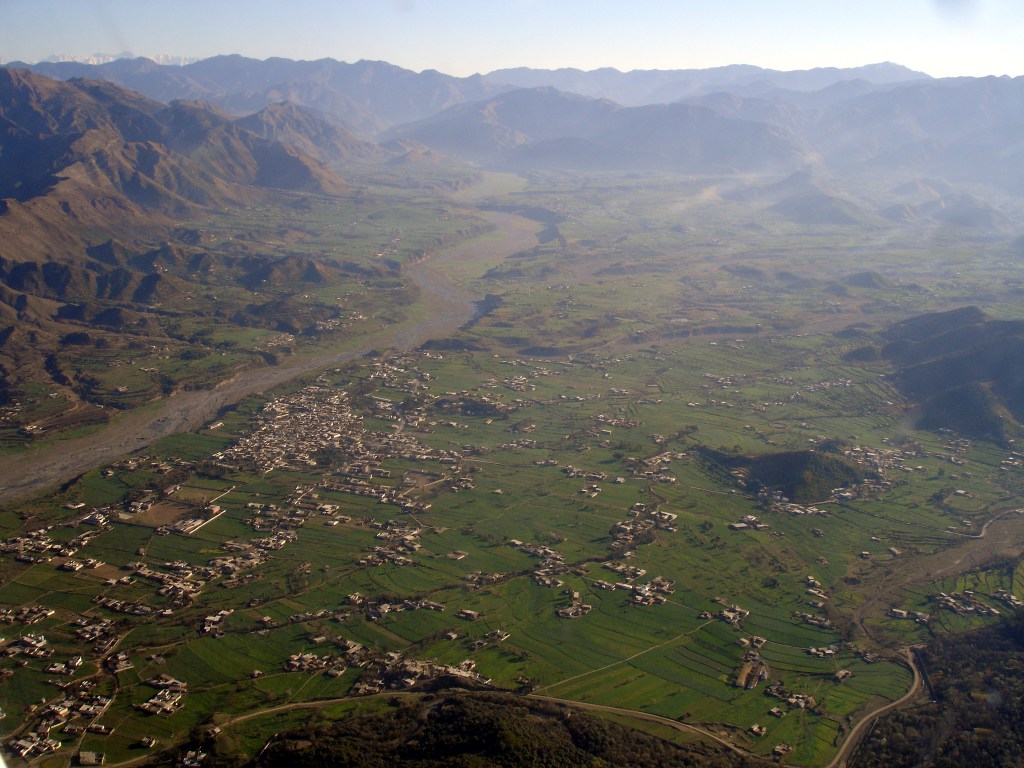
The village of Mulbar

“Did Munshi Babu bring you here?” he asked.

“No, I do not know Munshi Babu,” I replied.

“He is the doctor’s brother in Sambalpur. You mean he did not bring you here? How could you find your way here? It is impossible.”

It was obvious that he did not believe me. Briefly, I told him about our trip from Bhubaneswar, and how the folks from the nearby village guided us. He said the doctor was a legend in this area, and everyone knew and respected him.

Soon many of the villagers joined us. As usual, I engaged the people by asking several questions, including their names. However, they were more interested in who I was and what had brought me here. I told them I had emigrated to the United States many years before to discover the secret of what makes some people rich and powerful and others poor and powerless.

I also told them that Dr. Sahu had asked me to come to the village to tell them about Trees for Life. I requested one of the villagers to ask Som to come and join us. As is customary in these small villages, they brought us chai to drink, and we began to share our stories.

They told us the village depended on dry-land farming. During three months of monsoon rains, there is lots of water, but it drains off. This is followed by a period when there is hardly any water. The land, they said, produced very little food, and the cows barely gave any milk. As the population had grown over the years, the land surrounding the village had been stripped of trees. Farmers in the area grew rice and also a few vegetables during the rainy season.

I told them how our Trees for Life movement helped people in villages just like theirs to plant fruit trees.

“But we don’t even have enough water to drink! How can we take care of trees?” one man shouted from the back of the crowd.

“That is why I am here. You will soon see how it works,” I said.

“My great, great grandparents were born in a village much like yours. Many people helped them break out of poverty, and now I am helping to repay that debt by sharing a simple formula for what makes people powerful and prosperous.”

“What is that formula?” one person asked.

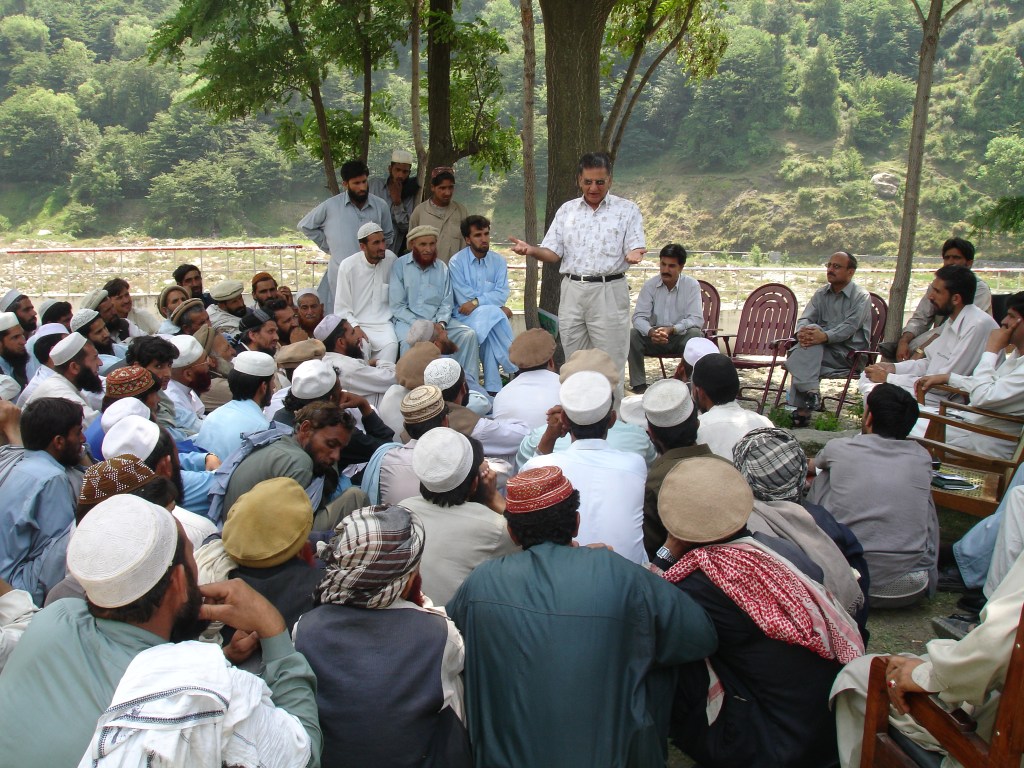
On May 4, 1988, villagers in Mulbar gathered around the “dust-covered stranger”
and learned about the Trees for Life formula.

There was a deep silence on my part. Many villagers thought I had not heard or understood the question. So, they repeated the question again several times.

Slowly, I said, “Lakshmi, the goddess of prosperity, comes and dances in the courtyards of those where people are prepared. Just like rice will grow only where first the field has been prepared, there are three steps necessary for this preparation:

“Step 1:  There must be a strong determination and commitment.

“Step 2:  We must learn the science behind whatever we do.

“Step 3:  We must have the discipline and the stamina to follow through.”

There was complete silence in the group. They were listening to me very intently. I asked them several times to repeat the steps back to me.

I said, “Let us start with step one. When the desire of a group becomes so strong that people are willing to pay this price for Lakshmi’s dance, then Lakshmi appears unbidden. Everyone can have a desire, but that is not enough. Desire has to become commitment and determination. So, the people I share this formula with are those who exhibit the determination to dance with prosperity.”

“We are determined,” someone said. Some people nodded their heads in silence.

“If there are a few determined people who can agree to work together and meld their hearts and minds together for a cause, then no force can stop them,” I continued. “This force is called Ekta — when many become one. Where there is Ekta, miracles come unbidden. Even problems that seem totally unsolvable are solved. If water is a problem, and you follow the formula, then water will appear. I do not know how, but I can guarantee you that it will.”

I asked, “Are there some people in this village who are willing to work as one mind and body, so that the entire village can experience such a miracle?” 

A murmur went through the crowd. Dr. Sahu’s cousin was the first to volunteer. Then, six others volunteered.

“That’s enough. Let us start with a very small group,” I said. “Just like a mighty tree needs a small seed to start, in the same way, a mighty shift needs a few people to help it get started.

“The question is, will the rest of you help and support these few people, or will you oppose them and create friction among yourselves?”

“We will support them!” they shouted several times. 

One young man raised his right fist above the crowd and shouted, “Ami korbo!” which means “We shall overcome!” I looked at that person. He was leaning on a bamboo stick, and I realized that he had a lame leg. A current went through my body, and I quietly started to look over the entire crowd from left to right. The people began to chant quietly, “Ami korbo, Ami korbo, Ami korbo.” The chant became louder.

I could feel the current go through the entire crowd and a shiver go through my body.

Part 3: The Wrong Road

After the meeting with the villagers, Som drove us almost 50 miles in the pitch dark, dodging potholes all the way to Sambalpur to meet Dr. Sahu’s brother.

As Som was parking the car across the street, I went into the Sahu Pharmacy.

“How may I help you?” Manaswi Sahu asked, as he looked up at me through his bifocals from behind the pharmacy counter.

When I introduced myself and Som, Mr. Sahu did a quick double-take. He was expecting an American, and here I was, an Indian in local clothing, covered from head to toe in dust. He took off his glasses, rubbed his eyes, and stared at me.

Munshi Babu, which is what all the local people called him, had a peculiar look on his face. I could not tell if he was laughing, amazed, or angry — perhaps all three.

I apologized and explained about losing my briefcase with the contact information for him and his brother, Dr. Sahu, in Des Moines; the long and bizarre trip that amazingly had taken us to Mulbar; and the meeting with the villagers.

 “But you were supposed to have called me from Bhubaneswar, then come here to Sambalpur, and I was to accompany you to Mulbar the next day,” he said. “Now you’re telling me that you have already been to Mulbar, formed a committee, and started the work?!” He was miffed.

Then, finally understanding the situation, Munshi said, “You guys must be very tired. Let’s find accommodations where you can wash up and then we can take you to my home so you can get something to eat.” As he started to lock up his pharmacy for the night, he told me that he had been ready to close when we walked in. If we had come even 10 minutes later, he’d have been gone and his house would have been impossible for us to find.

He took us to the best hotel in town, where only one room remained for the two of us. We were too exhausted from the long day in the blazing heat to eat. The nighttime temperature was still above 100 degrees Fahrenheit. Since there was no air conditioning, we opened all the windows and had the ceiling fan going full blast. Normally, it would have been impossible to sleep in that heat, but both Som and I slept 12 hours in our skivvies.

When I awoke the next morning, I was still exhausted and could only imagine Som’s condition, after driving so many hours filled with detours, potholes, and playing “chicken” with a barrage of oncoming vehicles. He had not complained once. A feeling of admiration and love poured over me like warm syrup on pancakes.

Mr. Sahu picked us up and took us to meet his family. Munshi Babu and his younger brother lived in a joint family with their spouses and children in one house. We met everyone and exchanged our stories, then started back to Bhubaneswar.

The road to Bhubaneswar turned out to be a well-paved highway, without any construction and with fast-moving traffic. Within five or six hours, we were back in Bhubaneswar. That evening during dinner, we shared our adventure with my friend and his family. As we started to describe all the detours we encountered trying to get to Sambalpur, my friend looked puzzled and asked Som, “What road did you take?”

Som pointed in the direction of the road we had started out on at 4 a.m. the day before.

His uncle exclaimed, “Oh, no! You took the wrong road!”

We had taken the road behind the house, not the one in front of the house!

We all laughed and marveled that even though we did not know the name of the village nor its location, and despite all the detours, the Universe had taken us where we really needed to go. What had seemed like the wrong road was really the right road after all. I shook my head in bewilderment.

A version of this story told from the perspective of Mr. Manaswi Sahu (Munshi Babu) was published by Trees for Life in the booklet “Dancing with a Dusty Angel.”