It was 11:30 at night when I was received at Mr. Sethi’s guest house.
The next day Munish’s family and I started off to visit all the temples. At Mahakaleshwar temple there was a long line — a two-hour wait to get in. Because of Munish’s contacts, we were inside the temple within a few minutes. I felt guilty and embarrassed. I had to remind myself that I was in India, which is still a feudal country. Just as the Indian mores would not be suitable in the USA, my western sense of propriety was out of place in India. This justification helped me control guilt feelings in similar situations later on.
That afternoon we ran into one of Munish’s friends, Mr. Pandeya, a local politician and journalist in Ujjain and a member of the Mela management committee. I told him I would like to meet someone who has a strong foundation about the Kumbh Mela and who can help me experience its very essence.
“Ah, I know just the man!” Pandeya exclaimed excitedly. “I want you to meet Abhimanyu Dabbewala. He is a Panda (a Hindu priest) who knows everything about the Mela. He is the man you are looking for. Abhimanyu is also a college lecturer who speaks fluent English.
Pandeya’s mood then turned pensive as he said, “The problem is that I have not seen Abhimanyu for more than a year. I do not know where he lives, and he does not have a telephone at his home.”
Meeting Abhimanyu
The next day at 9 a.m, I met Abhimanyu! How could that happen? When Mr. Pandeya left us the previous day, guess who he ran into in the teeming streets of Ujjain? As Abhimanyu told me later, when he came home from work, his wife insisted that he take her for a stroll. He was tired and did not feel like it, but he complied. During the walk he ran into Abhimanyu.
“A miracle!” Mr. Pandeya exclaimed.
“Quite a coincidence,” I remarked.
“There are no coincidences,” Abhimanyu answered. “It was your and my sanskars (intentional journeys that come together) that brought us together. “Out of the millions of people present in Ujjain, we have met. This meeting could have been conceived and put in motion long years ago.” Abhimanyu’s eyes were dancing in childlike joy.
Abhimanyu’s Conversion
To have a meaningful discourse with Abhimanyu, I wanted to be honest with him. I wanted him to know I was not a devotee, but a skeptic trying to find the essence of the Kumbh Mela.
I told Abhimanyu, “Wherever there is a spider, there is a web. The web is much larger than the spider. I am looking for the spider and not to get caught in the web.”
“I used to be an atheist as a teenager,” Abhimanyu said, “And then I met a certain sadhu (a renunciant holy person).
Abhimanyu told me the following story:
“This sadhu asked me to sit down alongside him. When our thighs touched, I immediately felt as if electricity were passing through me. I sat there for four hours in a trance-like state of mind with this feeling of electricity flowing through me. After that encounter, I was no longer a skeptic. This sadhu became my guru, my spiritual teacher.
Abhimanyu described a second incident: “My guru asked me to put a blank piece of paper in my hand. Then he said a few mantras, and this piece of paper suddenly had writing on it in red ink that described my last life and the role I was destined to play in this life.
“My guru died a few years ago,” Abhimanyu recounted. “A sick man had come to seek his help. My guru told the man that he could not help him. The guru knew that the illness in this case was brought on by the supplicant’s own intentions. Upon the sick person’s constant imploring, my guru cured him with mantras, but my guru died as a result.”
The Hindu concept is that everything must balance. For example, if someone took out a loan, then that loan must be paid. In this case, the guru paid the person’s loan.
Abhimanyu became my friend, philosopher and guide. I met his family and had several meals with them. His wife reminded me of my younger sister who had recently died. At dinner time she asked me about my experiences of that day, and she would offer me sisterly advice. It was obvious to me that Abhimanyu had a very high regard for his wife and valued her advice.
My experience at the 1977 Kumbh Mela (see the earlier stories “Just Around the Corner” and “The Barber”) was so moving for me that I decided at that time to attend the next four Kumbhs over the next twelve years — Insha Allah! (God Willing).
Three years later, just before leaving for Ujjain, where the next Kumbh Mela was being held, I had second thoughts. I did not know anyone in Ujjain. Would I be able to have a peak experience like the one I had in Allahabad? Would the trip be worth the expense? What was I truly going for?
I shared these apprehensions with DeAnn, my secretary. She urged me gently to listen to my inner voice rather than my practical reasoning or rationalization. So, the journey began. I would fly to New Delhi, then to Bhopal and on to the Kumbh Mela in Ujjain.
To “set the stage,” I will first share some background:
History of the Kumbh Mela
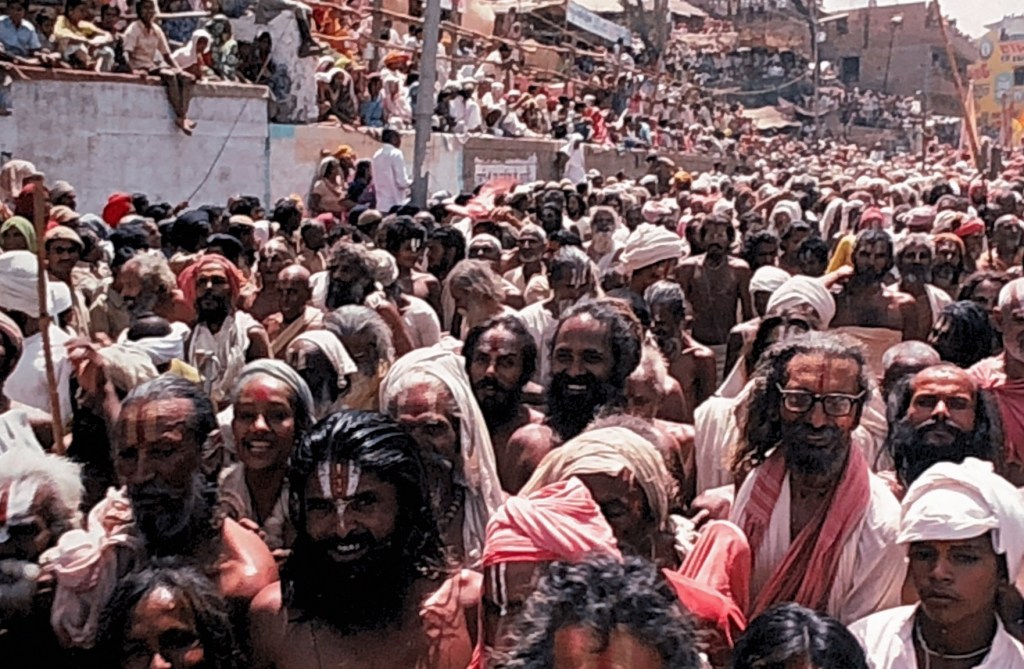
The Kumbh Mela is one of India’s most ancient Hindu festivals and pilgrimages, originating nearly 3,000 years ago. The 40-day festival is held every 12 years in a three-year cycle, alternating in the cities of Nasik, Ujjain, Allahabad and Haridwar. According to Hindu mythology, these cities, located along the banks of four different rivers, are believed to be the locations where angels once hid pots of amrit, a magical nectar with the power of immortality. Millions of spiritual pilgrims flock to the Melas to meditate, visit temples, attend lectures by spiritual leaders, and to immerse themselves for purification in the rivers’ holy waters.
Devotees attend the 1977 Kumbh Mela in Allahabad, India.
The City of Ujjain
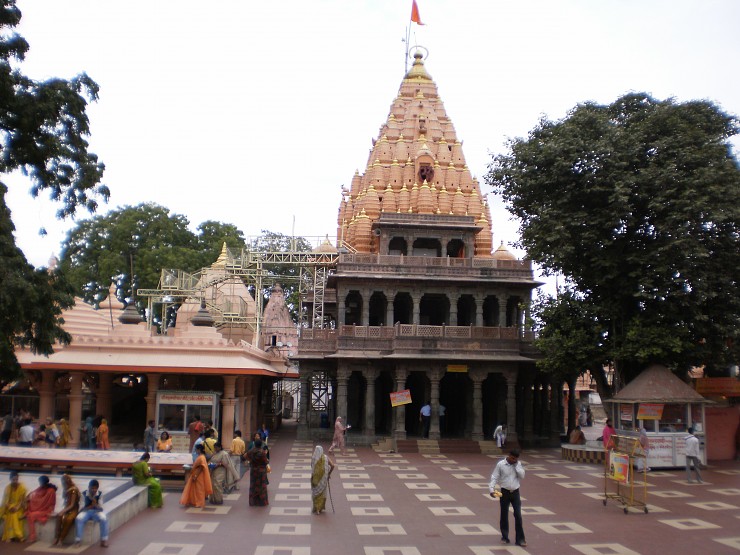
Located on the banks of the Shipra River, the city of Ujjain is located in the state of Madhya Pradesh. It is one of India’s most ancient cities and is known for its many temples. Perhaps the most famous temple is Mahakaleshwar, which is the center for the calculation of time in India, much the same as Greenwich, England, is the home of Greenwich Mean Time (GMT) in the west. The Kumbh Mela in Ujjain is also known as Simhastha.
Mahakaleshwar Temple in Ujjain
Ujjain via Bhopal
Upon arrival in New Delhi on April 16, 1980, I learned that all transportation was heavily booked because of the Kumbh Mela. I was 24th on the waiting list of the Indian Airlines flight to Bhopal. I called one of my cousins, who was head of a large travel agency. He helped me make arrangements, and the next day I was on my way to Bhopal.
In Bhopal I stayed with Vimal, a college classmate and also visited another college friend, Acharya.
Vimal fretted about my going to Ujjain.
“It’s too hot,” he said. “How will you get there? Transportation is jammed. Where will you stay?”
I showed him a letter of introduction to Mr. B. K. Sethi that I had been given by a friend. Arrangements had been made for me. Vimal looked relieved and indicated that Mr. Sethi was perhaps the most influential man in the state of Madhya Pradesh. The next morning, my friend Acharya took me to meet his boss, Munish. Munish and his family were planning to go to the Mela that afternoon at 4 p.m. and offered me a ride. I was on my way!
“Sahib, have you met Guruji?” My uncle’s driver asked me this as he was taking me to a business appointment in New Delhi.
“Who is Guruji?” I asked.
“He assisted your family when they were having trouble finding a marriage match for your cousin,” he said.
I asked the driver to take me to see him before continuing on to my appointment in the city.
“But, sir, he lives in an area where you may not want to go.”
I said, “Let’s go.”
He turned the car around, and soon I could see what he meant. The area was one of the poorer sections of New Delhi with an open sewer that had a strong, offensive stench.
Guruji lived in a small, one-room house. When we went in, he was seated cross-legged on a cotton mat on the floor. He acknowledged me with a nod and, for several minutes, we sat there in total silence. I looked around the room, assessing my surroundings.
My host appeared to be in his seventies, with a full head of white hair, yet his physique was of a wrestler, befitting that of a much younger person. He was dressed simply. I learned that he used to be a cow herder and milk delivery man, a gwala.
After we sat together for a few minutes, a gentle smile crossed his face.
“What brings you here today?” he asked.
I hesitated. I was there on a hunch, with no particular question or reason. He laughed and said, “You are here to test me.”
“Yes,” I agreed. He had articulated my thoughts.
I told him I did not believe in psychic powers. I believed those who claimed to have such powers were duping the ignorant and fostering superstitions. I was curious to see if there was any validity to such phenomena as psychic powers.
He nodded his head in agreement.
“You wonder if all of these things—miracles, magic—are nonsense? The fact is that everything is connected,” he said. “Sansar—the universe—is one body, and we are all getting the information simultaneously about what is happening in this universe, but we have blocked ourselves so that we can’t listen. Just listen internally. You will be able to access all the information from the past, present, and future. Everything.”
I challenged him with a rhetorical question: “But all religions tell us to follow their preaching.”
“Ignore that. Listen to the voice inside,” he said.
I asked him how to do that.
“Come back tomorrow exactly at 7 a.m.,” he said.
There was nothing more inconvenient than what he had asked me to do. It was a 45-minute drive by car from my uncle’s house to his. The morning was cold and his house had no heat. But I was anxious to hear his answer, so I arrived at 7 a.m. sharp.
The four walls of his house were covered with images of religious prophets from practically all the religions of the world … something I had not noticed before. When I arrived, he was in the process of touching each image with his forehead and quietly mumbling a prayer. There must have been 50 such images. Patiently, I waited about 15 minutes until he was finished and sat down.
“Aren’t you a hypocrite?” I asked. “Yesterday, you said it’s all about going inside yourself. You said religions are all structures of the mind. Now you are going around bowing to each of these images.”
“Why do you think I called you here at seven in the morning?” he asked.
“I have no damned idea,” I said, irritated. “How would I know?”
“I asked you here just to demonstrate: The first thing I do each morning is come to terms with the outside world, because if I don’t come to terms with the outside world, it will not let me go inside. I will be stuck in the outside world.”
I spent the rest of the day with him. At his suggestion, we drove to a market in old Delhi, about an hour away. Our destination was a hole-in-the wall bookshop, where he bought a particular book for me about the mystery of the breath. Guruji told me that by understanding our breath, we could understand the mysteries of the universe. He explained that our breath is the connecting force between us and the rest of the universe. He was trying to teach me that one could go inside by paying attention to their breath.
At the market, we passed a shop renowned for jalebis, fried dough soaked in sweet syrup, a mouth-watering dish for Indians.
“Would you like some jalebi?” I asked him.
He was walking on my right side and pulled me down close to emphasize what he was about to say. “If you want to go inside, you will have to become highly disciplined,” he said.
After our day together, Guruji and I became good friends. Whenever I was in New Delhi, I went to see him. This man, who had practically no worldly possessions and lived by himself in his old age, turned out to be a great thinker and philosopher. During those visits, there were numerous occasions when I witnessed his ability to reach in and share remarkable information.
One day, my uncle’s driver visited Guruji to talk about his son’s future. Rather than responding to the driver’s question, Guruji asked the driver when I would be coming again from America to India.
“There is no plan for him to come anytime soon,” the driver told him.
“Mr. Mathur will be sitting right where you are sitting in three days,” Guruji told the driver.
I had no plans to go to India. But that night, at about 11 o’clock, I received a call from a client who lived in Texas. He asked me to fly to India as soon as possible to handle a business deal for him. I told him my passport had been sent in for renewal, and I did not expect to receive it for several weeks. To my surprise, the next morning, the postman delivered my passport to my office.
My secretary checked on flights. The next one was leaving in an hour-and-a half. I rushed to the airport and bought my ticket. My secretary packed my briefcase, Treva packed my suitcase, and they met me at the airport. Within 24 hours, I was in India. The family driver was at the airport to receive me.
“Sir, I have one question,” he asked, after we’d driven about half-a-mile. “When did you decide to come from the United States?”
I laughed. “Just 24 hours ago.”
“Just 36 hours ago, Guruji told me you would come today.”
When I accounted for the time difference between the U.S. and India, I figured out my client had called me almost simultaneously to when the driver was meeting with Guruji.
On a subsequent visit to India, I planned to see Guruji after having lunch with a client. My client took me to a posh restaurant in his gold Mercedes. After lunch, he offered to take me to where I was staying. I tried my best to turn him down, as I didn’t want him to know I was going to see Guruji instead of going home. I was fighting with my own skepticism about what I was experiencing. I did not expect this man to understand.
Finally, when my client wouldn’t take no for an answer, I explained to him the real reason—that I was going to visit my friend who lived in the slums.
“I want to go,” he said. “I want to experience this.”
When we arrived, the first thing that Guruji said was, “How was your trip to Bombay?”
I was startled. I had taken a last-minute side trip to Bombay, but I hadn’t told anyone I was going.
“How did you know?” I asked.
“Three days ago, you had planned to come, and then you didn’t show up,” he said. “This afternoon, after lunch, I took a nap. In my dream, you came to me and said you had gone to Bombay and that’s why you didn’t come sooner. You said you were bringing a friend, and you drew his natal chart for me.”
After awakening, Guruji had drawn the chart, which was now placed in front of him. My client looked stunned.
Most of the teachers I met left me in some sort of quandary. I often wondered if Guruji was simply viewing the incidents from far away or if he was instrumental in shaping them? I was skeptical that if such people were truly able to see an event in advance of it happening, then they were in some way, even if unintentional, influencing events.
On a subsequent visit, Guruji, who knew that his death was near, suggested that he train me to learn his abilities.
“No, that is not the role I am destined to play in this life,” I told him. I tied a knot in my memory with one of the first things that Guruji ever taught me: If you want to live where the undercurrents are, you must first make peace with the waves. Make peace with the outside world, so you can go inside to realize your connection to the universe.
December 10, 1980, was my 45th birthday, and I went for an early morning bike ride along the banks of the Ganges. Without planning to, I found myself in front of the camp of a spiritual teacher known as Sacha Baba at the Magh Mela, known as an annual, though smaller, Kumbh Mela. On the gate was a large banner proclaiming: “The sun of Indian philosophy is now rising in the West.”
What arrogance, I thought. India is so far behind, yet these ignorant people who have been cooped up in the backwaters of India, who have never seen the West, feel they have something to teach the West. Stupid people!
For a few minutes I stood there shaking my head and smiling to myself. Then I had an impulse to go inside. It was a beautiful, cool morning. The sunshine coming over the horizon felt good. The whole Mela was unusually quiet. There was a sense of purity in the gentle breeze. I resisted my impulse to go in. That would spoil this beautiful mood, I thought to myself.
I had first met Sacha Baba at the Kumbh Mela in 1977, and I had acquired an instant dislike for him. He was an obese man, seated on a dais, dressed only in his dhoti (traditional loincloth). A long line of devotees was approaching him. One by one they bowed and touched his bare feet, leaving currency piled up in front of him. This is just another con man making money off of people, I said to myself at the time and left with no desire to see him again.
Now I stood outside his camp as a second impulse came. Submitting to that impulse, I went inside to see that man again. I was in a frivolous mood.
This time the scene was quite different from my first experience. Sacha Baba was wearing all-white clothing, sitting perfectly calm and quiet on a dais with his eyes closed. Half a dozen people were seated around him quietly, with their eyes closed. Peace and serenity permeated that early morning scene.
Silently, I sat down on the ground. After a while, Sacha Baba opened his eyes, looked at me, and asked me for an introduction.
I gave him a brief background and told him that I had first met him three years ago, during the Kumbh Mela.
“It seems like you have a question,” he said.
“Yes. When I saw you three years ago, I was not impressed. You were surrounded by piles of money. I left convinced that you were just another person fleecing people out of their money. But now you seem completely different. What happened?”
All eyes turned on me, dagger-filled, as if to say, “How dare you walk in and say such things about our beloved teacher!”
But Sacha Baba was not bothered. His eyes were benign and smiling, almost mischievously.
“Something changed within you. You are seeing the same things from a different perspective. Tell me about it.”
I protested. I felt as if he had turned the tables on me.
“At that time, you were focused on money, so you saw money,” he said. “Indeed, money is needed to operate this ashram and its presence is there. But something shifted in you, and you are not focused on money. You have a different quest now.” His eyes looked straight at me, inviting me to talk.
“You seem to know,” I said. “You tell me.” I realized my tone was sharp and combative.
Sacha Baba gently nodded his head, as if accepting my challenge.
“You are going to go in a direction that is uphill.” He raised the palm of his right hand to indicate steepness. “It will seem dangerous and unnerving to you,” he said.
Gently, and in a soft voice, he shared two stories. He said the first story was from the Christian tradition, in which a man was asked to tell his people of disaster coming to their city because of their evil ways. The man shared the message but on the given day, no harm came to anyone. People called him a false prophet, tarred and feathered him, placed a crown of thorns on his head, and paraded him through town on a donkey, then dumped him outside the city walls. That night, the man asked God why he was tarred and feathered instead of honored for conveying God’s message. God appeared and told him that because of his message, people corrected their evil ways and avoided the wrath of God.
“Would he rather have allowed the wrath of God and saved himself from that humiliation?” Sacha Baba asked.
“In doing God’s work, do not look for people to shower you with flowers,” he continued. “The hands that can shower you with flowers can also pelt you with stones. You do God’s work because you are commanded to, not because you expect anything from those you serve.”
The second story was from the Islamic tradition, he said, in which a man tested his faith in God by going into a cave in the middle of the desert, telling God he would not eat until God himself fed him. Later that day there was a sandstorm, forcing a caravan to seek shelter in the same cave. When it was time to eat, the leader of the caravan told the man it was their tradition that they must first provide food for a stranger before they could eat. The man refused, even after much beseeching. The members of the caravan threw him down on the ground, one person holding his hands, another holding his legs. A third person sat on his chest, forcing food into his mouth. The man started to laugh out loud. Bewildered, the caravan people wanted to know why he was laughing.
“God is holding my hands, God is holding my legs, and God is sitting on my chest feeding me!” the man laughed in ecstasy.
“In doing God’s work, there will be times when you will not have enough resources. There will be times when you may not even have enough food in the house,” Sacha Baba said. “Remember, God will not forsake you. God will appear in different forms to provide for you.”
Sacha Baba told me I was about to launch myself in response to God’s bidding.
“There will be times when people will not believe you,” he said. “There will be times when people will insult you. However, at no time will you be alone. At no time will you be at risk because the one who is bidding you will also be guarding you.”
Then he told another parable. The offspring of monkeys cling to their mother, and she takes them where they need to go. A cat’s kittens stray from the moment they are born, even before their eyes are open. But the mother cat watches very carefully and when the kittens stray too far, she picks them up in her mouth and brings them back.
“You are a wanderer, just like the kittens. The heavenly mother is keenly following each and every step and will pick you up and dump you where you belong.”
Sacha Baba, through his stories, was gently making a point about the power of faith. Even though he was speaking to me, it was as if he were sharing these stories with all his followers there.
“Mother has already grabbed you and is taking you where you need to be,” the Baba said.
There was silence. I became self-conscious, feeling as if all eyes were on me. They were looking at me curiously, no longer with anger.
After several minutes of deep silence, the Baba said, “You must write down your experiences.”
“To write about oneself is prohibited,” I replied. There was a sense of pride in my statement because I was quoting from the scriptures of the Hindu religion, which prohibit such writings because they feed the ego.
“If you are commissioned to write, your ego will be taken away from you.” Baba had caught the exact inference of my statement. “You will be given the power of detachment.”
“The path you are walking is a lonely one,” he said. “People who travel this path need to have some mile markers, so they know they are on the right track. Write as an obligation for those who will come after you,” he said.
“But I am not a writer,” I protested.
“The ability shall be provided to you,” he answered.
I had gone to the Mela for pure entertainment and ended up meeting Sacha Baba again. I left his presence with a mixture of feelings that I could not define. I did not realize this gentle saint had given me one more nudge to dive into the unknown life that was calling me.
I was standing on the shore of a lake. I felt like taking a swim, so I waded into the water. There were many people swimming, playing, and horsing around. I waded deeper into the lake until the water reached my neck.
A rope marked the edge of the safe swimming area and separated it from the rest of the lake. As I touched the rope, everyone suddenly stopped and looked at me. Then there was a commotion, in which everyone angrily shouted at me to come back to the shallow water. Without realizing it, I had touched some nerve in the lake. I felt perplexed and threatened by the crowd.
While trying to decide whether or not to cross the rope, I saw a man on the shore. He was obviously the lifeguard, and no one could cross beyond the rope without his permission.
He read my thought that I wanted to go beyond the safe swimming area. He silently conveyed the question, “Are you sure you have the courage to cross over?”
“Yes,” I mentally assured him.
His calm smile clearly said, “If you have the courage, go ahead.”
Lifting the rope, I stepped into the restricted area. Immediately, the color of the water changed from muddy brown to deep blue. I looked up, and the lifeguard was no longer there.
As I started to swim, a rapid current caught me and carried my body away from the shore. I had no control. An invisible force pulled me faster and faster through the water, as if a ship was taking me someplace.
Suddenly, I slowed down and landed at the edge of a washed-out embankment, which was above my reach.A person reached over and lifted me onto the shore. It soon became clear that people here lived in a totally different dimension. The beach was vertical, as opposed to the horizontal dimension from which I came. I was unsure how to balance myself in this dimension.
Soon a few people appeared. I understood they were the teachers who would guide me.
It took me years to realize that this dream was a harbinger of things to come. I would be entering a world where the perspective was totally different from what I was used to, and I would need teachers and guides who could instruct me.
I encountered a number of such teachers — extraordinary people and events that shook the very foundations of my being. They appeared in many ways: physical and non-physical, in dreams and in waking life. Each encounter moved me a step forward by creating an upheaval in my life, and giving me a glimpse of other dimensions and realities. I learned as much from them as I could, but not always willingly.
What I thought were the teachers were the Mystery.
And, the Mystery was the teacher.
Here, to the best of my ability, I write about some of those teachers — or Mystery, if you will.
Sometime during the early 1980s, I was in New Delhi visiting my uncle and aunty. During that trip, I became ill and developed a high fever. Fortunately, a couple, who were both physicians and long-time friends of mine from Iowa, were also with us. The husband immediately prescribed an antibiotic.
I refused any medication, which confounded everyone. Adding to the irritation was the logic that I offered for my refusal: “I want to experience the fever.”
Since my temperature was very high, my doctor friend was quite vocal with his concerns. First, he tried logic. Then, he threatened to call my wife, Treva, in Wichita or even to have me tied up and be given a shot, if necessary. I am sure he was only half-joking. Irrespective, I could not be budged.
Looking back through the prism of many decades, I can see that it was a period when I was going through an intense internal struggle. Without realizing it, I was starting to write a new chapter of my life.
I was experiencing a vague feeling of becoming aware, conscious, waking from a slumber. It was as if, up to that time, I had been crossing the river of life in a boat with relative ease and comfort, but now I wanted to swim. I wanted to experience the wetness of the water, rather than the dry comfort of the boat. So, it was in that framework that I told my physician friend that I would not take any medicine.
For the next two or three days, I lay with a relatively high fever in the guest bedroom on the main floor. My body was burning up, as if on fire. My appetite was nonexistent, and I went in and out of a delirious state.
To experience the fever, I decided to play a mind game with myself. I pretended the fever was a real entity, and I decided to become its friend. I formally welcomed it and asked it to help me find out who my heroes were.
The fever obliged. Images of people and events started to float through my mind. They seemed two-dimensional, like images on a poster. They were images of religious icons, friends, relatives, people living and dead, male and female—sometimes in black and white, at other times multicolored.
Some images would come and stay for a while; others would float by, as if I were seeing them from a fast-moving train. Sometimes the images were clear, and other times they were blurred. Some images were jumbled up with each other. Sometimes they would come into view, one at a time from one side, and at other times they bombarded me from both sides. The images were accompanied by a cacophony of sounds. My mind was like a blender churning of its own accord at erratic speeds.
Then the movement suddenly stopped. I saw two boys from my high school days in Ajmer, Rajasthan.
These two boys had joined the school during the final year, a few weeks into the term. They were obviously from a village and spoke to one other in a Rajasthani dialect none of the other students could understand. Their clothes and their sparse belongings made it obvious that they were from a poor and rustic background.
Normally, those who were different would have been hazed and picked on by others, but not these boys. They were bigger and stronger than the other kids, and no one would have thought of tangling with them. Perhaps because of that, they did not socialize. They kept their noses buried in their books. However, there was some indefinable aura about them that commanded respect. They were men among boys.
It was not until I attended an intervarsity volleyball game that I understood the mystique of these two gentlemen. I was surprised to see them on the court. No one knew they were volleyball players. But what I witnessed was awe-inspiring. They were giving everything they had in that game. They were covering almost the entire court, perspiring heavily from effort. These two boys, who hardly spoke to anyone, were shouting and cajoling the other players on their team in their stern, loud Rajasthani lingo, urging them all to give their very best.
After that, whenever these two were on the court, the message spread like wildfire. Everyone dropped what they were doing and rushed to see them play. I remember a friend at our youth hostel remarking that seeing them play was like touching a live wire.
During that time, the Russian national volleyball team came to Ajmer to play an exhibition game. These two young men were invited to be part of the city team that lost 15 to 1 in the exhibition game. These two class fellows of mine received a special commendation from the Russian captain.
I had never thought of these two as my heroes, and thus it surprised me when they appeared to me during my sickness. However, at that moment it became clear that, indeed, they were my heroes. They inspired me to do my very best under all circumstances. It was not about winning or losing; it was about doing your very best, even when things were going badly.
In the state of my high fever, I could not remember their names, but I could see those two boys in action. The images were blurred—like a picture of fast-moving action taken with a slow-speed camera. However, I could see, and almost smell, the sweat dripping off their faces. My heroes were right there in the room with me.
I have no idea how long I stayed in their presence, but soon my mind started churning again and I was instantly caught up in the whirlwind. Then, once again, the churning stopped.
It was as if I had suddenly been dropped into a void of total stillness and calm. There was ink-black darkness. Clearly, my mind had stopped.
In that total stillness, in which even a ray of light could not move, I turned around. There in front of me was an amber light. As my eyes adjusted to the light, I saw a small child, perhaps three to five years old. The child was not in the light—he was the light. He had no clothes on. His body was translucent. The light was emanating from inside him. I could not tell if it was a boy or a girl, but somehow, I presumed that it was a boy.
He was playing with pots and pans and was so consumed in his play that he was absorbing all the sounds. I could not hear anything. I could see the child, yet he was unaware of my presence.
A sense of awe and reverence fell upon me, and I was drenched in a wave of love and affection. It is hard to describe that feeling because I had never experienced any such thing before.
I looked at the figure intensely, feeling that I knew this little boy. Then a recognition dawned—it was me. I was somehow seeing myself, or perhaps experiencing myself, as I never had before.
I looked again, and I saw something else. Engulfed in love and reverence, I felt like I was in the presence of the divine. It had a form, and yet no form. It was me, and yet it was something far greater. It is hard to describe now, but in that moment, it was so clear, so natural, without any shadow of doubt.
The next thing I knew, my fever had broken. I lay there for the rest of the night. There were no thoughts or images that I can remember, just a feeling of wholeness that felt good. I had experienced something that I did not know how to describe. But it did not matter.
My guide, the fever, had done its job: bringing me face-to-face with my heroes. Perhaps all these years I had known my heroes, but now I could also recognize them.
“You must write about this day,” DeAnn’s country neighbor said.
“That’s true,” I responded. That day would be etched in my mind forever.
“Yes, but you must write it down for your children,” she said.
I replied, “My children won’t be interested, but I’ll write it down for the experience of trying to capture these events. I could never recount to anyone all that happened in these last few days.”
July 17, 1983
I reached DeAnn Corbin’s cabin at 5:15 p.m.
I was feeling extreme pressure because I was being called to launch into a new venture for which I did not feel capable. I did not know what to do or how to do it. I was being torn apart because I felt I was not ready for this task.
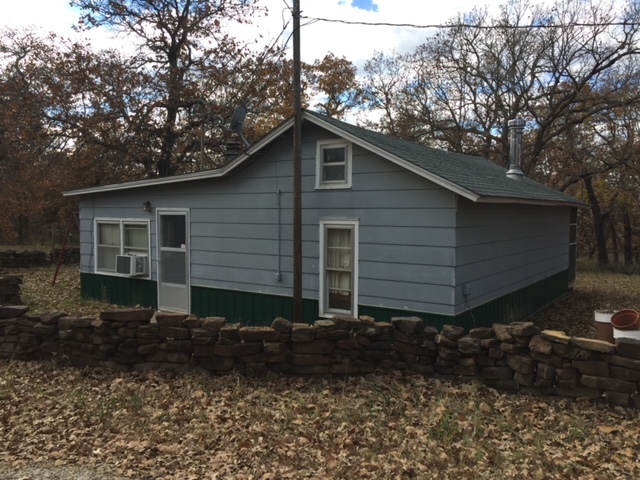
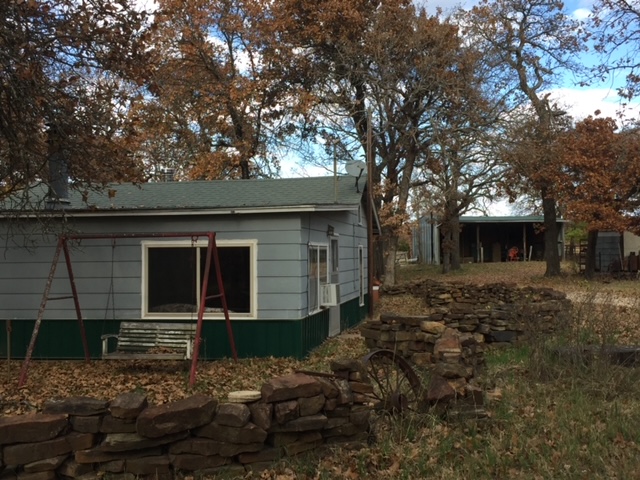
DeAnn was my office assistant and I had asked to use her family cabin for a five-day retreat to meditate. Her cabin was 150 miles from Wichita – a three-hour drive. This retreat, away from my daily activities and the noise of the world, might give me some clarity. And that clarity might provide me some courage.
I was planning to eat very little during this retreat, so I had requested that Treva pack me a picnic basket of cold foods. I decided not to take any suitcase, just one change of clothes, along with my personal items. The only other thing I took with me was a pen and a yellow legal pad. I planned to keep a diary during the retreat.
Photos of DeAnn’s cabin shared by DeAnn’s son, Andy Corbin, in 2021.
As she handed me the keys to her cabin, DeAnn requested that I water the flowers and tomatoes, since she and her husband would not be going to the cabin during my stay. Upon reaching there, the first thing I did was to water the flowers and tomatoes. As I watered the plants, I sought their guidance and their assistance during my stay. I believe I heard them say, “Do not rush; let it happen. Do not force things, relax. It will happen.”
The cabin, which had been closed up for some time in the Kansas summer heat, felt like an oven. I pulled a pillow from the couch, turned on the window air conditioner, and lay down in front of it on the bare linoleum floor, the coolest spot. Before I knew it, I dozed off. When I awoke, it was 8 p.m.
After a drink of water, I found a comfortable chair on the porch. The sun was still up. The birds and the crickets were chirping. I started listening to the sounds. My mind wandered. Time and time again, I brought my mind back to the sounds. It was like a symphony. A small airplane lazily flew across the sky. Its sound was as natural as that of the birds, and it blended into the symphony.
Gradually, the sounds started to intensify. The tempo of the sounds increased several-fold. I felt as if they were penetrating my whole body. There was a definite beat and rhythm to them. The sounds started with a bird somewhere on my left, whose sound traveled sharply and quickly to the right. Then, a similar sound came from the right and traveled left. Yet there was no pattern. Sometimes the sounds continued going left or right without stopping. I felt as if the sounds were from within me. It was as if I were on a swing made of sounds. Sometimes the swing would go only a few feet above the ground, and then the next time it might go 360 degrees. And yet, at other times, it kept going around endlessly. I had no control over the sounds. I could not decipher any pattern. At some point, the sounds were no longer pleasant or musical; they were piercing. The rhythm and beat were that of wild, African music.
Then, I felt the darkness falling all around me. The half-moon was 45 degrees to my left. There was a low star nearby. I could not keep my eyes open. The moonlight was covering me like a cobweb. It was pleasant. But I determined that sounds were where I must remain.
The sounds were so piercing that it felt like they were shooting out of my body through its tiny holes. The hairs on my arms and the back of my neck stood on end. The sounds were now only inside. I lost awareness. There were now no sounds. Suddenly . . . silence. My mind could not take it anymore. A few thought patterns went through my mind. They were not flashes. They were like a presence. It was a phenomenon that I could not describe.
Then there was the presence of white light. It was diffused. It was not bright and sharp or focused, as I had sometimes experienced in the past. It was opaque. I was enveloped by it. The light was coming from front and above. I could see myself sitting in the chair. There was a feeling of levitation.
There was a presence, a sense of recognition. I could not recall her name. There were no words. Just feelings. Just thoughts. She told me we had both been initiated by the same preceptor. She was here to help and guide. I begged her to stay with me throughout my retreat.
With each word or thought, I could feel my body quiver like the string of a musical instrument. It was very pleasant. I heard the sounds again. My mind must have drifted. I must have fallen asleep. I knew I had to concentrate on the sounds. I believed my mind was playing tricks.
But my body could not take it any longer. The sounds were only inside of me. They were not in my entire body. They were only at the top part of my head. It was as if that part of the head was ready to explode. I felt as if I had been in meditation for a long time. I lost interest in the sounds. My head remained heavy.
Gradually, I opened my eyes. The moonshine was too strong and bright. The moon was 75 to 80 degrees in front of me, yet it was pitch dark all around me. I must have slept a long time.
There was a feeling of suffocation. I needed to breathe immediately. I took long breaths and pushed them all the way down to the bottom of my stomach. It was as if, for some time, my breathing had been confined only to my head.
I was too relaxed or too weak: I could not decide which. I did not feel like moving. My body felt light, but my head felt heavy. I stayed sitting for some time before I went inside the cabin. It was almost 11 p.m. I was tempted to break my fast but decided to use my willpower. As I lay down to sleep, I was still able to hear the sounds in my head.
July 18, 1983
I broke my fast in the morning with an orange. I drank orange juice all day mixed with plenty of water. I needed that because it was hot as I lay under an oak tree all day long. At one time, a single oak leaf dropped on my right shoulder. “You like me, eh?” I said to the tree. Good omen.
Why did I say, “good omen”? Because I was reminded of a similar incident when, one night, I visited Dr. Sinha in Allahabad under the tree where we always met. I told him about some health issues I was having, but he waited a couple of hours without suggesting a medicine. Then suddenly a leaf had fallen on him, and he leapt forward to catch it. He said that was a good omen, which confirmed to him the medicine he was planning to prescribe for me. No matter, why consider it a good omen? The falling leaf was an event, and I could treat it as I wanted. And so, it was a good omen. “I love you too,” I said to the tree.
Throughout the day, I tried to write. Up to that point all I had been writing was old stuff that had already jelled in my mind. My speed was slow, and I was producing very little written material. I kept on dozing, perhaps because of the heat. But all was not lost. New thoughts started streaming in, just like leaves falling from the tree. The new thoughts crowded out the old thoughts. I felt the need to digest the old thoughts before letting in the new ones. I worked until 8 p.m.
Both meals that day were light. I had orange juice, pita bread, a small piece of cheese, and celery. I went for a six-mile walk from 8 to 10 p.m. The sunset was just beautiful. I felt the presence of Laurel, a friend I knew, and let out a loud shriek of, “Raaa!” Oops! That broke my vow of silence. I contained myself, took off my glasses, and looked at the sun for several minutes.
Back at the cabin, I tried to meditate on the sounds again. They were no different. I faced east. They started in my left ear, went across, then started back. I could not concentrate for too long. I was still angry at one of my friends, though I did not know why. I looked inside at my anger, and it looked like a cactus in my heart. I imagined uprooting that plant with all my might. Then, in the hole, I planted a seed of love. I observed it growing into a five-pointed purple tulip.
While trying to meditate that night, I saw the image of a young man, unshaven with unruly hair, dressed in a hand-woven garment. Knowing DeAnn’s deep Christian beliefs, I felt it might be the image of Jesus. So, I said to myself, “Jesus, I am in your house, so please be my personal God and guide me. Show me your light, show me your light.” I said this over and over. Suddenly, I felt a bright flash near my right eye. Instinctively, I opened both my eyes. There, within my reach, off to my right, was a lightning bug with a long, flashing, neon light. Maybe it had come to see who I was. “Playing tricks on me, you ole toad!” I thought to Jesus. Or, could it be that the lightning bug had said the same prayer, and Jesus was showing His light in each of us to the other. How little we understand. I laughed and laughed.
At midnight I was hungry. I had a banana, a piece of cheese, and some rye bread before falling into bed.
July 19, 1983: The Longest Mile
I woke up at 5:30 a.m because I was chilly and pulled up the blanket. I was too comfortable to get up, so I stayed in bed until six. When I went outside it was such a beautiful day that I decided to meditate there.
By 7:30 a.m. I was ready for a walk. It was still chilly, but I anticipated it would get warm, so I dressed only in my undershirt, cutoffs, and walking shoes. I didn’t expect to run into anyone on this lovely country road so there was no need to comb my hair, but for some reason I did.
Some cows jumped up, startled, as they saw me. “I won’t hurt you. I love you,” I said to them. Oops! I was not to speak. My vow of silence was broken again. I knew I had to be more attentive.
My sense of time told me that I must have walked about an hour or so. My reliable legs told me that I had walked three miles. The sun was already blazing, and it was time to return.
After walking half a mile or so, a man in a yellow pickup truck stopped by, his window already rolled down. “Are you in any trouble?” the driver asked. I shook my head, indicating that I was not. He turned off his ignition, folded his hands across his chest. “Well, well then,” he said quizzically. His question was rhetorical. The look in his eyes said, “Well, well . . . look what we have here.” From experience, I knew that look.
I jerked out the folded piece of paper and pencil from my pocket, which I carried for just such an occasion. I went over to the hood of his pickup and wrote, “I am staying at Corbin Farm. I am in meditation and under a vow of silence.” I felt like adding, “God bless you,” but I refrained. He might have thought me to be more of a kook, so I blessed him mentally. One must be practical.
He took a long look at the piece of paper. His forehead wrinkled. He must have been wondering what meditation meant. I had tried to write retreat instead of mediation, but the word wouldn’t come, and I wrote meditation instead. He was in his 30’s, I think. I caught my reflection with a quick glance in his big side mirror. My hair was windblown and scattered. My face adorned a three-day old beard, reddish with fine dust. I must have looked quite a sight to him. He was neat and trim and must have just showered. I, on the other hand, had not bathed for three days.
He looked at me, smiled suspiciously, turned on his ignition, waved, and zoomed off at perhaps 80 miles an hour, covering me further with a coat of the fine, red dust.
It must not have been more than a couple of minutes when another pickup pulled up and stopped. “Need a ride?” this man asked. I shook my head, “No.”
“Out for a walk?” he asked.
I nodded my head, “Yes.” Inside the truck I saw a gun rack with two rifles and heard the same CB radio sounds as in the other pickup truck. He drove off. After a short distance, he turned around and came back, waving at me as he went by. He must have been curious. I’m sure they didn’t see strangers like me too often. However, the community was just watching out for its neighbors.
I continued my walk back to the cabin. It felt longer than I had anticipated, mostly because of the heat. Back at the cabin, I took off my shoes and socks and stripped off the rest of my clothes. My underwear and undershirt were wet with perspiration, so I put them on the stone fence to dry. I went inside and turned on the air conditioner and the fan.
Later, as I came out of the cabin, the door closed slowly behind me. In a way, it felt as if someone was moving it and I had a split-second choice . . . to hold the door, or not to hold it . . . I chose to let it close behind me. It was not that I knew the door would lock behind me, but somehow there was an uneasy feeling that I could stop it from shutting, but I did not. On some level, I must have chosen to let that door lock behind me.
I went to the fence, put on my dry underwear and went back to the cabin. When I tried to open the door, I realized it was locked. I went around the cabin to see if there was another way to get in. There wasn’t. I tried the door many times, hoping for a miracle. I just sat there for quite a while, wondering what to do.
I decided to walk the winding quarter mile down to the main road. It was excruciatingly hot, so I sat near the edge of the road hoping that someone, like those two guys who had come by earlier, would come again. After a few minutes, I put my ear to the ground to see if I could hear any rumbles of a vehicle coming, but it was silent. I repeated this routine several times.
I remembered when drove in on my first day that I had passed a small farmhouse. I decided that my only hope was to walk there. The county was getting ready to repave the road, and they had put rather large stones on the roadway, preparing to put down the blacktop. It was blazing hot, and those stones were like hot coals, much too hot to walk on barefoot. I tried to walk on the side, in the grass, but it was full of burrs. With the first step, I had to stop and pick thorns out of my feet.
I couldn’t walk on the stones, and I couldn’t walk on the grass. So again, I stopped and waited for another 10 or 15 minutes, thinking that someone would surely come along. Finally, I realized that wasn’t going to happen.
I decided to break two bushy branches off a tree. This was difficult because the branches were about four or five feet long, still green, and I didn’t have a knife. I put one branch on my head to shade me from the blazing sun, and one on the ground in front of me, and took my first step. I quickly realized the branches had to be very precisely placed. The gaps between the leaves caused burning jabs. I took the branch on my head, set it in front of me, and took my second step. Then, I picked up the one from the ground behind me and put it on my head. I knew I had to walk fast to keep the heat from penetrating through the leaves. I took perhaps 100 steps and knew I could not continue doing this.
I decided to override my mind and go into a meditative state, as if I were doing a Fire Walk. Thoughts started to vanish. I was totally focused. There was a short scene, almost like a movie, where I viewed myself walking down below. I saw an odd-looking person, trying to walk as fast as he could, mechanically moving leafy branches between head and feet. I was seeing this in slow motion. It was an entertaining cartoon that made me smile.
The scene was eventually interrupted by a house appearing on my right. It was a farmhouse that, over time, had weathered to gray without any paint. I moved toward it.
I had no memory of how I reached there so fast.
A grandmotherly-looking woman, who might have been in her 70s, was sitting on the porch in a rocking chair. She was wearing a white house dress with a floral design. When she saw me coming, I could see a look of horror on her face. I went near the porch and tried to speak, but my throat was totally dry, and nothing would come out. I was mute. I cupped my right hand and put it to my mouth in the universal language of thirst.
She went inside, and after several excruciating minutes, came back with a large, clear-glass pitcher of cold water. I drank the entire pitcher. My voice had still not come back, and I motioned for more. Soon she returned with another pitcher of water, and I drank all of it. I must have drunk seven or eight glasses of water. The water was cold and soothing. Only then was I able to tell her that I was staying at the Corbin’s farm and that I had locked myself out.
She went back inside the house. When she returned, she told me she had called DeAnn, who confirmed that I was, indeed, her boss, and that I was staying at their cabin. I couldn’t blame my host for checking, because I must have looked horrible—a scary scene for an older lady living in a rural area where normally no one walks around in their underwear, undershirt, and no shoes.
After 15 minutes or so, her husband appeared from inside the house. She introduced him to me. She blushed as she admitted that when I first asked for water, she had called her husband on the wireless because he was out in the field on his tractor. Only then, did she bring me the first pitcher of water.
Since I was in such bad shape, her husband said, “Come, let’s have you clean up.” They filled the bathtub with cold water, and I slipped into it and must have soaked for half an hour. Then they brought me some of the man’s clothes. They didn’t fit me well, but I tied things up, and they did the job. She asked if I was hungry. I mentioned that I didn’t eat meat. She laughed and asked, “What do you eat, then?” I apologized and said, “Ma’am if you have any cheese, you could make me a sandwich.” She made me a grilled cheese sandwich with thick pieces of homemade bread and all the trimmings—lettuce, tomato, mustard, and catsup. It was a hearty, delicious meal, and I felt her love in every bite.
After I had eaten, the lady laughed and said, “We have a spare key to the cabin! DeAnn and her husband left it with us in case of emergency.” I remember her gentle belly laugh.
When I was fully revived, they drove me back to the cabin. I sat in front with the farmer, and his wife sat in the back. He kept on saying, five or six times, “Why didn’t you just break the glass?” In my mind, I hadn’t broken the glass because the cabin was way out in the country, 150 miles from Wichita. I had worried that if I did so, mosquitos and flies and maybe two-legged or four-legged critters might get inside. I didn’t want to leave the cabin in shambles. I didn’t know how long it would take for them to get the window fixed. I didn’t know how to explain all of that, so I had chosen to keep quiet.
The drive back to the cabin took barely five minutes, but walking there, under my circumstances, had taken more than two hours, and that was after my morning six-mile walk. I had left the cabin around 10 in the morning, and it was 2:30 or 3:00 p.m. when I got back. When I went inside, I found a small mirror and took a look at myself. I thought, “Oh, my gosh! How scary I must have looked to that lady!”
Then I settled into a comfortable chair next to the air conditioner and pulled up another chair for my swollen feet. I was still glowing with the love that DeAnn’s neighbors had shown for me. I glowed further thinking about the neighbor lady’s suggestion that I write about the experience.
I started to review what I had learned from my experiences during those three days of my retreat. Clarity and courage had been provided to me in one experience and I received a message that would serve me in many future situations that would have otherwise seemed impossible. The message was: One step at a time with total focus.
One step at a time with total focus.
At that moment, I felt as if the tension that had been building within me for a long time broke loose. I started to wail like a baby.
July 19, 1983: The Second Lesson
After a few minutes, I nervously got up and looked out the front door’s glass panel to make sure no one was hearing me cry. I realized no one was around for miles.
I continued to feel all the emotional release as thoughts arose: How dare I think there is no one seeing me cry! What about all the tomato plants, the flowers, the trees, the birds, the critters, the lightning bugs, and the muses that honored my request for help? They were here! And perhaps, upon witnessing my profound breakthrough, they were celebrating with singing and dancing!
I had a dream in which I saw myself driving. It was a beautiful day in Wichita. The sun was shining, the birds were chirping, and I could see light, empty, white clouds on the right side of the horizon. Treva was sitting next to me with a big smile of contentment on her face, and the kids were in the backseat. My green Buick felt big, luxurious, and comfortable.
Then I came to a ramp that would take me onto a highway. I had gone only a few yards up the ramp when I found it was clogged with traffic in front of me. Suddenly, night fell and it was pitch dark all around us. Lights from the surrounding neighborhood started to come on and twinkle like stars in the sky. Some instinct told me that I had taken a wrong turn, and now I was stuck. A sense of panic enveloped me. I could observe the same feeling in Treva. It was too dark for me to see the kids in the backseat of the car.
A car drove onto the ramp and stopped at the end of the long line of cars that had formed behind me. The headlights of that car were big and bright. Two people got out of the car. With flashlights in their hands, they walked toward my car. I could only see their silhouettes outlined against their bright lights. Upon reaching my car, they stood quietly next to my window. Deep silence and peace showed on their faces. Instantly, I recognized them as my guides.
They had come to me many times before, and still do, to this day. I cannot call on them. They come whenever they consider it necessary. In each case, I know they are the ones with the answer, and they command authority. Even though I am in a state of sleep at those times, part of me is highly alert and conscious. After these encounters, I can fully recall the meetings years later, as if they have just happened. For lack of a better description, I call these encounters “dreams.” My guides usually come in pairs, and although they may look different from dream to dream, I know who they are.
On this night, the guides appeared to me as middle-aged, white men with dark hair. One was taller and heavier than the other. They were wearing windbreakers.
“I am stuck,” I said to them.
“What would you like to do?” the taller man asked. As he spoke, his face came into focus. The other man remained totally still and silent, and his face remained out of focus.
“I want to go back, but I do not know how to do it.” I was embarrassed to let Treva and the kids know that I had taken a wrong exit.
“Then why don’t you go back?” he asked.
“I don’t know how,” I said again, with embarrassment.
“You just go back the way you came,” he said.
I looked at them again. Their faces started to fade. They turned around and walked back toward their car.
For a moment I sat there, scared that the cars behind me would not move. I shifted into reverse and started to back up. The guides, as well as the long line of cars behind me, began to back down the ramp.
At age 10, I remember falling sick, and I was down for a prolonged time. My body became quite weak and my skin color started to turn ashen. Penicillin had just become available in India, and I remember having a severe allergic reaction to it.
My mother, worried for my health, begged me to start eating eggs. I refused because I had been a vegetarian since age four. She even tried to sneak eggs into my milk, but I refused to drink it and told her that if she persisted then I would even give up milk. She started to cry and promised me she would never try that again.
I remained a vegetarian until I was 16 years old. After a long, drawn-out discussion within myself, I made the decision to start eating meat. That decision does not seem logical, but it seemed like the correct thing for me to do at that time. Looking back, I had no idea that in the near future I would be going to the United States and, by eating meat again, I might be preparing myself for some foods in my new home. Indeed, it would have been a great hardship for me, as well as for my hosts, if I were to have been a vegetarian in the U. S. during the 1950s and ’60s. Meat in the United States was easy to obtain and relatively inexpensive. So, I became an avid carnivore. Steaks and barbeque ribs became my favorite foods. I would willingly travel 50 miles to have a nice hot plate of BBQ ribs!
In the summer of 1979, I was tucking my son Keir into bed when he told me that he’d been invited by a friend to go hunting with his family, but he had turned down the invitation.
“Why?” I inquired.
“I told him my father says, ‘Thou shall not kill.’ ”
“And, what did your friend say?” I asked.
“You have to kill to eat, don’t you?” Keir’s friend had answered. Keir was merely relaying the information, not asking for my advice, so the subject was dropped.
However, I asked myself, “Do I have to kill to eat?”
The answer was obviously “no.” But then the question arose: why was I participating in killing, if that was not necessary? Why was I not practicing what I believed?
A story from my childhood surfaced. A woman who had traveled a long distance with her son to see Buddha, said, “Venerable Buddha, my son eats too much salt, would you please cure him of that habit?”
Buddha asked the woman to come back in 30 days. Upon her return, the woman again was asked to come back in another 30 days. The third time she made the long trek back with her son, Buddha simply laid his hands on the child’s head and said, “You should not eat too much salt.” The child looked at Buddha and nodded his head in agreement.
“What?!” said the mother, furiously. “If that is all you had to do, why did you make me come back three times? You could have said this much to him the very first time!” she shouted angrily.
Buddha said, “When you brought him the first time, I realized that I also eat too much salt. So, I could not ask him to do what I myself do not do. I thought I might be able to change my habits in 30 days, but I was not able to do so, and had to request an extension. In these 60 days, I was able to change my habit and can thus talk to the child.”
This story was still fresh in my mind as I left for London, Kentucky the next day. On my return trip, I picked up a couple of barefoot hitchhikers with long hair and beards. They were dressed in full-length, off-white robes of thick, heavy, hand-spun material. They carried no possessions. They told me they were “Jesus freaks.”
They had been arrested in a small town for having slept in a church, whose doors were somehow left open. The minister insisted that the police arrest them. However, after a couple of days, the police let them go because the jail was not equipped to feed vegetarians. They had not eaten for two days.
They were gentle fellows, articulate and strong in their beliefs, but did not try to convert me. They held that Jesus was a vegetarian and strongly believed in the righteousness of their views.
“Are you a vegetarian?” one of them asked.
Whizzing by at 80 mph on busy I-75 in my small, black, rented car, I was focused on the road and not paying enough attention to their question. I heard myself say, “Yes.” Immediately, I regretted saying that and wondered where in the world that answer had come from. I wanted to take it back and tell them I was not really a vegetarian, but I was not interested in further engaging with their views.
When we reached the town where I was to drop them off, I bought them a vegetarian meal and we parted ways. As I left them, I questioned why I had told them I was a vegetarian. No answer came. Somehow, the answer was unimportant.
Without making a conscious decision, I had once again become a vegetarian.
I drove to the airport and flew home. When I arrived, and without much thinking involved, I told my wife Treva that I had become a vegetarian. She didn’t ask why, but simply said, “I hope you will not discontinue eating eggs, or I will not be able to bake for you.” Since that time, many moons ago, I have not had a desire for, nor eaten meat.
Those two gentle, young men will never know the impact our brief encounter had on me.
In the late 1970s, I joined a group of businesspeople in Wichita who met on a regular basis to meditate. They were some of the most prominent men in town. However, they did not want it known that they meditated.
One of these men, several years my senior and a deeply spiritual person, became a good friend. After I had known him for a few years, he was diagnosed with cancer. His cancer progressed and, at the end of his life, I visited him nearly every day. As he neared death, I was with him at his home and asked him if I could rub his feet. He was hesitant. I do not believe he had ever allowed anyone else to touch his feet, but he relented and allowed me to rub them. The next day, when I arrived to see him, his wife wiped her tears. She told me he was no longer conscious, though he was still breathing. I went into his room and, as I began to rub his feet, I felt something happen. Something came through his feet and into me.
Suddenly, I remembered an event from my youth. As a teenager, I developed a bias against religious doctrine, which I considered to be unscientific “hocus-pocus,” and my British schooling reinforced that bias. But despite this, there was a period during my youth when I felt like there was someone who was guiding or leading me. This feeling did not fit with my training and perspective, and I found it disturbing.
One night when I was on a long walk, I felt the presence and said to it, “Hey, I don’t know who you are or why you are here, but I need to develop the logical side of my brain. Otherwise, I will always be dependent on you, and I don’t want that. Would you please leave me alone?”
I felt something leave my body. It was a physical experience. No words were spoken, but I understood it to say, “I will be back when you are ready.”
Now, at the side of my friend’s deathbed, I knew I was ready. I recognized what it was and allowed it to open the door of my psyche and walk in as a friend.


 balbirmathur.com