The Immersion

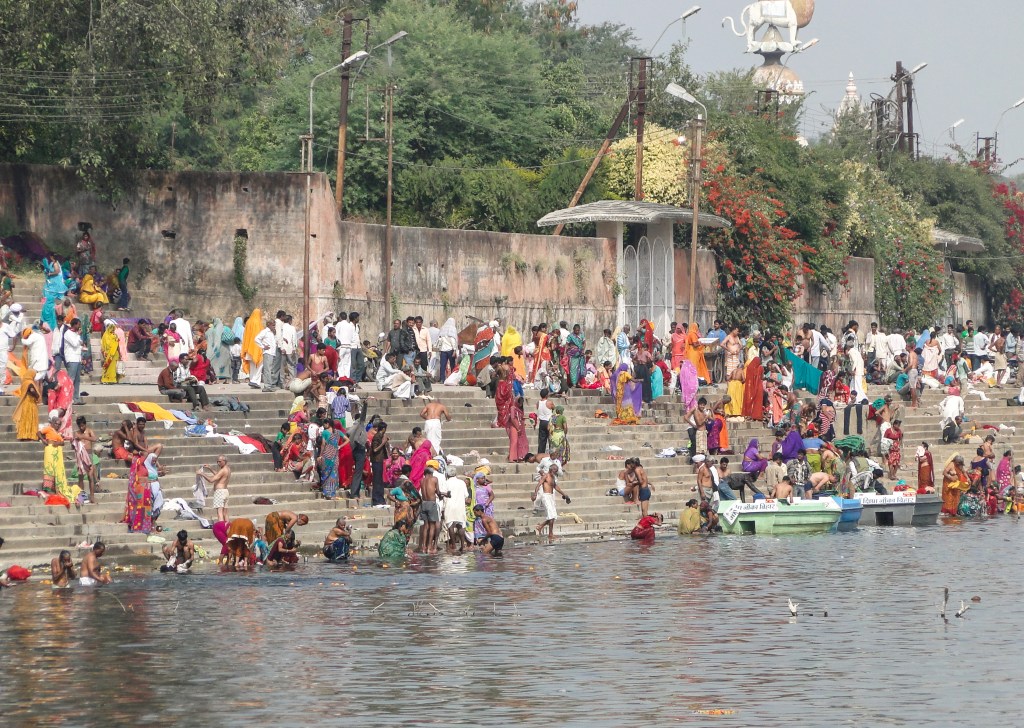
Having experienced a transformation, I decided to embrace the spirit of the Ujjain Kumbh Mela. At one a.m. on the auspicious day of the festival, I joined Abhimanyu and Mohan for a dip in the Shipra River.

At first, I felt silly, until I got in the mood and started to enjoy it. I thought about Abhimanyu’s words that I should concentrate on my own desire. What did I want or need? I could think of nothing. I had a feeling of deep gratitude. Oh, yes! There was something I wanted to ask. The request welled up from the deepest part of my being: “I want to experience life as it is, rather than demanding anything from it.”

I could almost hear, “So be it!”

Abhimanyu, who was the head of the Hindu priests in Ujjain, said matter-of-factly, “Let us do puja (prayers) for your sister.” Though I had been too proud to mention to him my desire to do this prayer ceremony, I was glad that he made the suggestion. He asked me to fill my cupped hands with water from the river while he said mantras in Sanskrit. Then he asked me to do the same thing again, this time for my father. Perhaps in recognition of my known antagonism to rituals, he did this without fanfare, in the simplest of ways. It seemed “the essence.”

Ram Ghat at the Shipra River, Ujjain

For the first time in my life, I felt as if I were a Hindu. My philosophy and religion had blended. What I had hated turned out to be a mirage.

A few days later, when I was leaving for the airport in New Delhi to catch a flight to New York, my driver asked me, “Sahib, did you make the holy immersion (snaan) in Ujjain?”

“Yes,” I admitted sheepishly.

“Wah, Sahib, wah” he said with deep emotion. “One must fully experience the religion into which he is born in this particular life.”

A Return to Kindergarten 

Toward the end of my trip to the Ujjain Kumbh Mela, the pomp and show, the big tents, the lights, the blaring music on the loudspeakers, the arrogance of the swamis, the blind faith and superstitions of the masses–things that I considered to be show rather than substance–were rubbing me the wrong way. I looked at the individual faces in the crowds hoping to find a reflection of my irritation, but there was none. These people were, in fact, enjoying themselves. I felt like I was in high school and this pomp and show was catering to kindergartners. There was a look about them that reflected a feeling of contentment. In my opinion, the swamis were utilizing the tools of mass communication and showmanship to attract the illiterate, for whom this whole experience was a vacation. 

Suddenly, something became clear to me: The people I had assigned the role of kindergartners found this experience most meaningful and important! My comparison of the kindergartners and upperclassmen now struck me as arrogance on my part. I now had a feeling of appreciation for the Mela-goers, and I felt humbled that, until now, I had looked down upon their way of doing things.

I mentioned this realization to Abhimanyu, who accepted it with a nod of his head, as if he already held this belief and was glad that I could now see it too. Abhimanyu suggested that I close my eyes to my skepticism and take a dip in the Shipra River at midnight the following evening. For those attending the Mela, this particular day and time was deemed the most auspicious moment to bathe in the river.

“I cannot do that,” I said. “I have nothing against taking a dip in the river, but to do that tomorrow night would be an acquiescence to the superstition and rituals that I firmly stand against.” I told Abhimanyu that this would be as if I were going back to kindergarten again. Let these people, for whom it has meaning, enjoy themselves. I told him, “It has no meaning for me, and an act without meaning is a wasted act.”

Abhimanyu accepted my feelings and said nothing. The next day he invited me to his home for dinner. I took Mohan with me, uninvited. Abhimanyu brought up the subject again. He said, “You should take a dip in the river tonight.”

Mohan was surprised that I did not plan to bathe in the river. While I did not want to make a big deal about this whole subject, somehow I was glad that it had come up.

“I do not believe in the blessings that come as a result of these rituals. Please tell me why you insist. What will be bestowed upon me if I am a non-believer?”

Abhimanyu replied, “As you have said yourself, the Brahma (Creator) is within us. This Brahman (Universe) is a mere reflection of our inner selves. So how can anyone give anything to anyone? It is you who has to decide what you want to get. We are the ones who desire and, in turn, receive what is dictated by our sanskars.

“For example, one who does not get two square meals may desire food. One who does not have a child may desire progeny. One who wishes to obtain higher consciousness may desire that. No two people desire the same thing in the same way. As you mentioned earlier, some people need a kindergarten education, while others may be working for their doctorate.

“Just like there is sunlight all over, you still require a magnifying glass to concentrate those rays to generate a flame. Similarly, all the accumulated energy of all the people gathered here provides that concentration. No one can give you anything, but you can benefit from the flow of energy to accomplish what you have set out for. Everyone in life has some mission, whether they know it or not.”

He did not press the point further or seek my agreement but told us that dinner was ready and that we should eat.

Unknown to Abhimanyu, I had already made my decision earlier that afternoon, but I was too proud to admit it. We are slow to grow up when we are born and then we linger in our death. Similarly, we do not readily wish to admit the defeat of our old beliefs and the emergence of a new comprehension against which we have fought so hard. 

That afternoon, I had been overcome by the feeling that I knew Abhimanyu’s wife before I actually met her–- as if I were her long-lost brother. I saw her image merge with that of my sister, Shakti. For the first time since Shakti’s death, approximately three years prior, in the privacy of my room, I cried. I had a great urge to do a “Kriya-sanskar” for Shakti while in Ujjain. However, in Hindu culture, this ritual, that is performed for the peace of a dead person’s soul, is a privilege reserved for the husband or son of the deceased. Then it occurred to me that the true bonds were not those dictated by traditions or rituals but those forged by love. I remembered my secretary, DeAnn, saying, “Listen to your heart.” I then understood that this was, perhaps, the reason that I had come to Ujjain. I had fought against such rituals for so long–I did not even perform this ritual after my father’s death. I did not want my son to perform such a ritual for me. But both my father and Shakti would have liked it; they were believers.

My decision was made, it was time to return to kindergarten, and I would start by taking a dip in the Shipra River.

Who Do You Worship?

While at the Ujjain Kumbh Mela, my friend Abhimanyu and I returned to the Mahakaleshwar Temple. It is the most prominent and important temple in Ujjain and is dedicated to Lord Shiva. The Mahakaleshwar Temple was once the focal point for calculating time in India before Greenwich mean time became the standard. People from all over India make the pilgrimage to visit this temple.

When we arrived, there was a very long line, perhaps five people wide, moving slowly to get inside the temple. I guessed that it would take about 90 minutes, standing in sweltering heat, to gain access. Since I felt no need to go inside, I stationed myself in the shade of a tree and decided a better choice was to put my camera to use.

I had not been there long when Abhimanyu tapped me on the shoulder to point out that the temple’s head priest had joined us—a rare coincidence. Abhimanyu, who knew the priest well, began to introduce me to him.

Rather than making eye contact with the priest, I continued to look through the viewfinder of my camera to photograph my surroundings. As I did so, I asked, “So you are the worshiper of Shiva?” Then I proceeded to ask him the difference between the worship of Shiva and all other forms of worship.

Without hesitation the priest answered, “What is most important is the act of worship itself. Our temperament and traditions lead us to choose the object of our worship. There is no difference between the worship of Shiva or any other. They are all one. It is only our lack of understanding that causes us to see them as differently. We are all so busy surviving, making a living, raising a family, sleeping, and entertaining, that we do not have any time left for contemplation of God. We are all forms of God.”

I thought to myself: Here was an imminent, high priest whose duties were to perform rituals. I had been judgemental of his perspective and therefore asked him questions that were cynical and baiting. Yet, philosophically, he and I were totally aligned in the belief that there was only one God.

Upon this internal reflection, I pulled my camera away from my face and asked the priest with love and humility, “May I take your photograph, sir?”

The Astrologer

One evening during the Mela, I met with Mr. A.S. Vyas, publisher of Panchang, one of the official publications of India’s astrological community. I found him to be a soft-spoken, educated man, known as the dean of Indian astrologers.

Even though many people believe in astrology in India, I was a skeptic and never went to astrologers except out of curiosity. I told this to Mr. Vyas and thus started our interview.

“Is there any basis to astrology, or is it a pacifier for the ignorant?” I inquired.

“It depends on how one perceives it,” he responded. “If one does not believe, then for him it does not exist. A person can close his eyes and not want to see something; thus, for that person, the thing really and truly does not exist even if it may exist for all others.”

“Well, let me state my question another way,” I said. “Does astrology have any substance, or is it of marginal substance on which a great farce (dhong) has been woven?”

“It again depends on your perspective; you can choose. We believe in astrology,” he said calmly. “Our culture’s belief has the validity born of ‘our’ experience. Hindu scriptures are full of astrological predictions which proved to be true in history. Our publication serves those for whom astrology has meaning. We are not trying to convince anyone.

“Yes, it is a profession,” he continued. “People make a living at it. There are some good and some bad practitioners. As in any profession, there is some dramatization. A doctor may have poor bedside manners, and, in that case, even good medicine may not heal. From another doctor, even a placebo may be effective. The same is true of astrology.”

I asked him to give me some real-life examples. He gave me examples from his father, Mr. Ved Vyas, an esteemed astrologer who established the journal that his son was now publishing.

“For example,” he said, “there was a person who was diagnosed as having cancer and an operation was scheduled. This person’s horoscope was shown to my father. By merely reading the patient’s horoscope, he determined that the person could not have cancer. More medical testing was done at his suggestion, and the previous diagnosis was proved incorrect.”

Another example he gave was that of a housemaid who brought her mistress’ horoscope to his father. Her mistress had been depressed for many years and no remedy seemed to work. By seeing the woman’s horoscope, Mr. Vyas’ father prescribed a mixture to be prepared, in part, from leaves of the tree known as bhel. The maid followed his instructions and effected a cure for her mistress.

Mr. Vyas spoke only about his father’s achievements; he did not give examples of his own feats, even though he was also a well-known astrologer. From his son’s description, it appeared that the father was a humble, self-effacing person. I thought, how lucky is the parent whose son would speak so glowingly of his father.

Then, I asked, “But if all events are predetermined by our own sanskars, and if we must enjoy or suffer the results of our own activities, then does that not preclude any room for astrology and its remedies?”

Mr. Vyas responded, “One may break his leg tripping on something due to his sheer negligence, but that does not mean that you do not treat the ailment. Just because it is summer and it will be hot does not mean that one cannot look for the shade. If it is cloudy, one may deduce that it might rain and take an umbrella that day. It is simply that life continues for all of us. There are several roads to get there. One may choose a rocky road, another may choose a scenic route, and the third may choose the shortcut. They all get there with or without that knowledge. It depends on your personal perspective and the choices you make.”

At that point, I asked Mr. Vyas what predictions astrologers might have about the future of India. First, I inquired about India’s future national scene.

“The Indian astrologers see Indira Gandhi coming back to power stronger than ever,” he said. “Law and order in the country is deteriorating. The prospects for India are not bright for the short-term. There are troubles.”

“What about the international scene?” I asked.

“We see the year 1980 passing without any major war. But the conditions for war will continue to gather strength. In 1981, the clouds of war will be thick and dark and there could be a war. The signs are not too good.”

“What about the long-term future?”

“India will play a major role someday, which is not being clearly perceived by the world today.”

Mr. Vyas had to answer a number of phone calls during my interview, and I could see that I was interrupting a very busy man. Under normal circumstances, it would have been valuable for me to spend more time with this most interesting man. I made a note to someday come back and do exactly that.

Today, having the benefit of 40 years hindsight, Mr. Vyas’ predictions seem to have come true:

·  Roaringly, Indira Gandhi did come back into power.

·  There was no war in 1980, but clouds of war started to gather and India and Pakistan began the Siachen Conflict in 1984.

·  Today, India is playing a more important role in the world than what could have been perceived in 1980.

The Mind Reader

While I was at the Ujjain Kumbh Mela, as I expressed my desire to experience either the unusual or the accomplished, several people suggested that I meet Mr. Handa, the Additional Superintendent of Police for the MeIa. He was known for his ability to make a “prashna kundli” – the ability to tell many things about a person based on a question that  the person asks.

As I was leaving one of the temples, I asked a traffic policeman where I could find Mr. Handa. “Sir, he could be anywhere at this Mela,” he answered. 

Locating Mr. Handa appeared to be an impossible feat due to the Mela crowd. However, a few minutes later, as I was getting into the jeep, the traffic policeman came running up to me to say that Mr. Handa had just arrived at the temple camp. What an impossible coincidence, I thought!

Mr. Handa was the top police official brought in to manage the 7,000 person police force at the Mela. He spoke good English and we struck up a sort of friendship. He asked me to contact him sometime during the festival, and he would give me a demonstration of the “prashna kundli.” He was hesitant and almost shy about it.

Some days later, as we were returning from the Mangalnath Temple, my police friend Mohan suddenly asked me if I had had a chance to contact Handa. 

“I met him, but we did not have a chance to speak at length,” I said. “I have been chasing him all over. I have seen him a couple of times. He must not be too eager to talk to me.”

Within a few minutes, we saw a jeep coming from the opposite direction. It was Handa.  Everyone stopped and we got out of our jeeps. 

Mohan remarked, “What a coincidence, we were just talking about you.” Handa remarked to me, “Well, I have hesitated to visit with you because the subject of prashna kundli can be so easily misunderstood. But since you are sincere about pursuing me so doggedly, I will show you.”

It was as if he had overheard my remarks to Mohan. He then asked Mohan to bring me to his office that afternoon.

“What time?” I inquired.

“Let’s not fix a time. Let it simply happen,” Mohan said. I was frustrated because no definite appointment was set.

At five in the afternoon, I went to find Handa at the police headquarters. He was busy meeting with ten other officers. He excused himself and took me to an adjoining room. There he asked one of the officers to bring a piece of paper. He tore off a piece and asked me to go outside the room and write down a question.

Hiding the question behind my notebook, I wrote, “What is the name of my youngest sister and what is her illness?” Meanwhile, Handa had made a chart on the rest of the piece of paper.

Handa then asked me to fold up my paper and place it anywhere on the chart. Given my experience earlier in the day at the Mangalnath Temple, I placed the paper on Jupiter. “No, that is the wrong place. Put it anywhere in the upper quadrant,” he said. I placed it on Saturn. He asked me to put a paperweight on the top of the question, perhaps to prevent it from flying off the desk because of the ceiling fan.

“Please concentrate on the question. I will read your mind.”

As I was thinking of the question, Handa started to write something on a small piece of paper in his palm.

“You have asked two questions instead of one. The subject about whom you have asked is far away. I will have to concentrate in order to tell her name and illness. As you can well see, I cannot concentrate here at this time.”

“I am most impressed, Mr. Handa,” I said. “May I see the piece of paper on which you wrote?”

He handed me a piece of paper and on it was written, “What is the name of my youngest sister and what is her illness?”

“How did you do it?” I reacted like a little child after seeing a magic trick.

“It is simply mind reading,” he said. “I asked you to write down your question so that it solidifies the thought in your mind. Then, once that was done, it was easy for me to pick up your thoughts. Under normal conditions, if I had the chance to concentrate, then you would not even have to write your question down.”

“Is this art learnable by others?”

“Yes, you can learn it. In the morning, at the time of your meditation, just think of someone you would like to see, perhaps someone that you have not seen for a long time. Concentrate on this person five or six times. You will be amazed that you will soon see that person. Try it, then you will see what I mean.”

Mr Handa’s words summarized exactly what I had been experiencing at Ujjain. Whatever I thought about would materialize. I was experiencing how my thoughts and the universe interact almost instantaneously. My experience with Mr. Handa made it clear to me the importance of our thoughts, but I was also aware of the responsibility this entailed. Just as positive thoughts could materialize, I knew I had to be careful not to give room to negative thoughts or they too would become reality. This was a very significant lesson that I learned at the Mela.

“The Receiver Must be Ready”

After I had been at the Mela for a few days, I thought to myself that I would like to go to visit the encampment and activities near the Mangalnath Temple. It was approximately six kilometers away from where I was staying, and there was hardly any transportation available. The only option was to walk, and it was 115 degrees Fahrenheit outside. I abandoned the idea.

Within ten minutes, K.B. Mohan, a Deputy Superintendent of Police, who was staying in the same guest house and who had become a friend, came and said that he was sitting in his room when it occurred to him that we should go to Mangalnath Temple today! Soon we were off in his jeep. Another coincidence?

Even at nine in the morning, the sun was blazing hot. The crowds had already started to move in for one of the special days, which was to occur within 24 hours. Almost everyone was traveling to the temple on foot, and I felt guilty riding comfortably in a jeep that was barely edging through the crowds. The few automobiles, buses, and auto-rickshaws were asked to park a great distance from the temple. But since we were in a police jeep, we were able to go almost to the doorstep.

The crowd was suffocatingly thick. According to Indian custom, men and women formed different lines in order to climb the incline that led to the temple atop a small hill. In order to manage the immense flow of worshipers and to avoid a stampede, police officers guided temple goers into enclosed areas and released one group at a time to enter the temple in a controlled manner.

Mangalnath Temple

At the temple, we had a long visit with the priest and his son, who impressed me from the start with their wisdom and intellect. They told us of the Mangalnath Temple’s energy as one defined by a relationship between earth and Jupiter. They explained that before the advent of humankind, when other consciousness moved on the earth, this location had been selected as a point of powerful contact between the two planets. They told us that Jupiter has a great impact on the lives of human beings and that, by coming to this location on certain astrologically-determined days, one could benefit from those energies. The way in which one would benefit would depend on the individual and their free will in utilizing these energies.

The priest asked if I had my horoscope, which would help him determine the impact of Jupiter on my life. It so happened that I was carrying a copy of my horoscope for just such an opportunity as the one that now presented itself. The priest and his son studied my horoscope and remarked that Jupiter was protecting every step of mine and had a great impact on my life and that of my family. This was not news to me, as many other astrologers had told me the same thing.

The priest left our company to attend to the many temple visitors, but I continued to speak with his son. I explained to him that, after having lived decades in the United States, I was on a mission to understand the treasures and wisdom of Indian culture. I asked him for guidance as to how to pursue my quest. The priest’s son said to me, “There are many valuable things that the world can learn from India. Things beyond comprehension for the layman. For centuries these things have been subject to neglect. Therefore, quite a bit has already been lost. It is not only important to be willing to give this knowledge, but the receiver also must be ready. If the receiver is not ready, then that moment of transference is lost forever in eternity. If you are ready to receive it, then there are many people in India who are most eager to give you what you are seeking. In fact, we have been waiting for a long time.”

The Sorcerer

One experience during the Ujjain Kumbh Mela stands out as a turning point for me. Although, it felt like something very far from that at the time.

One night, I went to bed thinking that I would like to meet someone who was highly accomplished spiritually, someone who could teach me. The next morning, I awoke feeling totally drained and debilitated.

By 8:35 I was finally pulling myself together to leave for my 9:00 appointment when a room attendant appeared. He said there was a gentleman who would like to see me, but as this man was infirm, I was asked to go to his room. Not wanting to be late for my appointment, I planned to keep the meeting short.

I was taken to a small, dark room in the servants’ quarters where a tall, thin man with only a small towel across his lap was waiting for me. His hands and legs were emaciated and twisted from some crippling disease. He asked me to take a seat and ordered the servant to leave us alone. I noted the brusqueness of his voice.

“Let me introduce myself,” he said, and with some difficulty handed me his card. “Shri Krishnacharya Maharaj,” it read. I’ll call him “Mr. K.”

He told me he had acquired powers in three areas: medicine, mantras, and astrology. “I heard an astral sound about you,” he said. “You are in a period of nineteen years in which you can achieve anything you desire. Tell me, have the past nine years been ones of comfort and progress?”

I made a quick mental review. “Yes,” I affirmed.

“Let me tell you why I called,” Mr. K said. “I am a sick, old man. These gifts have been in my family for 600 years, and I need to pass them on to someone. I have a 25-year-old son, but he is neither talented nor capable. My divine guide told me that you have reached a stage where you are ready.”  

Several thoughts ran through my mind: Can I believe this man? Have I found the highly accomplished person I was looking for?

“I have already prayed for you and saved this blessing,” he said, and pointed to an orange lying in front of him.

His promises then flowed quickly. “The powers I give you will fulfill all your desires. You will become a multimillionaire. You will spread my message around the world. I want you to establish a monastery in my name, which will cost around three million dollars.” From time to time, he would pause to read my face.

“First, we will have a ceremony to transfer the powers to you.” He asked what it would cost for him to travel to the United States for the ceremony with a servant and a translator.

“Why is it necessary to have the ceremony in the States?” I asked.

“All the temples in Ujjain are very crowded at this time,” he said. “In order to obtain full concentration of my powers, I have to achieve a trance. It takes me around three hours of devotion and worship to acquire that state. The distraction of crowds would prevent this.”

I told him the Chintamani temple was a short distance out of town, and we might be able to do the ceremony there. He said if that can be arranged, he would have no objections. I started to feel that I might be getting into a con game.

I was nervously checking the time, as I was almost an hour late to my appointment. “Don’t worry, you won’t be late,” he said, and handed me the orange. He stated that it was a blessing—a most important gift—and I was not to share it with anyone. As I received it, I felt a chill go through my body.

I soon left to meet my friend Abhimanyu at the Mela grounds. I was an hour late for our appointment. However, Abhimanyu was not there yet. He arrived a few minutes later and apologized for the delay. I recalled Mr. K’s remark that I would not be late for my appointment and wondered how he knew.

As Abhimanyu and I toured the Mela grounds, I told him about the episode. He said I was lucky to get such an offer. I suggested that he meet Mr. K. and give me his evaluation as to whether he was genuine. He agreed.

“How will you know?” I inquired. 

“One cannot hide the sun in a gunny sack,” he said. “If this person is for real, we can get the ceremony done tomorrow.” He was genuinely pleased for me.

As soon as I returned to my room, there was another summons to Mr. K’s quarters. When I arrived, he was counting money. He gave some money to the servant and ordered him to fetch a cart so he could go for a ride. He was as rude and obnoxious to the servant as he was polite to me.

“So, you have decided to do the ceremony tomorrow!” His statement surprised me. I wondered how, sitting in that dark room, he had been privy to my conversation with Abhimanyu.

He proceeded to tell me my yearly income and how much money I had earned in the past. He was close. But I was nervous about his emphasis on money and felt like he was laying a trap.

“I am going to give you formulas for power, prestige, and wealth,” he said. “You will spread them around the world. You will have to build a monastery for me, and you will pay me fifteen hundred rupees a month for services I will render. What a small amount, considering the benefits you will receive!”

Now I started to feel sorry for him. He was not the accomplished spiritual figure I was looking for. It seemed he was a con man, and I felt leery of him.

He obviously could read my face. “Is there any hesitancy?” he asked.

“Yes,” I said. “I do not make such major decisions without consulting three people. One is my wife, another is someone smarter than myself, and the third is my divine guide. I will give you my decision tomorrow.”

He mentioned that my wife was not there, and he inquired who the person smarter than me was and how I would contact my divine guide. “Yes, my wife is not here,” I said. “But I will ask my friend Abhimanyu, who is smarter than me, and then contact my divine guide in my sleep.”

He was incensed. “You must make a decision right now! Any other person will give you wrong advice because of jealousy. The slightest hesitancy or doubt will destroy the gift!” I wished he knew that the left part of my brain was trained to doubt! I was not buying it.

“Did you not feel my presence in your dreams last night?” he inquired.

Oh! I thought. That son of a bitch tapped my subconscious! No wonder I was so tired.

That evening, I told Abhimanyu my decision was negative. “Good,” he said. “I told my wife about it, and she said I should not let you get involved with such powers and people.”

“A woman’s intuition at work?” I asked.

“No,” he said. “She is a religious person who worships a lot. She thinks such people are dangerous. She believes only in worship of God with devotion.”

Abhimanyu said that Mr. K had used worship to acquire powers for personal gain, and that is looked down upon in our Hindu way of life. True worship results in humility and service, and does not seek power. Achieving Godliness leads to unity with all. But, when one acquires personal power through prayers, it leads to pride and self-centeredness. One then becomes a sorcerer, not a holy person. It not only stops future progress for the worshiper, but also harms others.

That night, there seemed to be a peculiar presence in my room. I felt that Mr. K. must be trying to influence my decision. It was an eerie feeling. For the first time in memory, I was afraid to turn off the lights.

This was the last straw. I will finish this damn thing, I thought. But, will I be able to match wits with this sorcerer? I felt as fragile as an eggshell. I realized that I was afraid of Mr. K. Ah! I am no better than he is, this person I pitied for having such an ego!

Suddenly it was all clear. Only my ego could be scared, not “I,” my true self. “I” am one with the entire creation, only an instrument. My world is safe. For a momentary flash, I felt a total sense of unity with the universe. I was no longer afraid. Instead, I was laughing out loud. I shut off the lights and had a sound sleep.

The next morning, I was called by Mr. K again. I purposely delayed for 30 minutes before going to his room.

He was all upset, and his hands were shaking. He reminded me of a fish out of water. He already knew my decision. He was loud, out of control, almost violent.

“What is your decision?!” he demanded.

I told him of the wonderful sleep I had last night, and that my decision was obvious to me in the morning. “The powers you are trying to give me are best suited for people like you, not me. There will be more competent people who will come and accept this gift from you.”

Oh, was he angry! He described his abilities to destroy people. He said he could create hundreds of people like me. He tried all sorts of threats. He said he had tried all his powers to get me to Ujjain. Now I believed he was afraid his powers did not work.

I was sorry to leave him in this deep agony, which was of his own creation. Abhimanyu remarked that this fellow had tried to entice me with the four weapons: persuasion, greed, threats, and disunity.

Later that afternoon, Mr. K called for me again. I again waited a while before going to his quarters.

He was most apologetic for his behavior that morning. “My blessings will always be with you,” he said. “You are like a son to me. Let us keep the transfer of powers pending.”

He said he would like to give me some medicinal formulas, and I should try to market them. He claimed that his formulas would make me a multimillionaire. He was not a businessman, so he needed my marketing “smarts.” His share as inventor would come out only after my profits. Then he offered to show me around town and explain all the salient points of the area, if I would get us a taxi.

He was an excellent manipulator, again trying to use persuasion and greed—even bargaining for a free ride during the Mela! I said I would give him an answer the next day.

I asked Abhimanyu if I should give the guy a hundred rupees to get rid of him. He suggested that there are better causes for charity.

Attempting to bring an end to this bizarre situation, I told Mr. K that my divine guide said that all his troubles were caused by his ego, and I really could not be of too much help to him. He looked defeated, like a man who had lost everything in a card game.

The following day as I was leaving my room, I found him outside in the courtyard, well-dressed and sitting majestically on a cart. He remarked that there had been some misunderstanding and “obstacles” in our relationship and suggested that we keep the channels open for future contact.

That was the last time I saw him.

I was disappointed that Mr. K was not the man I was seeking. I felt as if the entire experience was some kind of test for me.

Only later did I realize that a real shift had taken place within me. I was no longer impressed with those kinds of powers. In the right hands, powers can be used for good, but in the wrong hands they only build one’s ego—and ego is always attached to fear. After that, I knew that I only get scared when I forget that I am just one small part of the whole, a child of the universe. When I remember that, who can harm me in any way?

Angels come in all forms. I now believe that, to help awaken me to this understanding, an angel came to me in the form of a con man and sorcerer called “Mr. K.”

The Tyagis

My new friend Abhimanyu invited me to visit a group of Sadhus, who are Hindu ascetics. Abhimanyu told me this group, known as Tyagis, was dedicated to a life of contemplation and promoting education to villagers.

Even though I had a built-in resistance to the Sadhus, I was impressed by what I experienced. These Tyagis had renounced all worldly goods. They begged in the mornings and ate only what they could receive in the palm of their hands. They did not stay in one place. When seeking food for sustenance, they did not seek money nor accept it, if offered

The evening of my visit, the Tyagis sat in a group and chanted. How beautiful that I did not understand the words, as my brain would have started analyzing, losing the beauty. The chanters were not in unison, nor did they care; they were beyond that.

“Why this chanting?” I asked one of the Sadhus standing outside of the group.

Looking at me from head to toe, he calmly replied, “To achieve God consciousness, one does not need wealth, status, intelligence or education. The path to God consciousness is Bhakti (devotion).”

“Then, how does one acquire Bhakti?” I asked.

He told me there were nine steps, then listed them in order: (1) Keep good company; (2) Love God; (3) Learn devotedly from your teacher, with full faith; (4) Worship without any personal demands; (5) Chant the songs of worship with full faith; (6) Achieve victory over the five senses and renounce the fruits of one’s efforts; (7) See God in everything; (8) Learn from the teachings of the saints who have come before; and (9) With great humility, renounce worldly goods and depend on God, not concerning yourself with the illusionary opposites of pain and pleasure.

 “Anyone who practices even one of these steps with full faith and devotion will get closer to God consciousness,” he added. ”Through our chanting, we are participating in the fifth step.”

“What made you become a Sadhu?” I asked.

“I must have been one in my last life but must not have finished my work. A mango only grows out of a mango seed. One must have the necessary past to become a Sadhu. Even though we are all exposed to the same knowledge, like rain falling on a slope, only depressed areas collect water,” he said.

I wanted to learn more. After the chanting concluded, I asked to be taken to the leader of the group and I asked him to teach me meditation. Humble and soft spoken, the leader asked me to come back the following day. I was so touched that I returned the next evening. Again, I was told to return the following evening. The third time I returned, the group leader asked, “What is your aim for meditation?”

“To control my internal dialogue, so that I can be in tune with myself,” I answered.

“Do you meditate now?” he inquired.

“Yes.”

“How?”

“I internally chant the sound AUM.”

He then suggested that we meditate together. I immediately felt in tune with him. After a few minutes, he asked if I was getting a mental picture of the sound AUM.

“No,” I said.

“When you inhale, mentally chant AUM. When you pause between the inhale and the exhale, visualize the AUM in the center of your eyes above your nose,” he said, as he pointed at his forehead. “As you exhale, mentally repeat AUM. When you inhale and exhale, be fully conscious of your breathing and realize that THAT IS YOU.”

He asked me to practice again with him. “There is no magic in doing meditation,” he said. “Follow any method that suits you best. You can mentally hold the image of any deity, but do it consistently and with faith.”

Once our session was over, I wished I had come to Ujjain a week earlier and spent the entire time at the Tyagis camp. Despite my initial disdain for the Sadhus, I now considered this man to be my idol. I could imagine myself as a renunciant. Perhaps after ten years I could renounce all worldly goods and promote education—maybe. The Tyagis’ emphasis on education is what had drawn me to them. In that brief encounter, I left a piece of my heart and found another part of my totality.

Abhimanyu

Ujjain Kumbh Mela, continued

Arrival in Ujjain

It was 11:30 at night when I was received at Mr. Sethi’s guest house.

The next day Munish’s family and I started off to visit all the temples. At Mahakaleshwar temple there was a long line — a two-hour wait to get in. Because of Munish’s contacts, we were inside the temple within a few minutes. I felt guilty and embarrassed. I had to remind myself that I was in India, which is still a feudal country. Just as the Indian mores would not be suitable in the USA, my western sense of propriety was out of place in India. This justification helped me control guilt feelings in similar situations later on.

That afternoon we ran into one of Munish’s friends, Mr. Pandeya, a local politician and journalist in Ujjain and a member of the Mela management committee. I told him I would like to meet someone who has a strong foundation about the Kumbh Mela and who can help me experience its very essence.

“Ah, I know just the man!” Pandeya exclaimed excitedly. “I want you to meet Abhimanyu Dabbewala. He is a Panda (a Hindu priest) who knows everything about the Mela. He is the man you are looking for. Abhimanyu is also a college lecturer who speaks fluent English.

Pandeya’s mood then turned pensive as he said, “The problem is that I have not seen Abhimanyu for more than a year. I do not know where he lives, and he does not have a telephone at his home.”

Meeting Abhimanyu

The next day at 9 a.m, I met Abhimanyu! How could that happen? When Mr. Pandeya left us the previous day, guess who he ran into in the teeming streets of Ujjain? As Abhimanyu told me later, when he came home from work, his wife insisted that he take her for a stroll. He was tired and did not feel like it, but he complied. During the walk he ran into Abhimanyu.

“A miracle!” Mr. Pandeya exclaimed.

“Quite a coincidence,” I remarked.

 “There are no coincidences,” Abhimanyu answered. “It was your and my sanskars (intentional journeys that come together) that brought us together. “Out of the millions of people present in Ujjain, we have met. This meeting could have been conceived and put in motion long years ago.” Abhimanyu’s eyes were dancing in childlike joy.

Abhimanyu’s Conversion

To have a meaningful discourse with Abhimanyu, I wanted to be honest with him. I wanted him to know I was not a devotee, but a skeptic trying to find the essence of the Kumbh Mela.

I told Abhimanyu, “Wherever there is a spider, there is a web. The web is much larger than the spider. I am looking for the spider and not to get caught in the web.”

“I used to be an atheist as a teenager,” Abhimanyu said, “And then I met a certain sadhu (a renunciant holy person).

Abhimanyu told me the following story:

“This sadhu asked me to sit down alongside him. When our thighs touched, I immediately felt as if electricity were passing through me. I sat there for four hours in a trance-like state of mind with this feeling of electricity flowing through me. After that encounter, I was no longer a skeptic. This sadhu became my guru, my spiritual teacher.

Abhimanyu described a second incident: “My guru asked me to put a blank piece of paper in my hand. Then he said a few mantras, and this piece of paper suddenly had writing on it in red ink that described my last life and the role I was destined to play in this life.

“My guru died a few years ago,” Abhimanyu recounted. “A sick man had come to seek his help. My guru told the man that he could not help him. The guru knew that the illness in this case was brought on by the supplicant’s own intentions. Upon the sick person’s constant imploring, my guru cured him with mantras, but my guru died as a result.”

The Hindu concept is that everything must balance. For example, if someone took out a loan, then that loan must be paid. In this case, the guru paid the person’s loan.

Abhimanyu became my friend, philosopher and guide. I met his family and had several meals with them. His wife reminded me of my younger sister who had recently died. At dinner time she asked me about my experiences of that day, and she would offer me sisterly advice. It was obvious to me that Abhimanyu had a very high regard for his wife and valued her advice.

Going to the Ujjain Kumbh Mela

My Journey Begins

My experience at the 1977 Kumbh Mela (see the earlier stories “Just Around the Corner” and “The Barber”) was so moving for me that I decided at that time to attend the next four Kumbhs over the next twelve years — Insha Allah! (God Willing).

Three years later, just before leaving for Ujjain, where the next Kumbh Mela was being held, I had second thoughts. I did not know anyone in Ujjain. Would I be able to have a peak experience like the one I had in Allahabad? Would the trip be worth the expense? What was I truly going for?

I shared these apprehensions with DeAnn, my secretary. She urged me gently to listen to my inner voice rather than my practical reasoning or rationalization. So, the journey began. I would fly to New Delhi, then to Bhopal and on to the Kumbh Mela in Ujjain.

To “set the stage,” I will first share some background:

History of the Kumbh Mela

The Kumbh Mela is one of India’s most ancient Hindu festivals and pilgrimages, originating nearly 3,000 years ago. The 40-day festival is held every 12 years in a three-year cycle, alternating in the cities of Nasik, Ujjain, Allahabad and Haridwar. According to Hindu mythology, these cities, located along the banks of four different rivers, are believed to be the locations where angels once hid pots of amrit, a magical nectar with the power of immortality. Millions of spiritual pilgrims flock to the Melas to meditate, visit temples, attend lectures by spiritual leaders, and to immerse themselves for purification in the rivers’ holy waters.

Devotees attend the 1977 Kumbh Mela in Allahabad, India.

The City of Ujjain

Located on the banks of the Shipra River, the city of Ujjain is located in the state of Madhya Pradesh. It is one of India’s most ancient cities and is known for its many temples. Perhaps the most famous temple is Mahakaleshwar, which is the center for the calculation of time in India, much the same as Greenwich, England, is the home of Greenwich Mean Time (GMT) in the west. The Kumbh Mela in Ujjain is also known as Simhastha.

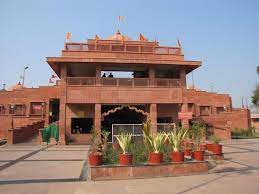
Mahakaleshwar Temple in Ujjain

Ujjain via Bhopal

Upon arrival in New Delhi on April 16, 1980, I learned that all transportation was heavily booked because of the Kumbh Mela. I was 24th on the waiting list of the Indian Airlines flight to Bhopal. I called one of my cousins, who was head of a large travel agency. He helped me make arrangements, and the next day I was on my way to Bhopal.

In Bhopal I stayed with Vimal, a college classmate and also visited another college friend, Acharya.

Vimal fretted about my going to Ujjain.

“It’s too hot,” he said. “How will you get there? Transportation is jammed. Where will you stay?”

I showed him a letter of introduction to Mr. B. K. Sethi that I had been given by a friend. Arrangements had been made for me. Vimal looked relieved and indicated that Mr. Sethi was perhaps the most influential man in the state of Madhya Pradesh. The next morning, my friend Acharya took me to meet his boss, Munish. Munish and his family were planning to go to the Mela that afternoon at 4 p.m. and offered me a ride. I was on my way!