The Spark – Part 4: The Barber

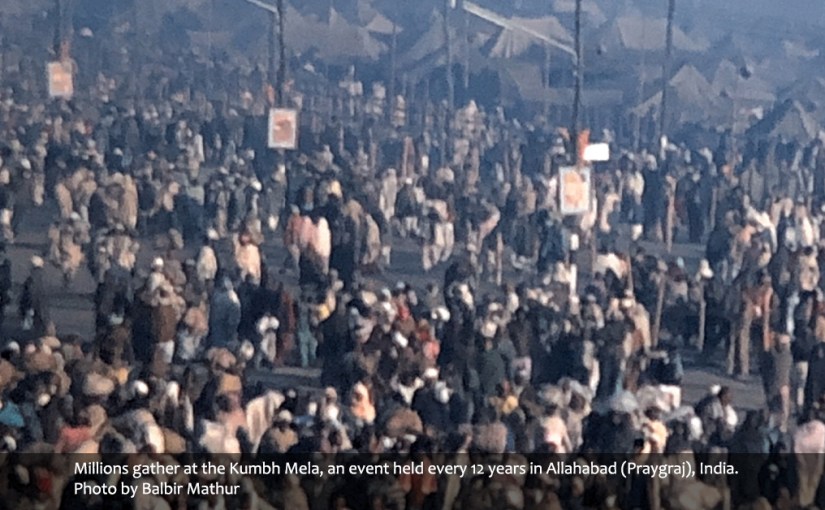
It rained and rained all night and most of the next day, drenching the millions of pilgrims who had gathered on this cold winter day at the Kumbh Mela. All the planning and arrangements broke down. Crowds of people were slipping in the mud. Ambulances were stuck and could not reach the disabled. New problems arose that no one had even imagined. Thousands of families were separated. I saw a desperate woman whose three children were lost. Later, I saw a small child, barely four years old, lost, dazed, and trudging through calf-deep, slippery slush. 

All the suffering confirmed my revulsion for religion.

That afternoon, I interviewed an itinerant barber. He and his customer were squatting in the slush, drenched. With his tools beside him in a tin pail, he was oblivious to the commotion around him, doing his job of shaving pilgrims’ heads for one or two rupees. 

“How much money had you expected to earn today?” I inquired. He told me he had expected to earn 125 rupees, but because of the rain he had earned only about 20 rupees. For a poor barber like him, it must have been a financial disaster.

“Did God do good or bad by sending this rain today?” I inquired condescendingly.

Without missing a beat or even looking at me, he patiently answered that rain was simply a happening. “We can choose what we wish to perceive in it,” he said. “Could we, with our limited perception, judge an act of God? Everything in the overall perspective happens for the best, even though it may not be evident to us at that time.”

The words of that barber were neither new to me nor very profound, but their impact on me was stunning. I stood there, speechless. 

I grew up with the understanding that everything happens for the best. It was something I believed. It was an “article of faith” for a little child, just like knowing the sun will rise or that my mother loved me. It was not based on any intellectual understanding. It just was.

But later, during the partition of 1947, when British India was divided into the two independent states of India and Pakistan, hundreds of thousands of people were killed—all in the name of God. That horrible experience did not match my belief that everything happens for the best. How could killing in the name of God be good? How could injustices, cruelties, or crimes be good? 

I concluded that the belief that everything happens for the best must be an “opiate of the masses.” As long as such notions persisted, there was no hope for human beings. As I started to explore my horizons, I could not find any intellectual support for my childhood belief. 

Now, after this one statement by that barber, I stood frozen, transfixed. I felt like any movement on my part would bring attention to my utter nakedness. It was as if something within me had been whittled down over time, and with the barber’s statement, it broke. After a few moments, I slowly moved on. The barber did not glance at me nor utter another word.

Soon after that, I left for New Delhi on my way back to the USA. I spent a couple days in Delhi with my aunt and uncle. 

The night before I was to depart from New Delhi, I went to bed early so I could get up and catch my 4 a.m. flight. After only two or three hours of sleep, I awoke and found myself engulfed in a powerful, yet subtle feeling, a beautiful ambiance. There was something familiar about it. And then, in my half-awake, half-asleep state, the flower appeared.

In my memory, I was transported back to when I was six years old, and my family was on vacation in the mountains. As I was walking down a narrow trail one day, I bent over to admire a tiny flower. From a distance, the flower looked solid blue. But when I looked closer, it was an amalgamation of several shades of blue, intermingling in a joyful mood—and I could see tiny veins in its petals. I stood there in awe, enchanted. 

Then, with the innocence and tenderness available only to the very young at unguarded moments, I asked, “Can you tell me the meaning of life?” I spoke to the flower as if I were talking to a newborn baby. I dared not touch the tiny miracle in front of me, for fear of hurting it. The wonder I beheld was precious, priceless. 

Perhaps, as a little child, I identified with that little flower. Because at that moment, I realized my own smallness and vulnerability. For a child who had been coddled as if he were the center of the universe, one would think such an experience would be disconcerting, or even threatening. The effect was quite different. 

I remember a gentle feeling dawning upon me, a feeling of lightness. I recall walking home with a big smile, as if I were walking on clouds.

Now I had that same feeling as I lay in bed in New Delhi. In my half-awake state, I could see the beautiful blue intermingling colors of that flower. It was as if the flower had come back to remind me of something. It had not answered my question. But somehow, in that moment I had discovered a slant, a perspective, an approach to life. The flower’s life would be so brief. Each moment was precious, a treasure, a miracle. In that light, how do I respond to this universe? The flower had not told me the meaning of life. It had given me a handle on life.

I thought of the barber at the Kumbh Mela. What was it that allowed him to remain so calm, even though he had suffered such a financial loss? And, it wasn’t just him. It was the crowd of millions of people who had remained calm in the middle of such chaos. What was their secret?

It suddenly struck me—I had focused on all the outer events of the Mela, how it was organized, the masses of people, the food, the bathrooms and so on. But I had missed the central point! I had missed the essence of it. The barber was extremely poor, from a village, with no education and no philosophical training. Yet there was something in him, something deep within the DNA of the culture itself—an unseen treasure. That is what I was supposed to learn, but I had missed it. I had not done my job as a reporter, and I would not be able to do justice to my intended article. 

Immediately I got up, canceled my flight, left a note for my uncle and aunt, and caught a train back to Allahabad. 
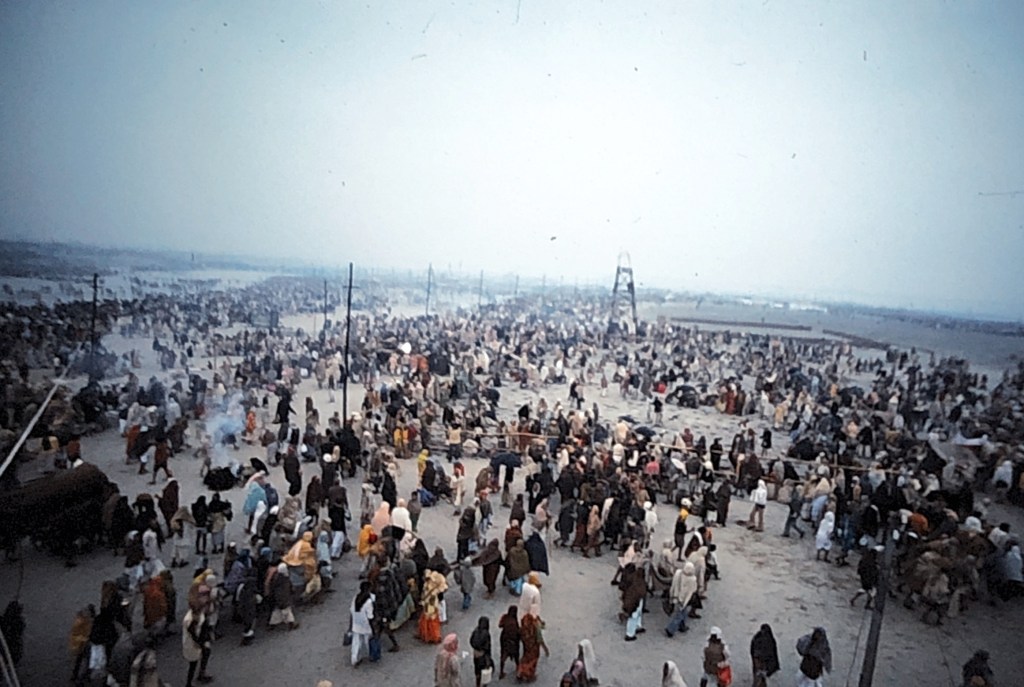
Pilgrims at the Kumbh Mela / Photo by Balbir Mathur

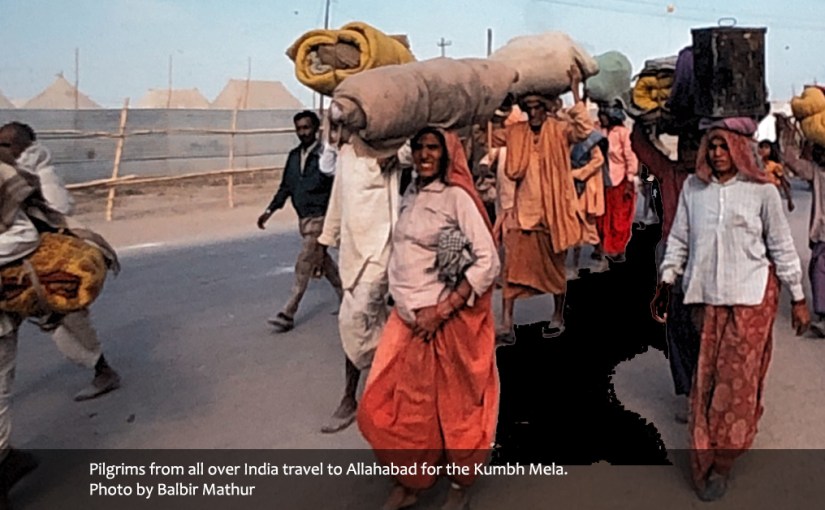
There was no time to waste. I went right to work. I was no longer interested in hobnobbing with the VIPs. This time I wanted to talk with the common people, the ones who had walked countless miles, often barefoot, just to be there and walk on the sands by the Ganges.

I realized that, having grown up with a Western education, I had never known the core values of the common people. As I spoke with them now, I was no longer wearing blue jeans, and I was no longer impatient with them. I interviewed 63 people, by count.

Everyone I spoke with gave me practically the same answer as the barber. Their perspective that everything happens for the best was deeply rooted, a part of their very being. From that simple acceptance of “life as it is” seemed to flow a great strength, peace, and wisdom, a deep understanding of life. Irrespective of their lack of education, their superstition or poverty, they could dance with life. It was not dependent on any outside circumstances. 

I was humbled. It became a matter of pride for me that I shared the same primordial DNA as these people.

In fact, I found my own perspective starting to shift. I was no longer seeing the Mela as a journalist. I was there to reconnect to my roots. I was no longer trying to understand it all intellectually. I wanted to experience it. I was like a child who has their first taste of sugar and just wants more and more. I was now a seeker. 

Just as quickly as the multitudes of people had appeared for the main bathing day, they left. In a couple of days, only the very dedicated pilgrims remained. They would stay there for most or all of the 40 days of the Mela. 
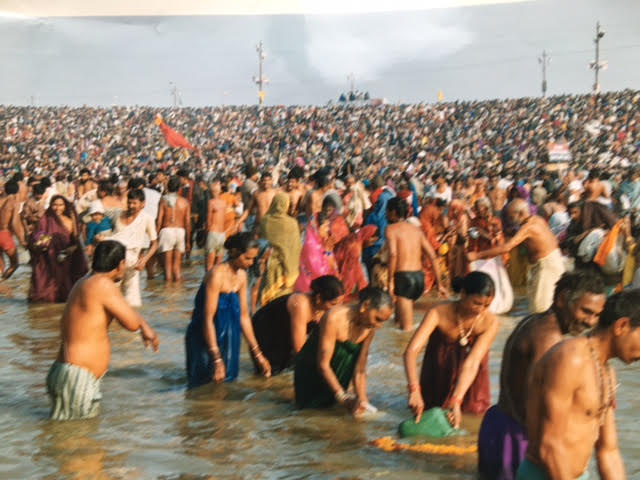
Pilgrims bathe in the Ganges River / Photo by R.K. Varshney

I never even saw the photographer sent by National Geographic. I was told he came on the day of the Mauni Amavasya and left the next day. Because of the rain, his photographs did not meet the standards of National Geographic, and they scrapped the idea of the story before I could even start writing. 

When I received the call from the magazine telling me the story wouldn’t run, the only thought going through my mind was, How did that “350-year-old man” know? To the person who called me, I just said, “I understand.” Because now I knew that I had not gone there to write an article after all.

Little did I know that on that rainy day, in the midst of an unforgettable human drama, a humble barber would change my life.
The Spark – Part 3: Just Around the Corner

The biggest news at the Mela was the presence of a saint reputed to be 350 years old. Even though the name of Devraha Baba was on everyone’s lips, I simply refused to give him any credence. When I needed to be polite to people, I simply ignored the topic and walked away. To others, I was curt. With some, like my mother, I would question their sanity. But the brunt of my anger was reserved for a monk I met on the night of January 18. 

It had been a long day. I had gotten up at four in the morning at the behest of a Dutch photojournalist who told me the best photographs are taken at dawn, even before the first sun rays hit the ground. That night, I was exhausted as I walked back to my tent hotel room. The hotel office was near the gate, and I peeked inside. 

That was my undoing. 

A Hindu monk was sitting there, literally twiddling his thumbs, as if waiting for someone. The way he had wrapped his long, cotton, ochre-colored dhoti (a type of sarong) suggested he was from the state of Gujarat in western India. He engaged me in conversation regarding the Mela, which was of interest to me. I found out he was called Shanti Bhai (shanti means “peace,” and bhai means “brother”). He asked why I was at the Mela, and then asked more questions about National Geographic. 

After several minutes of such talk, I begged leave of Shanti and started toward my tent. He followed and politely stayed outside, but continued to talk. 

I told him I had had a long day, and I reminded him that tomorrow was the biggest day of the Mela and I needed some precious rest. I would be glad to see him some other day. But, skillfully, he kept me engaged in conversation. 

Somewhat sternly, I told him again to come back the next day. He said the next day was Mauni Amavasya, so this may be our only opportunity. “This sanjog (coincidence of the stars) may never appear again,” he told me. “Have you met Devraha Baba, the 350-year-old saint?”  

That did it. I unleashed all my pent-up anger on him. My diatribe was sprinkled with profanity. I asserted that scientists in the U.S. had done all sorts of studies on longevity, and if there was anyone of that age they would have studied him a thousand times over. I guaranteed that there was no one in the world who was that old. The very notion of someone being 350 years old was absolutely preposterous. I blamed Hindus like him who circulated this type of nonsense. It made a mockery of the religion and only spread illiteracy and ignorance.

“India is underdeveloped and poor because of people like you!” I concluded. I wanted the intruder out of there. 

The calm smile never left Shanti’s face, which made me even angrier. “What type of journalist are you?” he asked. “This is the biggest news of the Mela, and you have discarded the information without even checking it. Rejection without investigation.” 

That statement touched a raw nerve and stopped my harangue. I needed to cool down. I took a short walk around the campsite, while he stayed outside my tent.

This man is right, I thought. I am not a journalist. I am a businessman acting like a journalist. What would I say about the presence of this allegedly 350-year-old man in my article? Would I simply ignore the whole thing? Would I say that even though tens of thousands of devotees flocked to be in his presence, I never investigated it? Am I being objective, or am I just bogged down with my own prejudices? Am I doing justice to my assignment, or am I a phony who gets by doing the very minimum? 

I felt as if I were in a boxing match and had been winning every round until my opponent knocked me out with one punch in the last round. This punch was below the belt.

Upon my return, I apologized to Shanti and asked where Devraha Baba was camped. 

“Just around the corner, only a few minutes’ walk,” he replied. “You will be back in no time.” 

I corrected him, because I knew this was not true. Devraha Baba was in Jhusi, across the river and several miles from where we were located. 

“Yes, that is where he was earlier, but he moved to be near the Mela tomorrow,” he assured me. “His new location has naturally not been made public. I know where he is, and I can take you to him.” 

“But it is too late,” I protested.

“No, not at all,” he asserted. “Most of his devotees come to visit him only at night. That is when he gives his darshan (the blessing of seeing a holy person).” I was not convinced, so I looked straight into his eyes. He did not even blink.

I grabbed my camera and left with him to find Devraha Baba.

Shanti was in his early 30s, lean, and of slight build. He was a brisk walker and invariably stayed about ten steps ahead of me. While I was dressed in multiple layers of warm clothing, including my topcoat, Shanti was dressed only in his dhoti.

Every half mile or so, I would stop and bark, “Where in the hell is this damn place?!”

He would turn around, smile, and say, “Just around the corner,” and then promptly race forward again. 

A few times, he looked back to make sure I was still following him. That gave me the notion of just giving him the slip—it would teach him a lesson! But what if the Baba was indeed nearby now? I tried to engage the monk in conversation, but he kept moving, avoiding any verbal contact. I was getting angrier by the minute.

As we started to cross the Ganges River on a pontoon bridge, it became evident that, indeed, we were going to Jhusi. It was too late for me to turn around. Even after crossing the river, it was a long walk farther. The lights and humdrum noise of the Mela receded behind us. 

This long walk in the dark took me back a few years to an incident when I fell into the clutches of a con man in Rome, Italy. It was the same pattern. A stranger takes you into their confidence. You are invited to go to a nearby destination, which turns into a long distance. Your inquiries are met with statements like “just around the corner.” In the end, you find yourself in a dark, isolated place where you are helpless. 

My sense of adventure had kicked in once again to override good judgment. In Rome, it had taken all my presence of mind and all my wits to come out of the trap alive and in one piece.

I would soon learn that on this trip, my wits would be of no value. 

We finally reached Devraha Baba’s hut, which turned out to be on the shore of the Ganges and built on top of four wooden stilts at least ten feet tall. The top half of the tower was covered with mist floating over the banks of the river. It looked surreal in the glimmering moonlight. Adding to the effect was the warm glow of the festival lights on the distant horizon. I felt like I was lightyears away from the Mela, on a different planet.   

We approached the tower slowly and cautiously, with the monk leading the way. There was one person sitting on the ground between the stilts under the hut. We had not been able to make him out there in the shadows from a distance, but he had been able to see all of our movements.

The whole setup surprised me. I had expected a big encampment with dozens of tents full of people surrounding the Baba, along with the necessary security arrangements. Here, the most renowned personality of the Mela was practically by himself.

The man sitting under the hut turned out to be a well-known chemistry professor at the University of Allahabad. Even I recognized his name after all these years, having earned my Master’s degree there in 1956. With prayer beads in his right hand, he was keeping warm under a solitary blanket. In a gentle whisper, Shanti introduced me as “the great Indian journalist from America representing National Geographic.” 

The professor recognized the name of National Geographic, but his eyebrows went up at hearing that I was a great Indian journalist. Of course he had never heard of me.  

He put a finger to his lips to make sure we would not wake up Baba. In a soft whisper intermingled with gestures, he conveyed that Baba was resting, and we would need to come back during the day. 

“But this man is a devotee of Baba who has come all this way solely to have his darshan and to write about him,” Shanti asserted. 

The professor was not impressed. 

“He is leaving in the morning!” the monk lied once again. “That is why we are here at this late hour.”

With sternness, the professor motioned for us to leave. 

The ease with which Shanti doled out his brazen lies disgusted and embarrassed me. I did not want any part of it. It was not my idea to see the old man. I was not a devotee. I was not leaving in the morning. Angry, I stood a few feet away with my head half-turned away from them.

Shanti looked at me and shrugged his shoulders in resignation, as if to say, “Well, we did our best.”

That would teach this SOB a lesson, I thought. I felt an ironic sense of justice.

Just as we started to walk away, a voice came from the hut above. “Who is there? What is going on?”  

It was the Baba.

Shanti rushed to reply before the professor could intervene. “There is a journalist from National Geographic who would like to write about you, Baba!” he shouted quickly. 

“National Geographic…” Baba replied in a loud voice. “National Geographic is not going to print the article. This man is here for something totally different. I will see him,” Baba’s voice seemed to boom in an otherwise silent and still space.

Is he predicting that my article will not be printed? I did not want to even hear such a thought. I regretted being there. I felt as if someone had hit me in the pit of my stomach.

Another doubt arose in me. His voice was loud, clear, and authoritative—even youthful. He sounded like an 18-year-old. Never having heard a 350-year-old man speak, I did not know what to expect, but this was positively not it. It seemed to me the con game was thickening. The image of Dorothy’s Wizard crossed my mind.

Shanti’s gratitude burst forth: “He is your devotee, Baba! Just a few minutes will do.”

Oh, I wish he had not said that, I thought. I am not one of Baba’s devotees!

The professor, who was now standing outside the stilts, turned towards me. A wide and knowing smile covered his face, and he nodded gently. He seemed to acknowledge that something significant must be taking place if Baba would actually come out in the middle of the night, and that he was fortunate to be there to witness it. His eyes were dancing.

There was a rustle inside Baba’s hut on top of the tower and then some brief chatter as his assistant helped him get up. Baba’s body was unsteady as he came out, like a 90-year-old man who had been awakened from a deep slumber. He was short, and had long, matted hair. He was not wearing any clothes at all in that cold air.

My camera was ready, and I immediately started to shoot pictures. Even though the camera flashes were piercing, Baba just stood there gracefully, holding onto the railing of the platform, without protest. A few times he tried to protect his eyes with his skinny hands. I kept shooting.

After I had shot a dozen or so photos, the professor said, “That’s enough.” But I kept shooting. 

After a few minutes, Shanti cried out, “Mr. Mathur, please, stop!” But I ignored him and still kept shooting, until my whole roll of 36 slides was emptied.

“Is it over now?” Baba asked. 

“Yes, Baba. Thank you,” I replied, standing in front of him under the tower.

Baba went inside and then called out to the professor, “Give the child some prasad (holy food, similar to communion).” The professor got a small bowl made of leaves and started putting food in it for me.

Baba’s voice came again: “Make sure you also give him charnamrit (blessed water).” The professor brought me a small earthen cup. 

Exhausted from our long walk, I sat down on the cold sand facing Baba’s hut. Shanti joined me, and we sat there in silence, each lost in our own world. 

I was trying to digest what had just taken place. Baba’s youthful voice and the smooth, firm skin of his face belied even the seeming age of his 90-year-old-looking body. Granted, he could be 90 years old, but there was no way he could be 350 years old—or even half that age! What had I come all the way here for?

Then remorse hit me. It was not appropriate for me to shoot that many flashes at any man in the middle of the night without his permission—not to speak of an elderly man like him. Why had I been so rude? What had come over me?

A drop of cold water landed on my forehead, right between my eyebrows, and brought me to my senses. It felt like coming back from some distant land where I had been lost. I felt drowsy. I must have dozed off, I thought.

I became aware that my hands were absent-mindedly sifting through the cold sand at my sides. I pulled one hand free to look at my wristwatch. It was exactly midnight. It was now January 19—the auspicious moment of the start of the Mauni Amavasya

Then I looked up to find the source of that falling droplet. A bird, perhaps? I wondered. 

What I saw sent a shiver through my spine. 

The sky was covered with thick, dark clouds. They were rolling in fast, like a well-trained army moving silently and swiftly to besiege a town under cover of darkness. The clouds had already gobbled up the full moon that had provided such a luminous ambiance only a little while ago. 

Did I doze off for a long time, or did those clouds appear in an instant? I wondered. I could not remember seeing a single cloud all day long. Then I realized that it had been pitch-dark as we were walking up to the Baba’s camp. The moon must have come out of the clouds only for a few moments when we arrived. 

For the huge masses of people gathered at the Mela with little or no shelter, rain would be a disaster. “Oh, God, no,” I said out loud. “Millions of your children are camped out in the cold. Spare them, please! They have come to experience You. They may be stupid, but they are your children. You are called merciful, so show your mercy! God, forgive these children of yours. They do not know what they are doing, but they mean well.”

I was praying in earnest, and I did not know what to think of that. I did not even believe in God. If I had heard these words from someone else, I would have been ready to argue and chastise them. And yet, here I was praying and using such words. It was preposterous.

The Spark – Part 2: Arriving at the Mela

My being at the Mela caused a stir among the foreign journalists.

I should have guessed that representing National Geographic called for being held in special esteem. It made me feel like an imposter. I was neither a journalist nor a photographer. My insecurities also were fed by the fact that I knew very little about the Mela. 

For that reason, I reached the Mela grounds a couple of weeks ahead of Mauni Amavasya, the main event scheduled for January 19, 1977, when millions of people were expected to bathe at the confluence of two rivers, the Ganges and Yamuna.

India was the country where I was born and grew up, a country that I once loved and for whose freedom I fought in my own ways. It was also a country I had left in 1958 at the age of almost 23 to discover the ways of the West. As I blended into the throngs of incoming pilgrims, I started to pity those poor, ignorant people who could not adequately feed themselves. What I saw around me fed my intolerance for religions, the breeding ground of superstition and inefficiency. 

I had made reservations at a campsite hotel established primarily for foreigners, including journalists from several countries. It was conveniently located and adequate. Each tent was divided into two small rooms and had a toilet and running water. There was a restaurant under a larger tent, which also served as the lobby for guests to get acquainted and hold meetings. 

My mother, who lived in Allahabad, also came to the Mela. It was an opportunity of a lifetime for her. She would not have been able to attend the festival if I were not there. She brought her maid servant, primarily to cook, and I hired a young man as an assistant to help me carry photographic equipment. We took two rooms at the campsite. 

The campsite was practically empty when we reached it, and some finishing touches were still being added. As the date of the main event approached, foreign journalists began to arrive. I noticed a pattern. At first, they would ignore me as “one of those natives,” a stranger. Gradually, they would find out that National Geographic was covering the event, and that I was their representative, and their attitudes would change. Whenever I was in the restaurant, they would gradually drift over to my table and linger.

One evening, a young new guest appeared. He was having a meal with another American journalist. The journalist spoke to him in a hushed voice, but when I started to see stolen glances and stares from the newcomer, I knew the journalist was telling him about me. Soon, the two walked over to my table, and the young newcomer introduced himself. He was an American freelance photographer.

“This is a bummer. I was hoping to sell my photographs to National Geographic, and now you are here!” he said, unable to hold back his disappointment. 

I tried to reassure him that I was a businessman who was randomly assigned by the magazine to be their eyes and ears at the festival. I was certainly not a photographer. 

“What about that stuff? Camouflage?” he said sarcastically, pointing to my camera and bag full of lenses and film. My smile was not convincing.  

Also in attendance was a Norwegian writer who had several books on Eastern philosophy to his credit. He was well-versed in English and sought me out as a friend. But I spent little time at the campsite. I was at the Mela on a mission, and time was precious. 

My workday started early in the morning and continued late into the night. Early on, I would stop by my tent a few times each day to check on my mother, but she quickly developed her own circle of friends.  

I reminded myself that, being a novice, I needed to work twice as hard as the professional journalists. It didn’t take long for me to realize that Lady Luck was also smiling on me. 

There was a large police force, more than 15,000 strong. This force was being commanded by three elite, high-ranking officers. One of them turned out to be a distant cousin with the same last name as me. The second was an old classmate of mine from Allahabad University. They introduced me to the third officer, who was their boss. He turned out to be an intellectual who admired National Geographic and lamented that, in India, he could not be a subscriber. Like me, he was also an early riser. On several occasions, we had our morning chai together while sitting in the sun. 

With the help of these three officers, I was able to put together a list of people I should meet and places I should cover. I was given proper introductions, and sometimes police-driven vehicles would take me to my intended appointments. I now not only had an inside track, but I was also hobnobbing with the VIPs and receiving salutes at police checkpoints. My circle of freshly-minted friends kept multiplying. For them, a man from National Geographic was a good “show and tell” exhibit. 

It was evident that an undercurrent of nervousness pervaded the administration. In practically all the press conferences I attended, one question invariably came up: “Record crowds are expected. What is being done to prevent a disaster like the one in 1954?” That was the year my college friends and I attended, when several hundred people were trampled to death and thousands more injured in the stampede. Everyone was still fighting that previous battle. The members of the administration were taking this fight personally.

The 15,000 police were being helped by at least that many volunteers. Army units were on alert in case of emergency. There was a sophisticated control room, commanded by a senior officer with considerable experience in crowd control. Three walls of a hall were covered with blackboards, and police officers on mobile ladders were constantly updating the traffic reports with colored chalk. Information on trains and bus traffic poured in from all parts of the state. Several times, traffic had to be delayed at the outskirts of Allahabad. Days before the start of the Mela, the control room predicted a crowd larger than what was originally anticipated. 

The administration had done a mammoth job of laying out the infrastructure for a temporary tent city covering several square miles. The main tents were already erected, along with roads and fresh running water in each area. Plots were laid out for large groups who had rented space to set up their tent complexes, and other areas were designated for pilgrims to set up campsites. The Army Corps of Engineers had erected dozens of pontoon bridges for people to cross the river at convenient points. The whole area was being sprayed for mosquitoes twice a day. For miles around, roads were being sprinkled with insecticides. 

As people started flooding into the Mela grounds, a new hubbub began. The campsites started filling with smaller tents. The main streets were soon dotted with restaurants and shops selling traditional souvenirs. There were gaudy neon lights, and loud music blared from many of the shops.   

Specific measures had been taken to prevent the previous disaster. On the day of the Mauni Amavasya, pilgrims would be contained in a series of cattle pens. They were to be released from one pen to the next in orderly fashion. Pilgrims would have to go through a snake-like, winding path for several hours before they could reach the bathing grounds. 

Hundreds of tall police towers with loudspeakers were erected at fixed distances to monitor any untoward happening. Messages could be communicated to the crowds at specific locations or to the entire body of millions of people at once. Several lost-and-found centers were established where people could be reunited. Announcements were being made constantly.

The administration was well-prepared. There was to be no stampede this time.

The Spark – Part 1: Assignment for National Geographic

October 1976

I woke up to a message. 

For several minutes I sat with half-opened eyes, trying to comprehend the message. I got up and walked down the narrow aisle of the Boeing 747 en route from New Delhi to London. The hostess at the back of the plane checked her wristwatch and told me we were still three hours from landing.

Perhaps for the first time in my life, I was glad we were not yet at our destination. I needed time to process the newly-emerged thought. 

While visiting my mother in Allahabad, India, I had seen a large tent city being constructed to host the Kumbh Mela, one of the most ancient Hindu religious festivals. Millions of Hindus gather every 12 years in Allahabad. For 40 days, throngs of people camp out on the banks of the Ganges River to worship or meditate many hours a day, visit various shrines, attend discourses by religious leaders, eat meagerly, and go for immersion in the holy river three times a day. Some people save their money for years in order to be able to attend the festival once in their lifetime.

Something—a voice—within me was urging me to go to Washington, D.C. and inform National Geographic magazine of this extraordinary event. But, no sooner had the idea emerged than the doubts kicked in: Most likely they already knew about it. After all, they are National Geographic! I would look like a fool.

Balbir Mathur, 1970s

I vaguely knew one person at the magazine, and what if he was not there or was busy and could not see me? Going to Washington without an appointment was risky. All I had to do was simply inform them in a letter from Wichita. If they had any questions, they could call me. Changing my schedule midway would be expensive. And my schedule was already loaded. Could I afford to crowd in one additional delay?

The idea was tender in its newness. But the doubts were strong and powerful, fully tested in prior battles—their long shadows like dark shrouds ready to smother the newborn idea. Like a baby, the fragile idea was holding tight to the only protection it knew—my trust in hunches from years of experience.

Just before landing, I made a decision. It would be like the toss of a coin. If it was meant to be, a schedule change would be feasible in London, and I would go on to Washington. Otherwise, I would continue to New York as scheduled.  

The head was praying for New York, and the heart was rooting for Washington. 

The heart won. The gentle lady at the Pan Am counter in London rerouted my flights through Washington and from there on to Wichita, where I lived. “Ah, the last seat!” she exclaimed victoriously. The die was cast, and I immediately felt relieved.

The next morning at 10:00, I was in the lobby of National Geographic asking to see Ken Weaver, the science editor. My heart was in my hands. As luck would have it, Mr. Weaver was in his office.

“I am the son-in-law of Everett Brown,” I told him over the lobby phone. “I met you a few years ago at McPherson College.” Silence. I felt my heart skip a beat. The wait seemed interminable. I realized that Mr. Weaver was trying to make the connection. After a long pause, he said he would come down to the lobby to meet me.

Ken was a third cousin of my father-in-law, and they had attended McPherson College together in Kansas. I had met him when my wife, Treva, and I had attended a dinner at one of my father-in-law’s class reunions.  

Fortunately, Ken recognized me, apologized for not remembering, and invited me to his office. “What brings you to Washington?” he asked.

I told Ken I was just returning from my hometown of Allahabad, India. I told him about the tent city being constructed to host the Kumbh Mela, and that six million pilgrims were expected to attend. The sheer number was mind-boggling—a record crowd. I had simply come to inform National Geographic of the event, in case they wished to cover the story.

That was all. 

 “Tell me about it,” Ken said, putting his hands behind his head and leaning back in his chair. 

As soon as I finished my story, he abruptly got up, asked me to wait a few minutes, and walked out of his office. Ken was gone for what seemed like a long time—long enough for me to browse through some books and magazines on his bookshelf. 

When Ken returned, his excitement filled the office. He was almost out of breath. He tried to calm himself as he told me he had gone to see Mr. Grosvenor, the editor of the magazine. Ken wanted him to hear my story. It was a tremendous stroke of luck that Mr. Grosvenor could see me for a few minutes, he said. Mr. Grosvenor was busy for the rest of the day and then would be out of town for several days.

Ken gave me a quick briefing on Mr. Grosvenor as we rushed up to his office. He was the grandson of the founder of the magazine, and the great-grandson of Alexander Graham Bell. Ken urged me to repeat the story exactly as I had told it to him, right from the beginning. 

We were asked to wait in his secretary’s office, because Grosvenor had asked three of his associates to join the meeting. Ken winked at me to indicate that was a good omen. Soon the others joined us, and we went into a large office. Grosvenor got up from behind his desk and came to greet us. He was much shorter and younger than I had imagined him. His handshake was firm. We all sat in chairs arranged in a circle away from his desk.

Grosvenor opened the meeting with introductions. There was the director of photography, the business manager, and a senior editor.  

“Ken tells me you have an interesting story to tell us,” he began. “I am eager to hear it,” Grosvenor’s voice was commanding, and yet his eyes were gentle and smiling, as if to make me feel at ease. 

I gave a thumbnail sketch of the historical background of the Kumbh Mela, but mainly focused on my personal experiences with the festival starting at the age of six. And then, I told of the last time I had attended.

“As college students, two of my friends and I attended the festival in 1954. We went simply out of curiosity; we were not spiritual pilgrims by any stretch of the imagination. 

“Crowds were walking towards the Ganges at a leisurely pace. Most of the pilgrims were walking in small groups, chanting spiritual songs as they walked. The three of us were talking to each other, paying very little attention to our surroundings, when suddenly the crowd in front of us abruptly stopped moving. 

“Before we knew it, the crowds at the back slammed into us. It was as if a car in front of us had stopped, and as we crashed into that car all the cars behind us slammed into us, causing a huge collision. Only in this case, it was not a multi-car pile-up, but a crush of human beings. 

“Within seconds, the crowd locked in place, with not an inch of space to spare. Everyone was being squeezed as if in a vise. It was hard to breathe. Even though it was a cold day, all of us were perspiring. 

“Suddenly, there was a movement—not of individuals, but of the entire crowd as one body. A block of several thousand people—male and female, young and old, rich and poor—were swaying as if they were one block of Jell-O on a plate. 

“I felt like a grape trapped in that Jell-O. The movement was like a human earthquake. We three friends were shouting at each other, ‘Hold on tight!’ With terror in our eyes, we held on to each other for dear life, but our grips started to weaken. People were screaming at the top of their lungs, and it seemed as if one single voice was being directed at the skies. At that moment, we were united not only as one body and one voice, but also with one thought. None of us knew if we would come out of that black hole alive.

“After a few minutes, the crushing movement suddenly stopped, though we were still locked in place for a long time, perhaps an hour. I realized that in the brief time of the ‘human earthquake,’ we had experienced a glimpse of eternity, filled with the cries of men, women and children. 

“Finally, the grip of the crowd broke, and we started to walk—like stunned zombies. After walking for a few minutes, we found out that, during the movement we had felt, several hundred people had been trampled to death and thousands more injured in a stampede. We three remained in that area for hours, consoling people who had lost friends and relatives. The stunned expression on the pockmarked face of one man will always remain with me—he had lost 28 members of his extended family.

“For days, we marveled at the thought that not one of us would have survived had we been a mere 100 yards ahead. Only a few steps separated life from death. We had witnessed the fragility and value of life.”

As I told this story, there was pin-drop silence in the room. I was experiencing something most unusual. After almost a quarter of a century, this was the first time I had been able to share that experience with anyone. Now, unrehearsed, the words flowed out from somewhere deep within me. I felt almost as if I were in two places at once—I was narrating the story, and yet at the same time I was in the audience, listening with rapt attention. 

When the story was over, there was a moment of silence. Finally, Mr. Grosvenor spoke. “We were not aware of this event and had not planned to cover it. Would you like to go back and cover it for us?”

“Look,” I protested, “I simply came here to inform you of the event. I am not a writer. I have never written anything before.”

Grosvenor crossed his arms, his right-hand fingers caressing his left elbow. He looked straight at me, steadied his gaze for a moment, then with a brush of his hand dismissed my objection. “We have all the writers we want. Your job would be to tell the story like you have just told us.” He had made his decision. 

I looked at the rest, and each of the faces was in support of what the boss had said. 

The business manager, a burly man of good size, took charge in his deep, resonating voice. He reassured me that they had writers who would love to work with me. “It will be your article. They will help you polish it. You will have nothing to worry about.”

“As far as I am concerned, there could not be a bigger honor,” I said. “But I really came here only to make sure the event would be covered.” 

“We understand that,” the business manager said. He then moved directly to the nuts and bolts of the assignment. When would I leave? How long would I stay at the festival? What would be my out-of-pocket expenses? I gave them an estimate, and it was approved on the spot. 

Grosvenor asked Robert Gilka, the director of photography, which photographer he might assign to cover this event. Gilka suggested Raghubir Singh, who happened to be in Paris at that time. “Wonderful,” Grosvenor approved.

Grosvenor then looked at the senior editor, who had been quiet up to this point, and said, “You will be working with him.” 

She nodded and took charge: “National Geographic is very thorough about making sure all the facts are correct. At least two people will be checking all the facts you submit. Make sure you bring back any supporting documents that you can.”

“What type of supporting documents?” I inquired.

“Any press releases, newspaper articles, notes, names, dates, places, etc.”

I nodded my understanding and agreement.

Robert Gilka and Ken took me out for lunch. Gilka quizzed me about my photography interest and skills. He suggested that I take pictures also, independent of Raghubir Singh. Then I had the honor of receiving some tips on photography from Gilka—the maestro himself. He was a man of few words who could get straight to the heart of the matter. 

Next I was taken to the executive viewing room, where the editor of photography, a gentleman from Egypt, was expecting me. He showed me some slides to demonstrate the elements of good photography. I was also loaned some specialized lenses for my Nikon camera.

I picked up my letter of assignment, and then I accepted Ken’s invitation to spend the night at his home and meet his wife, Modena. The next morning, I left for Wichita. 

I had gone to National Geographic on a mere hunch, and I ended up being handed a major assignment to cover the Kumbh Mela. It seemed all the stars were in alignment. It was all so surreal.