Slapped by an Angel

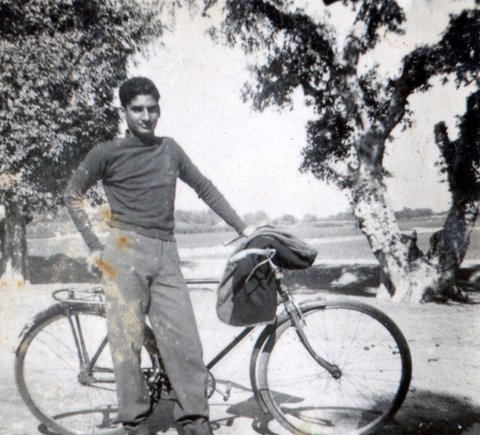
 At the age of seven, I received my first bicycle. 

My father paid 50 rupees to purchase the bike from a British family that was leaving India to return home to England. In 1942, even 50 rupees was a lot of money. Most bicycles were imported from the UK and cost in excess of 200 rupees, which would have been a year’s salary for a daily laborer. 

Since few people could afford bicycles, practically everyone walked—even great distances. Native ekkas (one-horse carriages) were available for hire, but most people did not have money even for that small fare.

All bikes were a standard size and painted black. But my bike was special: it was a small, child-sized bike, and it was shiny light green. I never saw another small bike like that in the whole city. I acquired celebrity status. People would stop in the street to watch me ride, or come to their windows to see me pass by. 

As a result, my showmanship blossomed. For me, it was never just a bike ride. It had to be a performance. I would pedal as hard as my legs would permit and catch up with anyone on a bike ahead of me. I would show off how I could ride with no hands, whizzing past all the pedestrians while precariously balancing on my two-wheeler. Or, I would challenge others to a race. 

Those must have been safer times. Not only was there very little traffic on the streets, but I could ride for miles out of my neighborhood without causing any concern for my parents. At one point, I even thought of making a map of the city, but I refrained when I realized I would not be able to draw it to scale. 

Not long after I got my bike, my father was commissioned as an officer in the Indian Army, which was part of the British Empire. World War II was in full swing, and immediately after his training, my father was packed off to fight the Japanese in Burma. 
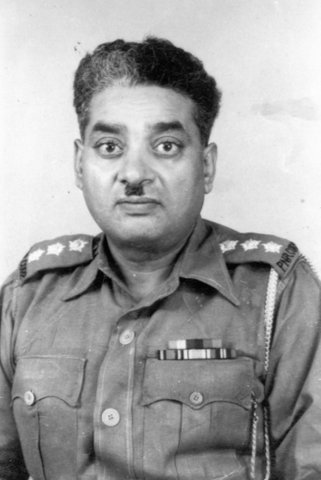
Balbir’s father Umrao Singh in his military uniform

Several months had passed when, early one morning, we heard a knock on the door. To my surprise and joy, my father was there! He was dressed in his uniform, and his left arm was in a sling. He had been injured, and was flown to a hospital in Calcutta. There he had been given a one-day furlough to visit his family in Allahabad, an overnight journey by train. 

Along with him was his orderly, the soldier attendant to an officer. Father told me his attendant would like to take a dip in the holy Ganges and asked me to accompany him. For the Hindu orderly, who came from a small village, this was an opportunity of a lifetime. 

The trip to the river and back was almost 10 miles, normally a great distance for a 7-year-old boy—but not when he had his mighty green bike! The orderly was in his army uniform and carried his lathi, a bamboo rod, which in those days was the main weapon for people from rural India. As he walked, I would race ahead on my bike and tell shopkeepers on the sides of the road that my father was back and I was taking his orderly for a dip in the Ganges. The orderly was my “show and tell.”

On our way back home, we had gone only a short distance from the banks of the river when two British soldiers rode past us on their bikes. This was bait I could not refuse. Pedaling fast, I caught up with them.

Dressed in their civilian clothes, the soldiers were leisurely riding and talking to each other. They looked at me once and then ignored me. I could tell by their body language that they did not welcome me riding along beside them. I could pick up only a few stray words of their talk. But then, one of them wove the Hindi word “chootia” (asshole) into the conversation.

It was a commonly used word in the local vernacular, but it caught me by surprise that an Englishman would know that word. I grew up in a family where we did not utter such profanity, or the punishment would have been much worse than having your mouth washed out with soap. Until that day, I had never said that word.

Astonished, I looked up at them and asked, “You know ‘chootia?’”

Unfortunately, my first two words were drowned out, but the last word caught their attention. Immediately, I knew I was in trouble. 

They stopped, ordered me down from my bike, and cornered me. One of them sternly asked me where my father was. Frozen with fear, I could not utter a word. My throat was as dry as desert sand. 

Father’s orderly was some hundred yards behind and running towards us. When he caught up to us, the same soldier asked him in broken Hindi with the deep accent of an Englishman, “Are you his father?” 

“No, I am his father’s ardaly,” he stammered, not quite knowing what was happening.

“Is his father an officer?” the British soldier inquired.

The orderly nodded his head, “Yes, Sir.” 

“Tell the officer his son needs to learn manners,” the British soldier said. 

The other soldier turned his face and moved a step away, as if he knew what was coming next and did not want to be a part of it. That, to me, was a warning of what was coming, but there was nothing I could do. The first soldier cocked his right hand as far back as he could, and with all his might he slapped my left cheek. The suddenness and force of it swung my head to the right and down to my shoulder.

For me, the world stopped at that moment.

It was not just another moment within the endless flow of time. I experienced eternity in that moment. My mind was clear, and I viewed the event as if from several feet above. 

I can vividly recall the looks of those two British soldiers. The one who slapped me had a long face and wore round-rimmed glasses. His face was stern and cold, and his hair was combed straight back. The other soldier, who seemed to be younger, had a baby-round face and dark fluffy hair parted on the side, and he would flip his hair to the side with a toss of his head. He also looked to be the friendlier of the two. They were both wearing white, short-sleeved shirts. They were perhaps 18 to 20 years old—but, to a terror-stricken 7-year-old boy, they seemed like giants.

I can still see the faces of the 15 to 20 bystanders who had gathered around us in a semicircle. They are still standing there, unmoving and mute as statues. I can see the wince cross the face of the orderly when I was slapped, even though I was not looking at him at that moment.

I can read the mind of the child, the center of attention. Scared as he was, he had expected to be lectured. He expected to get a chance to explain himself, that he went to a British school and could speak English, that he had meant no offense. As was his nature, he would have made friends with the two soldiers and invited them to his house for a home-cooked meal. He expected to be treated as an officer’s son—certainly not to be slapped in public. 

Upon being slapped, he expected immediate action from his protector, the orderly. He expected the orderly to use his lathi, a weapon that stayed frozen in his hands. He expected the surrounding crowd to curse the two British soldiers and beat them up unceremoniously. But neither the orderly nor the others in the crowd could lift a finger against them. Anyone trying to interfere would have been killed instantly, with impunity. 

The boy felt shocked and disappointed when the British soldiers mounted their bikes and rode off, without even being confronted.

And then, the child actually got scolded by the orderly. It was obvious that the orderly’s manhood had been challenged and humiliated, and he was irritated at the child for being the cause of it. He threatened to inform the child’s father of the incident. 

The rest of the way home, the child biked a few steps behind the orderly, as if in slow motion. Both were in a state of shame, and they could not face each other. They were experiencing the humiliation of helplessness—both personal and collective.

The slap had landed deeper than the child’s face. It had pierced the depth of his psyche.

For as long as I could remember, I had a sense that I was a visitor sent to live with my family temporarily. I felt that I was really from another family, another country. When I was four or five years old, I articulated that feeling to my mother. When she asked where my real home was, I told her, “England,” and that I would be returning there for good at the age of 10. Amused, she shared this with friends and relatives, and soon I was being asked to tell visitors about my “real home.” At first, I willingly participated. But, once I realized that I was being asked to perform, I stopped and refused to disclose any such feelings, even to my mother. 

When the British soldier slapped me, it was as if I had expected him to know. He was one of the people I felt close to and with whom I identified. It was a peculiar feeling, as if one of “my own people” had humiliated me in front of these “others with whom I didn’t really belong. Even more than that, it was as if I suddenly discovered how “my people” mistreated their hosts in their own land—hitting a child for a mere misunderstanding!

When the orderly was leaving with my father the next day, he took me aside at the railroad station and confided that he did not mention anything about the incident to my father. I was relieved. Compared to the British soldier who had slapped me publicly, I considered that poor, uneducated orderly to be much more civilized and cultured. It was clear that I did not want to grow up to be like the person who had slapped me.

With that one thunderous slap, I had grown up. I was no longer just a visitor in India. I was an Indian. 

How dare a foreigner insult me in my own country?! I was not going to take it lying down. I was going to avenge it. The incident did not diminish my desire to go to England. It inflamed it. But, now I had to go there to avenge—to kill as many British as I possibly could. I would not be able to kill enough. But, symbolically, I would convey the message that my people were not as helpless as the bystanders around us that day had seemed. There was at last one brave person among them. “My people” and “I” had become one, and my revenge was intensely personal.

Over the next few years, the embers of my humiliation smoldered into anger. My every thought was like a gust of wind that fanned the flames into rage and hatred for the British. 

That lasted until the evening of January 30, 1948, when Mahatma Gandhi was assassinated.

Gandhi’s nonviolent approach to driving the British out of the country had appealed to me as a child. At the age of six, I announced to my family that I was a follower of Gandhi. I even declared that I was only going to wear clothes made out of homespun Indian cloth, as Gandhi urged us to do instead of buying factory-made cloth from England. 
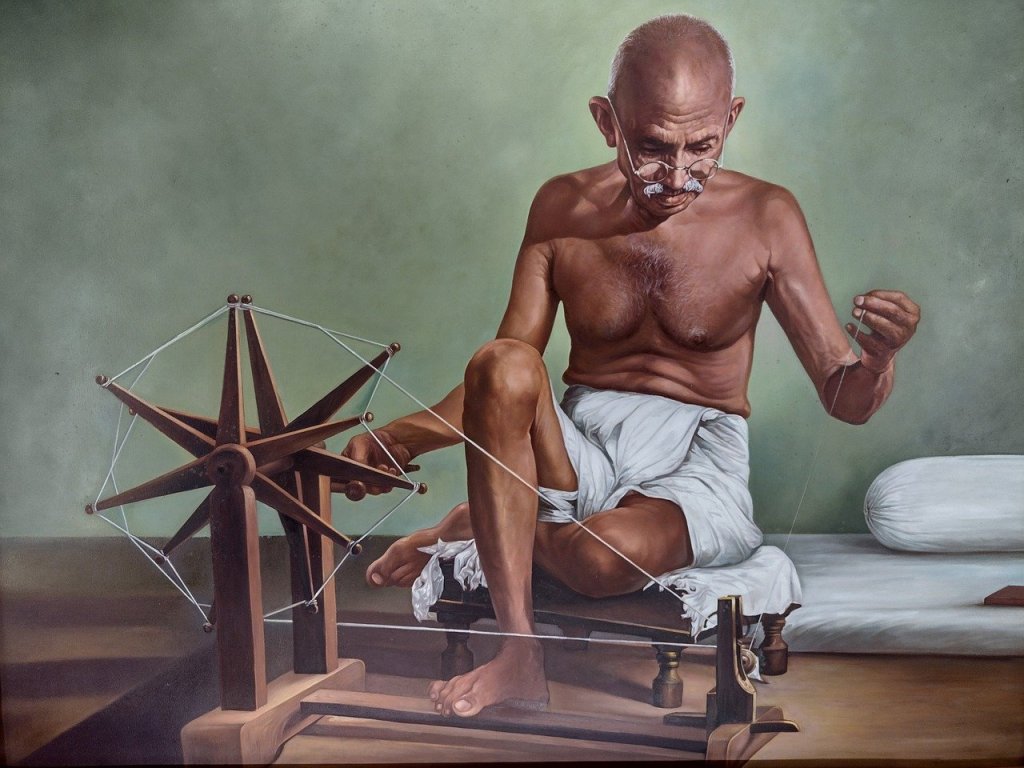
Mahatma Gandhi spinning homespun cloth

Two years later, that one slap convinced me that the British would need to face the barrels of guns to be booted out. I became strongly opposed to Gandhi and his message of “turn the other cheek.” The only thing the British deserved was “an eye for an eye.”

I decided to change my psyche, which was quite gentle. I could not kill even a fly or a mosquito, and for that reason I had become a vegetarian at the age of four in a meat-eating family. But now, I had to learn how to kill. I made up my mind to learn to damage people. I tried to become a bully, to pick fights for no rhyme or reason.

I demanded that my parents take me out of the British school. My father was in the British army, but I insisted that, if I were to continue living in my family’s home, the tricolor Indian freedom flag would have to fly from our house—and it did.

Then, on January 30, 1948, when I was twelve years old, I heard the news that Gandhi had been gunned down. My heart swelled, and I started to cry uncontrollably, tears flowing over my cheeks. My emotion caught me completely by surprise. Stunned and confused, I had no idea why I was crying for someone I opposed.

A large majority of India shed tears at the news of Gandhi’s death, but I wept all night long. My younger sister, ten-year-old Shakti, joined me, and we both sobbed as if our parents had died. Shakti and I were close, and I knew my sorrow alone was enough cause for her to cry.

The next morning, we saw the first rays of sun from our verandah, and at that moment we both stopped sobbing. It was as if the dancing sun rays had brought forth more than just a new day. For me, it turned out to be a new reality—a new life. 

Over time, I realized that those drops on my cheeks were no ordinary tears. For me, they turned out to be like holy water that cleansed my psyche. It was a deeply spiritual experience that set me free. And, I had no need to hate the British anymore. 

There is a legend in India that angels appear on the banks of the Ganges. I believe it, for it was there that those two British soldiers manifested themselves to awaken me. I thank them every single day.
My Life’s Theme Song

I have a vivid and tender memory of when I was three years old. My father and I were walking home from his restaurant one evening. We heard devotional songs being sung on the flat rooftop of a house along the road. My father said we should stop in as a courtesy to the neighbors. 

The house was three stories high, with three flights of stairs going up to the rooftop. Even though the stairs were too steep for a little boy like me, I would not let my father help me. I’m sure it took a lot of patience, but he watched as I slowly mounted the stairs, sitting on one step and pulling myself up to the next – one by one, all by myself.  

When we reached the roof, we saw about a dozen men singing. We took off our shoes and sat cross-legged beside them. The men were singing in Bengali, the native language of eastern India. Our family was Punjabi, from the north, so it was a foreign language to a small child like me. Very soon, I became bored. I snuggled up close to my dad and asked if we could go home.

With a nod of his head, he advised patience. He whispered that the beauty of the occasion was not in the words but in the people’s devotion. I did not know what devotion was, so I looked again at the men, this time with curiosity. 

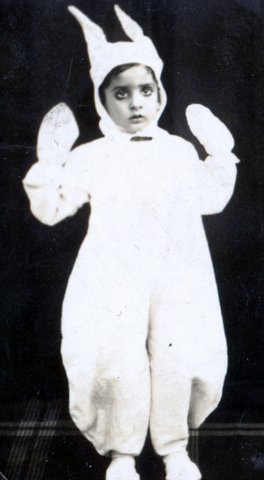
Balbir in rabbit costume handmade by his mother

They were singing at the top of their voices. The night was warm and sultry, and their faces were dark burgundy with effort, perspiration running freely. Their eyes were closed, and their bodies swayed. I watched intently, staring as only a child can do. 

They were chanting in Hindi now: “Muthi bandhe aye theye, hath pasare jain gay.” This was a language I knew, but I did not understand the relationship of these words in the context of the song. 

I asked my father, “What does it mean?”

He bent toward me and whispered, “When we are born, our fists are closed; when we die, our hands are open.”

“What does that mean?” I asked again.

 “It means that when we are born, we bring all the gifts given to us by God, and when we die, we leave empty-handed.”

As I think back, I realize I had no idea what it meant to be born or to die. Those words were not yet in my vocabulary. However, I must have liked the sound, the rhythm, the beat of that particular couplet. I do not remember any other part of that song, nor any other song from that evening. But, that one couplet stuck with me.

In those days, practically every Hindu home in India had a small family “temple” where we would offer thanks in worship. It would be a small corner in the busy house, but that corner was sacred, and each family member would offer their individual prayers there. 

The morning ritual was universal: prayers were said after bathing and before breakfast. After the family had been fed and the men had departed for work, women often spent longer times in prayer. During the rest of the day, anyone could go to this spot and offer their obeisance at any time. 

In our house, that place was at the top of the stairs that led down to the street. Each time we passed that place of prayer, we would bow with folded hands.

After that night on the neighbors’ rooftop, I liked to sit in that corner temple and sing that couplet over and over again. I would imitate those men, sitting cross-legged with eyes closed, swaying side to side and singing with all my emotion. Today I look at other toddlers and can imagine how comical and animated I must have seemed. So, it was no wonder that my elder relatives would ask me to perform for them. I became identified with that song.

My father had spoken of the “devotion” in those singers. I remembered the men singing with their eyes closed, bodies swaying, their lungs filled, and sound coming out with full power and intensity. So for me, the word “devotion” became synonymous with integrity between our inner feelings and our outward actions. As a child, I was merely imitating the singing. Over the years, devotion turned into intentional practice, and then experience.

 Some 40 years later, I had an experience of coming face-to-face with death. In that split second, I realized all the material goods of the world had no meaning. I could not take anything with me. Everything on this earth was to be left behind, even name and fame. The song I sang as a child came alive for me. It became a powerful beam of light that has guided the rest of my life.

On that hot summer evening when I was three years old, I had no idea I would acquire my life’s theme song. 

Stealing a Cake

I first became aware of poverty at the age of three.

My family had recently moved to the city of Allahabad, in Uttar Pradesh, India, and my father ran a restaurant near the university. My mother would dress me in the morning and send me to the restaurant, where I would play with the children of other shopkeepers on that street.

One day I strayed into an alley and saw two boys. I stopped in my tracks. Instinctively, I could see the difference between them and me. While I was clean and well-dressed, they had only cotton shorts on and their bodies were dark with dust, as if they had walked out of a chimney. 

They, too, were surprised. From a distance, they tried to assure me they meant no harm. For some reason, I was not afraid, just startled. They begged me for some food. I stared at their faces in disbelief. I could not imagine anyone being hungry. 

“Just wait,” the words tumbled out of me. I walked back to my father’s restaurant and entered through the rear kitchen door to see if I could find any food for the boys.

The first thing I saw was a white cake on the counter. I had never seen a cake before, as cakes were not made in India at that time. Little did I know that my father had gone to great lengths to make it as a rare delicacy. I only knew that it was beautiful. 

I carefully lifted the cake on its cardboard base. It was heavy. The cooks were swamped with breakfast orders and didn’t pay any attention to me. 

As I stepped out the door, I heard the head cook on the other side of the kitchen holler, “Hey, where are you taking that cake?” I thought I had gone undetected, but–darn it!–somebody had seen me. I took off running down the street. 

The head cook crossed the long kitchen to the door, expecting to see me there. When he saw me running, he shouted “Stop! Stop! Where are you going?” He came after me, with another cook right behind him. 

I soon realized that two “giants” were chasing me–and I was losing my lead! Sensing danger, my body shifted into high gear. I became aware of my little penguin-like legs running as fast as they could while I balanced the cake. I was deadly focused on getting to those boys before the giants could catch me. 

I heard swift footsteps behind me getting closer and closer. Fortunately, I had just enough of a lead to get across the road and reach the alley where the boys were waiting.

As one of the giants grabbed my left arm, I threw the cake with my right. It landed right in the lap of one of the boys. They grabbed chunks of cake as fast as their little hands could move, and the beautiful cake was destroyed in a split second. 

The cook sternly dragged me back to the restaurant, where my father was waiting for me. By this time, I realized I had done something seriously wrong. 

I expected a thrashing. Instead, my father gently patted me on the head and calmly explained that the next time I wanted to feed someone, I should just ask him. Then he asked one of the staff members to take me home. I did not tell my mother why I was sent home early. 

My experience with those two boys is one of my earliest memories. Its deep imprint shaped the rest of my life.

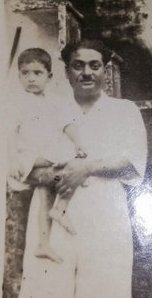
Balbir and his father, Umrao Singh, in 1938

Shaped by Upheavals

I was born in India in 1935. The British had occupied the country for 200 years. From all outward appearances, British rule in India—the “crown jewel of the British Empire”—was at its zenith.

However, several issues came to a head at that time, some that were totally new and others that had lain dormant for centuries during the British occupation. The movement for Indian independence was gaining momentum under Mahatma Gandhi’s leadership, creating internal pressure. Before I celebrated my fourth birthday, the Second World War began, bringing external pressure. 

These combined pressures opened a Pandora’s box of complex forces which converged to overwhelm the mighty British Empire. As a result, the last contingent of British soldiers paraded off Indian soil and boarded a fleet of ships in 1947, just before my twelfth birthday.

Thus, my formative years were fraught with political, economic, social, religious, and military upheavals. That time period was like a stormy night with the sky constantly pierced by bolts of lightning. Lightning strikes in the distance seem gentle, while those nearby are accompanied by crashes of thunder that shake the earth. Even though more thunderbolts are expected, still each one is startling.

Balbir Mathur during his formative years

During such a storm, an infant might not realize what is happening even as they lie  awake and alert. Similarly, although I was not fully aware of what exactly was taking place, I could not help but be affected by what was happening around me. Even today, when I read or see a film clip about events from that time, I find that I have memories about what happened. No doubt those powerful events that were reshaping the world were also shaping my psyche.

Looking back, I can also see that in my early childhood there were two times when I experienced significant psychological transformations. The first one occurred at the age of four. That is when I became distinctly aware of my surroundings. It was almost as if I had been living in a black-and-white movie and all of a sudden it became Technicolor. The world around me came to vibrant life.

At the age of six and a half, another transformation seems to have taken place. At that time I became aware of myself. I was no longer a child; I was a boy who had become aware of his body, of his own being. I was

I also became more aware of my relationship with my surroundings. It was at that time that I became aware that the British were occupiers of my country, and I did not like it. In fact, I was horrified at the thought. I could not understand why a foreign power could occupy our land. In an embryonic way, it was the start of my political awareness. 

I share this cultural, historical, and personal background because it has bearings on the stories I am about to relate.

Confession

“I have a confession to make.” 

My mother’s statement startled me. I was in India visiting my mother, who was not in good health. She was perched on the side of her wooden bed, and her body was gently swaying forward and back. I looked up from where I was sitting and found her eyes focused directly on me.

I was startled because I had never heard any such words from her in all my 54 years. Before she could say anything more, my mind started racing, imagining what she might have to share. Was she suffering from some serious ailment? Had my father committed some grievous mistake? Had she been conned out of all her savings? Or, perhaps I was not my father’s child? Such fearful thoughts raced through my mind.

I was speechless, my lips pursed, wondering what Pandora’s box she was about to open. I looked up at her again and saw a twinkle in her eyes aimed at some distant place. I could not decipher the mystery of her expression.

Then, with a gentle smile, she began her story: “My first child, Sharda, died in my arms at the age of ten months.”

Another shock. This was the first time she had ever spoken to me about the death of her first child. Twice, when I was a boy, I had tried to ask her about it. Both times she had laughed it off, avoiding the question. I had figured that her feelings were too deep for her to bear speaking about it. Now I sat in stunned silence as she continued.

“It was pneumonia, and my baby’s chest was throbbing heavily as I held her to my breast. There was no treatment for pneumonia at that time. I sobbed helplessly as she took her last breath. A new mother at 22, I cried day and night for my precious child that I had wanted so desperately.

“I became extremely depressed, as I had lost the most important thing in my life—my very reason for living. Worried for me, my mother took me to a distant city to see an ascetic holy man who was known for helping women who wanted to have children.

“The elderly holy man was dressed only in a loincloth and was sitting on a small platform beneath a large tree in front of his straw hut. In front of him was a small fire that was almost burned out. There were about 50 people sitting in front of the man in total silence. My mother and I quietly sat down at the back of the group.

“After some time, the holy man beckoned me to come forward. As I stood before him, with folded hands, I bowed deeply. He took a pinch of cold ash and put it in my mouth as a blessing. Then he said, ‘Celebrate, because you will have a son. He will rise above worldly affairs.’ 

“I said to the holy man, ‘I will dedicate my son to you.’ Then, I reverently walked backward away from him until he was out of my sight.”

A slightly bemused expression came into her face: “I have no idea what moved me so much in that moment that I would dedicate you to him.” After a pause, she continued,  “Not too long after that, you were born. When I first took you in my arms and looked at you, I was filled with a heavenly joy! But I was also reminded of the sacred vow I had made to that holy man. I was afraid if I took you back to him for dedication, you might also give up everything, including your own mother. I became terrified of losing you. I had already lost one child—I could not bear the thought of losing you also. I wanted you to grow up in our family, get married, and have children and grandchildren. I wanted to see you prosper, not become like that naked ascetic who had blessed me.”

“But I had made a sacred vow and knew that I had to keep it. I decided that, come what may, I would fulfill my obligation when you were one month old. But when that time came, I postponed it and said I would take you when you were one year old. At each of your birthdays, I was reminded of my vow, but still my fears were so strong that I postponed it until the next year, again and again.

  “Now I am 78 years old, and this is my only unfulfilled promise. I want you to go and present yourself to that holy man for his blessing.”

A hushed silence fell over the two of us. Finally, I asked, “What was the name of this man?”

“I do not remember,” she said.

“Which city had you gone to?” I asked.

“Hoshiarpur,” she replied.

“Which part of Hoshiarpur did he live in?” I asked.

“I have no idea,” she said. “My mother took me. I just remember that we walked several miles from the railroad station.”

“Mom,” I responded in frustration, “that was 55 years ago, and you have no idea what his name was or where he lived in Hoshiarpur! Most likely that man has been gone for many years. How do you suppose I will be able to present myself to him?”

“Yes, I know!” she said, a smile crossing her lips. She must have realized how ludicrous her request sounded. “He will be gone, but there must be someone connected to him. Perhaps one of his disciples! Y-y-you know what I mean,” she stammered.

I held my bowed head with both hands. “Mom, it’s too late to do anything about it now,” I protested. “We have no name, no address, and no way to even start the search!”

Now she was laughing boisterously, and the mood had changed. But still she was insistent. “There will be someone.… one of your friends—and you have many. Ask Sinha!”

“Mom,” I said, “I would sound so silly!” My face was contorted in a grimace, and I shook my head vehemently. 

“I beg you to try,” she said. Looking back now, that conversation with my mother feels a bit ironic. Neither of us realized it at that moment, but perhaps we both knew it on some level: my search had actually begun a long time before that. I had not been searching for that man, of course, because I did not know about him. But I had been searching, without knowing what I was looking for, or why.

Leave a comment