My Boat Is Called Surrender

Sharma and I continued to meet for our early morning trips to the Sangam. He started to treat me with a newfound respect. No longer would he try to enlighten me with his stories. Now, he would ask me questions on various subjects. On many such trips, local Trees for Life volunteers would go along, and Sharma would tell them about me with great affection.

One morning on the boat, an elderly friend confessed that even though he had lived all his life in Allahabad, he had never had the courage to take a dip in the Ganges or take a boat ride. He was deathly afraid of water. He had come this time, he said, because he knew nothing would happen to him since Mr. Mathur was with him. 

Sharma started to laugh out loud. “How mistaken you are, Sir, about these people of God,” he said. “Once, a holy man was traveling on a boat when a storm came up. The boat filled with water and was in danger of capsizing. Everyone rushed to empty the boat of water, except for this holy man, who started to put water back in the boat with his bare hands. When the storm finally subsided and the drenched and exhausted people sat down, this man started to take the remaining water out of the boat with his hands. One person quizzed him about his strange actions. The saint replied, “During the storm, God wanted the water in the boat, so I was fulfilling his wish. Now he does not want any water in the boat, so I am taking it out.”

Sharma could not stop laughing as he said, “Shrimanji (honored Sir), if you were drowning, everyone would try to help you, except Mr. Mathur, who would be trying to put you under!”

*****

Some years later, on another boat ride down the Yamuna River, Sharma announced, “Time for you to be initiated.” The statement came out of the blue, without any preparation or background. He was looking straight at me. 

“The message has arrived several times, and that is why I am approaching you. I have also talked with others, and they agree.”

I had a vague idea of what he was talking about, as well as the message and people. But I did not say anything. I just smiled. The matter was dropped. 

The smile on my face was forced, and for me that was a sign of how far I had come. Ordinarily, I would have aggressively debated the need for any initiation—of all things, not religion, and especially not the one into which I was born. That was taken for granted; my birthright. I was proud that I was able to keep that hostility in check.

But there was also an air of smugness in my smile.

I was remembering two past initiations. One, when I was four years old and was initiated on the banks of a sacred lake in Kashmir. I have few memories of that ritual, only that my head was shaved clean and my hair immersed in the waters as a thanksgiving by my parents. It was a pleasant experience.

The other memory was of an initiation during my two years of sickness in the early 1980s. It was as if that initiation took place in a dream, or rather, a trance-like state. I was at some distant place. It was dark and I could not see. But because of muted sounds and vague outlines that merged in darkness, I could tell that there were other people present. I was aware that even though I could not see others, they could see me. 

Someone was instructing me, but it was in a foreign language, and I could not comprehend anything. I felt no need to understand. The sounds were melodious, chant-like, soothing. A sense of assurance and safety permeated the air. I was handed something, which seemed like a scroll. I felt these people were postmen, and I was being initiated as a postman.

I was led to a body of water. I was on the shore of a small river. Soon we came to a small boat. Without hesitation, I stepped on board. I felt as if I had been on it before. I was ready, even though I did not know for what.

I heard a stern voice telling me the boat was called “Surrender.” This sound was sharp and piercing. Someone handed me two oars. Confidently, I put those oars in iron rings on the sides of the boat. It was a familiar act. I was an oarsman. The same stern voice told me that the oars were “Thankfulness” and “Forgiveness.” 

I looked up to where the sound was coming from. There was nothing—no people, no sounds and no shore. Gentle light seemed to be intermingling with the darkness. It was a beautiful sight. The boat was now floating, bobbing up and down on waves. It seemed like a large body of water with no end in sight. I knew my task was to cross this vast sea of water without knowing where I was going.

I have no idea when or where this initiation took place, or if it was a figment of my imagination, yet I have strong memories of that event. People have appeared in my dreams who I believe were part of the group. Others I have met in flesh and blood who I feel were part of the gathering that day, even though I could not see them. I am sure the initiation took place in some part of my vast, unfathomable reality.

*****

Later that week, after recalling these memories, I went to see my friend, Dr. Sinha. He started to tell me stories of how he had been initiated in various traditions and how he had gained from each and every one.

I had not brought up the subject, but was not surprised that he did. Sinha had the knack for knowing what was on my mind, and he would start answering a question without it being asked. In his stories, he covered the point that everyone holds a different piece of the puzzle. 

“We need to be open to all traditions,” I remarked at one point. 

“One needs to experience,” Sinha stressed. “You cannot just experience it from the outside. You have to enter into the house. That takes self-assurance and confidence.”

I spent the entire evening with Sinha, without ever mentioning Sharma’s invitation for initiation.

The next morning when I saw Sharma, I told him that I was ready for the initiation. A pronounced smile instantly lit his face, and he promised to organize it on the forthcoming Monday morning—an auspicious day.

The feeling that I had already been initiated was the reason for my smugness when we journeyed down the Yamuna River that beautiful morning. It was also something I did not believe I had the permission to tell anyone, including Sharma.

*****

On Sunday I fasted, and early Monday morning I reached Mankameshwar Temple an hour or so before the appointed time. Sharma reached there at the appointed time, and we both waited for priests whom he had especially retained to come and perform the initiation service.

The four priests showed up in their formal ceremonial clothes. The priests represented the four directions—north, south, east and west—and they took their respective seats, sitting cross-legged around the Shivalingam statue. It took the priests a few short moments to set up all the formal arrangements, including incense and a fire near the center. Then, without any notice, they broke out in chanting as they performed the rituals of a Havan (fire purification ritual). 

As the person to be initiated, I was expecting to be formally invited to be seated for initiation. The priests were not even aware who I was. I felt slighted. I decided to disassociate myself and, since I was there, to be just an observer. I stood there, resting my back on one of the temple’s pillars.

Soon I started to experience continuous waves of vibrations in my body. It was as if I were connected to an electrical source at the top of my head, and electricity was flowing down through my body.

My eyes started to close involuntarily, and my back, which was resting on the pillar, started to straighten up. To hold my balance, I stretched my legs out a little farther and stood erect. My body was literally vibrating. I did not want that flow to be disrupted. The pace of the chanting increased in speed and volume and with it the intensity of the vibrations. 

I could feel that the vibrations were coming from somewhere beyond my understanding and were being received by the Shivalingam statue, and from there the vibrations were being transferred to me. It was as if the source and the Shivalingam and I were in alignment. It was all one and the same. 

I could feel the warmth of tears flowing down my cheeks, and my hands were folded in awe and worship as I kept repeating, “I believe, I believe, I believe.”

It was not an intellectual belief or a dogma that was being reconfirmed. It was something much, much deeper. As the mantras were being recited, the Shivalingam became a channel to connect me with something beyond myself. It was as if I were no longer alone.

I felt that I was not chanting those words, it was the vibration itself. 

“Is our universe vibrating with this chant?” … my intellect took over, and I opened my eyes for a brief moment.

Pilgrims were coming and going, busy with their own worship, and hardly anyone was paying attention to us. Sharma was looking at me intently, smiling. 

The instant the chanting was completed, the vibrations stopped.

Sharma congratulated me for being initiated and introduced me to the priests as they were ready to leave. I gave them an offering and bowed reverentially.

As I bowed, I realized that for the first time in my life, I was bowing to Hindu priests with reverence. I had been born a Hindu, but I had just experienced Hinduism, and I was in awe. The rituals that I had held in disdain were real. They were not mere hocus-pocus, ancient superstitions for the illiterate and poor, as I had thought.

I had become a believer.
The Beggar: Part III

The day after meeting the Master, I began a five-day fast. This was my second time doing a long fast. My first fast was for six days in the early 1980’s, during my two-year illness, when I was practically immobilized. This time I was full of energy, moving from one village to another, overseeing, exhorting, and trying to inspire people to plant fruit trees. My mother’s house was full of Trees for Life volunteers and the house was buzzing.

I did not tell anyone I was fasting. I just made myself absent at mealtimes, and when food was offered, I declined by saying I had an upset stomach and would eat later. No one noticed except my mother who, on the third day of my fast, said to me, “Son, I do not know what you are seeking, but I am guessing it is some Shakti (power) that you seek. I know you will get whatever you are seeking, and I bless you; however, I do have one thought that I would like to share with you.”

I nodded my head in agreement. 

“Do not eat anyone else’s juttha (leftovers from their plate).” 

My first reaction was to ask for an explanation, but her look stopped me. She had dreamy eyes, as if looking at some distant object. I surmised that she would not be able to intellectualize what she had told me; I would need to ponder and meditate upon this subject.

I promised her that I would abide by her advice. We both sat there in long silence.

A few days later, I was awakened with the meaning of her statement staring straight at me: Food meant thoughts, ideas. Follow your own star

Quietly, I thanked my mother once again and got up to be absorbed in the whirlwind of the day’s activities.

*****

A couple of days after I broke my fast, Mr. Sharma invited me to join him in the evening to meet some of his friends. By the time I arrived, eight to ten people were already gathered on the second-floor balcony. Sharma introduced his friends, some of the most senior Hindu priests in Allahabad. It is not uncommon for the guests to be an hour or two late for such occasions, but they were all informed that I would be there at 5 p.m. sharp, so everyone was there waiting for me.

Guests were served ice-chilled Thandai, a sweet drink made of almond milk. All drinks, except mine, were spiked with bhang, an ingredient in hemp-leaf paste. Bhang was the priests’ drink of choice; what they considered the “drink of the angels.” I chided them for not offering me any. 

Soon it was dark and getting cooler. We were invited inside to a room that had been arranged for this meeting. There was a traditional double-decked aasana (guru’s seat). The base was a takht, a hardwood single-bed-sized platform, which was covered with a white sheet, and over it was placed a chouki, a smaller platform covered with a decorative carpet and a big round pillow for back support.

As people entered the room, they quietly squatted on the cotton floor mat in front of the guru’s seat. I happened to be the last person to enter the room. As I started to sit on the floor near the door, Sharma took me by the arm and pointed toward the aasana

I did not know there was going to be a discourse. When I saw the arrangement of the room, I presumed Sharma would be seated there because he was the president of the priests, not only in Allahabad, but in all of India. 

I refused, but Sharma insisted. I struck a compromise by sitting on the lower rung of the aasana. Sharma gave me a one-line introduction: “Here is the personality we are all gathered to meet.” 

The invitation to talk caught me by surprise. Over and above that, I had just received one of the weakest possible introductions. I sat there for several minutes in silence, with my eyes closed to collect myself. Then, very briefly and calmly, I shared my personal background, something that should have been done by the person introducing me. I gave a brief history of Trees for Life. It was no different than what I might say during a luncheon talk at the local Rotary or Lions Club.

Sharma was disappointed. He had obviously expected me to relate my mysterious experience at Sangam. I balked, as there was nothing to tell. Sharma told them a sketch of the events, as he had experienced them. It was evident that he had told them this story already, which was why they were there. I was expected to fill in the blanks, but I merely shook my head and did not oblige.

Sharma spoke again. “He met this eminence, but he did not recognize him and became tongue-tied. He did not have the necessary background. He could have had a darshan, but he came out empty-handed.”

The silence was broken by a person who said, “Here we are, hereditary priests for many generations. We serve Ganga Maiya (Mother Ganges) every day. And here is a man who walks in and has this experience. I, too, am envious.” His voice was firm and steady, filled with emotion. He looked at Sharma with rebuke in his eyes. I recognized him as one of the priests Sharma had invited me to eat with when he said I was part of their circle 12 years ago.

Another priest said, “We can only say our guest was tongue-tied because we have not had that experience. Such an experience has to be beyond thought and words.”

“Such experiences cannot be articulated,” added another. “The fact that he cannot speak about it even today, does that mean he is tongue-tied?”

“It is the result of penance over several lives,” said yet another priest.

An elderly priest, who had been silent up to this time, said, “The fact that he did not take the aasana shows he does not recognize who he is. He will have to recognize who he is. Many people are waiting.”

Another person said, “Who says he did not have a darshan? That experience was the darshan any one of us would die for.”

The subject moved to whom I might have met. 

“Babaji, of course,” said the priest who had earlier spoken of jealousy. He was referring to Mahavatar Babaji, the Yogi-Christ of modern India.

One or two heads nodded in agreement, but most of the others said nothing. I sat in silence, staring at the ground. I was not interested in encouraging or participating in this discussion.

“Indeed, indeed, how many of us would have dared to massage a leper’s feet?” Sharma asked. Silence followed. One quick glance told me: the very idea was preposterous to these Hindu priests who prided themselves on their purity. 

Soon Sharma nodded to his family members, who were standing just outside the door listening. The men brought in prasad–blessed food–on small metal plates. It consisted of panjeeri (an Indian sweet dish made with cream of wheat, sugar, butter, and dry fruit) along with pieces of fresh fruit. It was followed by a cup of chai.

Later that evening, as I carefully steered my scooter through the busy, narrow streets of Allahabad, I was reminded of my first day in kindergarten. My main memory was of the teacher playing “tail the cat” with the class. One child would be blindfolded and would try to attach a tail made of cloth to a paper cut-out of a cat displayed on the blackboard. I refused to go back to that school the next day. I was not going to school to learn to put a tail on a cat. I wanted serious learning. I knew what I wanted, and that was not it. As a result, I was admitted to a Montessori school, which set me on a lifelong journey to learn all I could, and of which, I have very good memories. 

The circle of people at Sharma’s house had somehow brought back memories of the school I refused to attend.

The Beggar: Part II 

Mr. Sharma arrived shortly after me at the camp. “I have been running,” he said. “I knew you would be here, and I did not want to keep you waiting.”

I said, “I met an incredible man just a few minutes ago.”

“How did you find him?” he asked.

“Absolute serendipity,” I said. “I ran into him among the lepers.”

“What did he say?” Sharma asked, without looking at me. 

“I hardly remember anything he said,” I told him. “I cried most of the time. Besides, what he said was not of much importance. His presence was what affected me.”

Sharma reached over and held my hands. “Friend, I would certainly like to meet him.” His eyes reflected the greed of a gambler, and his touch expressed urgency.

“Then let’s go,” I said with enthusiasm. “It’s only a 10-minute walk from here.”

“Wait. Tell me once again how you felt when you were with him.” Sharma’s eyes were piercing. He was deadly serious. 

I reflected for a moment to get in tune with my feelings and to be able to tell him exactly as it was. “My heart was tender, and I felt like crying most of the time,” I finally said.

“Then let us go immediately. But he will not be there.” Sharma sounded dejected.

“Why do you say that? I met him only a few minutes ago,” I replied.

“Let’s see,” Sharma said dryly.

As we raced along the banks of the Ganges to find the mysterious person I had just encountered, Sharma was holding on to his dhoti, breathlessly relating this story:

“Some 100 years ago, the King of Gaya, a small kingdom in Bihar, in north India, came to the Kumbh Mela. Though he was well known as a good king, few knew that he was an accomplished yogi with tremendous spiritual powers. The king met a sadhu at the Kumbh Mela, who gave him some spiritual guidance.”

In Indian tradition, Sharma related the story in a colorful and elaborate way. He told details of the king’s life so I could almost picture it. But to me it seemed mundane. There had to be more to the story. Most people who come to the Kumbh Mela meet some sort of sadhu. Several hundred thousand sadhus attend. A few are genuine, while most are suspect. What was the big deal about this King of Gaya meeting a sadhu at the Kumbh Mela? What was the point of the story? I wondered this to myself but did not ask as we raced along the river’s edge. I was out of breath and in no mood to encourage any talk.

“Where is he?” Sharma kept asking as we rushed along. Bridge No. 4 turned out to be farther away than I remembered. It was more than a mile from Sharma’s camp. Somehow, it had seemed just around the corner.

Confusion was written all over my face when we reached the bridge. There was no such man there. Neither was there a long row of lepers. The bridge was there, just as I had left it a very short time ago. So was the police watchtower with the Trees for Life banner. The same policeman was on duty.

“It cannot be,” I exclaimed, in a whispering voice.

Sharma did not ask me for an explanation and did not seem to need one. 

The whole scene had changed. The riverbank did not have a six-foot clay drop as I had remembered. It was a gradual, sandy slope all the way into the river. It was a beach on which there were dozens of wooden platforms where pilgrims were changing clothes before and after their dip. The whole shore was teeming with men, women, and children. There were no lepers anywhere. I could not believe my eyes.

“It’s not possible, but let’s see if I am mistaken about the bridge number.” My face was red with embarrassment.

Sharma and I started running again, crossing all the bridges up to bridge No. 1, which seemed like a very long distance, but to no avail. Nowhere was there anything like the scene I had experienced just a short while ago. It was baffling.

“It had to be bridge No. 4,” I said to Sharma.

We went back. This time we were not rushing. We walked slowly. We were merely trying to confirm what we already knew. I was hoping for a miracle; but it was not to be. 

“The scene has totally changed,” I finally admitted to Sharma. “It’s as if I were not at the same Kumbh Mela.” 

Sharma nodded in agreement, as if he knew. 

“You were pretty sure he would not be there. What made you so sure?” I inquired.

“Oh, I forgot to tell you the reason for the story about the King of Gaya and the sadhu he met.” Sharma’s eyes were lit up and he was animated. For a moment, the dejection left him. “The king had an almost identical experience to yours. I knew who you had met,” Sharma said.

“How did you know?” I inquired. “I shared very little with you. In fact, there was very little to be said.”

“Such Masters do not tell people about themselves,” Sharma said. “Most of them go to great lengths to hide their identity. But there is one telltale sign: when one is in the presence of such Masters, the heart becomes tender and one feels like crying.” Sharma’s two hands were squeezing some imaginary heart as if it were a sponge.

We stood in silence for several minutes. I was surveying the scene in disbelief, trying to understand what I had experienced or, in my ignorance, what I had missed. Where had I been during those two hours? I had not hallucinated. There was no question in my mind about that. Besides, it had happened only a short while ago. Bridge No. 4 was just as I had left it, yet everything else was different. Suddenly, the very sense of surety seemed to have left me. The whole thing could have happened a century or a millennium ago. I was not sure of anything.

“I do not understand,” I said. “Thousands of people must have passed by the Master today. Did all of them have such an experience?”

Sharma shook his head, trying to figure out a way to explain this to me. “Yes and no. Each one would have felt the tenderness in his heart, but only a few would have recognized it.”

“Who would recognize the Master and why?” I asked.

“It is a matter of the Master’s grace,” Sharma said. “Only when the Master wishes his identity to be known can he be recognized. We do know one thing: this phenomenon generally happens when the heart has been purified to a large degree.”

Sharma smiled benignly at me. “Our Rishis (seers) have maintained that 26 thoughts flow through our mind every minute. The mind tends to attach itself to each thought. As a result, many times each day our mind makes different resolutions but is not able to keep any of them. The mind is fickle.

“By the grace of Mother Ganges, you made a sanklap (pledge) to plant trees. You have been able to focus on that single mission. That is a very remarkable feat. Seers tell us that focusing on one idea for a great length of time is one of the ways to still our mind. You have been practicing.” Sharma’s eyes were dancing with mischief. Knowing his powers, I was pretty sure that he knew of the conversation I’d had with the Master.

“Who did I meet?” I inquired.

“No one knows. Only you will come to know. This is a very sacred place and a sacred time. We believe that at this time all the Devtas come to the Sangam, even Brahma, Vishnu, and Mahesh. The cumulative power of the devotees creates miracles here. God responds to the call of the devotee. A Master responded to our call.”

“What does it signify?” I asked.

“In one way, it was a reward for your work,” Sharma said. Then he shook his head vigorously and said, “That is not a good statement. There are no rewards on this path. It was a prasad (communion).”

Sharma continued. “This happening occurred to indicate to you the stage of your development. It was like a signpost, telling you where you are on your journey. What you do or do not do with it will depend upon you.”

There was a brief pause. Sharma was collecting his thoughts. “It was as if you met a lawyer who could have interceded on your behalf. He would have arranged a darshan (beholding of a deity) for you. But you did not recognize him, and you became tongue-tied.” He lowered his head and shook it side to side, expressing his disappointment.

“How did you know I had met such an eminence? You were pretty sure from the first moment I told you about him,” I pleaded in earnestness.

“An unmistakable glow in your eyes told me,” Sharma said, with the same confidence I had seen in him when, 12 years ago, he had told me I was a member of the same circle to which he belonged.

“How were you so sure that I belonged to the same circle as you, when we met at the last Kumbh Mela?” I asked.

“I did not know,” Sharma said honestly. “Swami Murkhanandji told me. After you left the tent, he told me who you were and to get hold of you. That is why, if you remember, I came running after you.”

“What did Swamiji say?” I was curious.

“Swamiji did not have to say anything. He nodded at me and that confirmed what I had already suspected.”

After another period of silence, Sharma put his hands on my shoulder. His touch indicated it was time to go.

Mitra (dear friend),” he said, “only one or two such Masters ever come to the Kumbh Mela, and…” Sharma repeated his disappointing head motion. However, this time, his jaw muscles were tight and his nostrils were spread wide, making his eyes a narrow slit. He did not finish the sentence. He did not have to. It was evident that, in his opinion, I had missed my chance.

I found myself looking straight into Sharma’s eyes. His eyes were red and had a peculiar look. It was a mixture of love, admiration and cold anger.

The Beggar: Part I

In 1989, I was at the Kumbh Mela to lead a Trees for Life campaign to distribute 300,000 guava saplings as prasad (communion) to the pilgrims. However, I had an inner feeling, an undercurrent, that I was there for something more. It was a familiar feeling of restlessness and unease that took place when I left for a long trip, knowing I would not see my wife and children for a long time. It was a mixture of anticipation and anxiety, as if I were at an important gathering but not fully dressed. 

On January 20, 1989, the auspicious day when the sun transitioned into Capricorn, the prayer beads I had worn around my neck for several years broke and scattered all over the floor. They had become an important part of me, yet I felt detached. This to me was an omen that a new phase of my life was about to begin.

I couldn’t sleep the first night at the Mela, so I gave up around 11 p.m., got out of my straw bed on the sand floor, put on several layers of warm clothes, and went for a walk. I was aware that the time had come for new challenges. I needed courage. From every speck of sand my feet touched, I begged for that courage. 

At midnight, the most auspicious hour, I bathed in the frigid waters at the Sangam—the juncture where the Ganges and Yamuna rivers meet. Then I walked for hours on the sandy banks of the Ganges. Around 10 in the morning, I saw four men singing devotional songs. They were seated on the sand and in front of them was a white piece of cloth with a small copper bowl. The passing visitors had thrown a handful of rice and lentils in the bowl for them. There were also a few coins scattered on the cloth. The men looked very poor. The love and pathos in their voices tugged at my heart. I squatted on the sand beside them and joined in their singing. Without a word, one of the men handed me a pair of cymbals, and soon I was in rhythm with them. Tears rolled down my cheeks.

Occasionally, I would open my eyes to see someone drop a coin in the beggars’ bowl or a foreign tourist taking pictures of the scene—me, dressed in Western clothes, with a heavy top coat and cap, sitting beside those four men who wore barely anything.

I was disappointed when, after a couple of hours, the men wanted their cymbals back because they were leaving. I had just begun to understand the heartbeat of the beggars. From their sustained passion, it was obvious that a deep vein of devotion ran in their hearts. No one could sing like that for a few coins. It was an expression of their love. They were really not begging for coins—like me, they too were acquiring courage. 

The Mela crowd, numbering in the millions, had started to thicken. Silently, I begged for courage from each one I passed. Soon people, sights, and noises all became one big blur and I was oblivious to everything around me. I crossed a pontoon bridge on the Ganges River to reach an island that had formed in the middle of the river. During winter, the water level goes down in the river and natural islands are formed. There, a tent city had been set up for the duration of the festival. Our Trees for Life team was camped on the island. 

Immediately after crossing the bridge, I noticed a long row of lepers squatting on the side of the river, begging—not an uncommon sight at the Mela. As I started to walk by, my feet froze near one person. I had almost passed him when, out of the corner of my eye, I saw him lying on the sand covered with a blanket. He looked like any other leper. Near his covered head sat three Hindu renunciant monks, called sadhus, in their saffron clothes and their long, matted hair. A woman in saffron clothes was sitting in front of the leper. My immediate thought was that the leper under the blanket had suffered a heart attack, and these people were attending to him.

I stood there for several minutes. While everything around me was muted, this scene was in perfect focus. I noticed the brown-and off-white plaid blanket on top of the person who was lying down. For some reason, the blanket riveted my attention. I realized the people around him were sitting quietly, without any movement. I became aware that I, too, was standing absolutely still. A reverential mood permeated the atmosphere. I felt my heart soften, tender to the slightest touch. My eyes were moist and my body seemed to have frozen.


Quietly, the woman got up, unfolded the blanket she was sitting on and spread it out just enough for two people. She motioned for me to come and join her. As I sat to her left, I noticed she was the only one in the group sitting on a blanket. The three sadhus were seated on the sand.

The moment I sat down, one of the sadhus started to speak. Although he spoke in Hindi, my mother tongue, I could not understand what he was saying. I only remember that his voice was melodious, and I was becoming very drowsy. I tried hard to keep my eyes open, but I could not. I assumed this was the result of my not having had enough sleep the night before. As soon as the sadhu stopped speaking, I found myself wide awake—my drowsiness had suddenly evaporated. I was now sure that the sadhu must be one with extraordinary spiritual powers. I had experienced the same drowsiness in the presence of Devraha Baba, the 350-year-old saint, whose powers were legendary in India.

After 15 minutes or so, the man lying under the blanket uncovered his head. Even though I could see only his face, I was somehow sure he was wearing nothing under the blanket. His face was dark and had a healthy, robust glow. His head was clean-shaven. His eyes were shining and yet blank. He turned his head and looked at me for several minutes. There was absolutely no expression of interest on his face.

“I am the one who recognized him,” the woman said. Her tone of voice and mannerisms reminded me of someone I knew. I tried hard to remember who it was. She kept talking. There was something frivolous and playful in her manner, which was interfering with my reverential mood.

Maharajji (the Master) can speak in any language,” she said. The woman named a few Indian languages and some foreign languages—Japanese, English, French, and Portuguese.

I then remembered who she reminded me of—it was a lady in Wichita who used to embarrass her children and visitors by asking the children to perform on a piano. It was uncanny how the two women had the same tone of voice and mannerisms.

I was uncomfortable with the woman’s chatter, and I felt that she was probably interfering with the reverential mood of the other sadhus. As if to apologize for her and to seek their indulgence, I turned to them. They were no longer there. Only a moment ago, one of them had been speaking. I wondered what had happened to them. I looked at the sand where they had been sitting but saw no footprints or any other trace that they had been there.

*****

I should have been surprised or shocked at the sadhus sudden “disappearance,” but I was not. I witnessed the event as if I were simply taking inventory.

“Really, what language would you like the Master to speak?” the woman insisted.

Remembering that the other sadhu had just spoken in Hindi, a language that I knew so well–and yet had not understood–I responded, “English will do, thank you.”

The woman’s actions and questions continued to irritate me. I wished that she were not there. The man did not speak. He lay on his back, gazing at the sky. After a while, I thought I detected a faint smile on his face. He rolled to his left side to face me. In his look, there seemed to be a gentle question.

What transpired in the next two hours is still unclear to me, though I have searched my mind to remember. What I have been able to recollect is only a mere shadow of the event, but something significant took place.

“I want to still my mind,” I said. 

Even though I had just requested him to speak in English, for some reason my question was in Hindi.

“Practice,” he said in perfect English. His voice was deep and gentle.

There was a silence, as if he wanted the words to sink in and take effect. Then, gently and in a very calm voice, he gave examples of how practice makes perfect. He gave examples of modern-day sports and music figures. That surprised me. How would a person like this know those names and their accomplishments? He said that only through the grace of God is one put on the spiritual path. After that, one needs to grace himself with practice. Practice is one thing under our control. Practice, alone, makes perfection.

“What should I practice, Sir?” I inquired.

“The goal of all methods is to teach us discrimination. Practice discrimination,” he said.

“What is discrimination?” I asked.

“Discrimination is the ability to separate the real from the unreal, or the illusion,” he answered. “Only by constant practice are we able to achieve such discrimination. Once we have experienced Reality, there is no going back, and illusion loses its hold.” 

“Sir, I am so imperfect, I need your blessings,” I said. “I need your help to practice. Give me one tool today. I come to you as a beggar. I am more than a beggar; truly, I am a thief …” 

By this time, I was choked with emotion.

Without a word, I moved over and took his feet from under the blanket, put them on my lap, and started to massage them. His feet were big and heavy, the soles thick and cracked. As I touched his feet, a slight current passed through my body. 

“Blessings are always there,” he said.

After a few minutes, he added, “Stand in the Ganges sometime for one hour and concentrate on your desire, and it will be fulfilled. Do it when the water is warm. Do not punish your body.” 

It was as if he knew about my early morning dip in the ice-cold waters of the Sangam. 

“Prepare your body for the task in gentle increments.”

The fact that I was massaging his feet did not in any way affect his demeanor. He did not seem to notice. I was sure it made no difference to him. I was also sure I was doing it for my sake rather than his. I was the beggar. A thief trying to steal a blessing.

By this time, the current from his body that had come as a slight touch was now coming in waves, ceaselessly—wave after wave, varying in intensity and power. It was like a crescendo of music in which my body was vibrating as a musical instrument. I felt like a hollow reed through which wind was flowing, vibrating the reed.

The voice of the woman jolted me. She was laughing. “Look at that guy. If only he knew how many blessings he is getting right now. His mind is already still,” she said, referring to me.

It seemed as if I went under a spell the moment I started to massage his feet. I thought I had been fully awake the whole time and aware of what was going on, but I have no recollection of anything that happened from that moment until the woman began to speak. 

I vaguely remember him talking to her. I think he spoke of the virtues and power of love. He said that of all the virtues in the world, love is the most important. Love is like the sun. Before it, all the lights of all the candles fade. Love is the driving force that we call God. 

It seemed that I had been at the Master’s feet only a moment when the laughter of the woman brought me back to earth. But from the position of the sun, I figured I had been there for more than an hour. I gently put his feet down and stood up.

“I should leave,” I said to the woman. “I have already taken too much of your time and have interfered with your dialogue with the Master.”

“If you wish to leave, that is fine,” the woman said with a laugh. “But do it for your own sake. Do not use me as a pretext.” She had a pained look on her face, as if I had already failed my first test.

I realized then that I did not wish to leave. There was an awkward pause before I sat down again with the woman. While I had been massaging the Master’s feet, she must have moved, because now there was room on her right side on the blanket. There must be some significance to that, I thought.

“Master, I need your help,” I said.

He laughed. “I am not a Master. I am a journeyman like you. We are all journeying toward the same goal—that is to become one with God. Practice will make you perfect. Practice.”

“Let us practice together,” the woman said, as she straightened her back to sit in the meditation position. I joined her. I reached for my meditation beads but remembered the string had broken the night before.

I must have entered a deep state of meditation quickly. Later, the pain in my knees made me realize I had been sitting for quite some time. My legs were asleep, but despite the physical discomfort, I felt an immense sense of joy. I looked at the Master. He had covered his face with the blanket again. I looked at the woman, who was no longer in meditation.

“Well done,” she smiled back, as if in appreciation.

I did not want to leave. I was determined to visit the Master each day I was at the Mela. I would stay at the Mela as long as the Master was there. I wanted to bring all my friends to meet him.

I remembered I was supposed to see Mr. Sharma that afternoon, and the position of the sun told me it was time. Since I first met Mr. Sharma at the Mela 12 years earlier, we had become good friends.

I memorized the place where the Master was located. It was immediately to the left of bridge No. 4, where the lepers were. On the exit point of the bridge, there was a police watchtower. The watchtower held a large, white Trees for Life banner announcing the distribution of the trees. It would be very easy to remember the location. The face of the policeman on the tower was clearly visible, and I looked at him intently to remember him.

Within a few feet of the Master’s back was the river Ganges, below which was a six-foot drop-off. It was a rugged, dark clay formation that takes place after the river erodes the riverbanks. I realized before I started meditation that I had seen a dark-skinned sadhu standing waist deep in the river in a worship-like position. He was still there more than an hour later. I marveled at his endurance. From my dip earlier that morning, I knew how cold the water was.

“Time for me to leave,” I said gently to the woman. “This time I take responsibility for myself and leave of my own accord.”

She smiled back in understanding. There was no emotion or reaction from the Master. I stood up and reached over to touch my forehead to the Master’s feet. Again, there was no reaction.

“Sir, may I know who I have had the honor to be with today?” I inquired. He looked at me. For the first time, there was a benign smile on his face. I felt I was in the presence of compassion itself.

“I am,” he said simply.

There was no accent in the voice. It was as if the words hung free in the air—as if the sounds had touched my ears without ever being uttered by him. I had no other questions and left.

I made sure I could remember how to get back to the Master’s place. All my senses were alert, noticing even minor details. I heard another set of beggars chanting. The music was melodious, but I did not stop.

I was eager to get to Sharma’s camp.

You Are One of Us 

It was during the early weeks of 1977 in Allahabad, while gearing up for the start of the Kumbh Mela, that I was introduced to a prominent Hindu priest. He was one of the pandas—one branch of the vast and varied pantheon of Hindu priests. The pandas specialize in conducting religious rites at the sacred riverbanks in India. This man was the head of the pandas in Allahabad. 

In those days, I was hostile toward all organized religions. In my opinion, they were the main culprits in keeping mankind in the dark ages, prisoners of an irrational world in which humans killed in the name of God. My dislike was especially intense toward the pandas, who I considered to be the ultimate disseminators of superstition and ignorance among the poor people of India. 

As a nonbeliever playing devil’s advocate, I challenged the priest on the superstitious, unscientific beliefs of Hinduism. But it was friendly sparring and, during our discussion, we became friends. 

The subject of mantras came up, and I dismissively referred to them as “hocus-pocus.” He told me his cousin, Narayan Prasad Sharma, was a very learned man and the president of all the pandas in India. He said Sharma could lead me to a Swami, a revered teacher, who would explain the magic of mantras

Within an hour of that conversation, the priest and I were walking on the banks of the Ganges when we happened to run into Sharma. It seemed an uncanny coincidence. At the priest’s prodding, I told Sharma I wanted to understand the importance of mantras. Sharma looked at me with disdain and growled, “You Westerners! You always want to understand everything.”

It was an inauspicious start. The three of us walked on together in silence. I knew exactly what Sharma meant about Westerners, but I could not understand what was wrong with my attitude. I resented his statement.

My priest friend tried to intervene on my behalf. “Mr. Mathur is a Hindu and is quite knowledgeable. Otherwise, I would not have brought him to meet you.”

Sharma waved the air with his hands to indicate that it was of no use. “He still has a Western frame of reference,” he said curtly.

The priest gave me a quiet look, begging me for patience even though the cause seemed hopeless. I was in no mood to defend myself and kept silent. I had things to accomplish and had no time to deal with the arrogance of Hindus. It seemed my priest friend had sidetracked me by introducing me to Sharma. I had no business wasting time with these people.

“Hinduism is not an intellectual exercise,” Sharma said. “It is an experience. Only through a combination of faith, love, devotion and feeling can Hinduism be known. You Westerners try to understand it intellectually, which is impossible. It will not be of any use for you to meet the Swami.”

It was not a pleasure to have met Sharma. 

Surprisingly, a few days later, our paths happened to cross again in the midst of the millions of people who had assembled at the Kumbh Mela. I was surprised when, out of the blue, Sharma spoke to me. He spoke calmly, automatically, and without looking at me—as if he were just talking to the air. “Swamiji has not arrived yet. Come back the day after tomorrow. He should be here then.” And with that, he walked on. I wondered if he had forgotten his hostility toward Westerners. 

Two days later, I went to see Sharma at his camp on the banks of the Ganges River. He was away on an errand, so I had to wait. Upon his return, he told me Swamiji had fallen sick but would be at the camp in the next few days.

I checked back at Sharma’s camp several times over the coming days. Finally, I was ushered into the presence of Swami Murkhanand (literally, “The Stupid One”). The meeting lasted about ten minutes. I did not have any questions, and the Swami had very little to say. I wondered why I had spent so much effort in order to meet him. 

I left the Swami’s tent, put on my shoes, and had gone only a few steps when Sharma came rushing after me. I was in no mood to see him again.

“Come join us for a meal,” he said. His tone was friendly and inviting.

“I’m not hungry,” I said curtly. I was feeling silly for having spent so much time in such a meaningless pursuit. I did not wish to waste any more time. But Sharma insisted. He took me by my arm and led me to another tent, where food was offered. While waiting to be served, I reminded myself that in India one does not eat such meals because of hunger. It is an act of communion—an act of love.

I sat on a cotton blanket, which had been spread on the sand for my comfort. The food was served on a disposable dish made of dried leaves, which was placed on the sand in front of me. Six or seven other men had joined us in the tent, but I was the only one served food. All eyes were upon me, as if I were an object of curiosity.

“Why am I the only one being served?” I asked.

Sharma explained, “It is not time for us to eat, but it is important that you not leave the premises without eating.” He and another man kept up the conversation with small talk as I ate. After some time, Sharma said, “It is now beyond a shadow of a doubt that you are one of us.” 

His statement hit me just at the moment my mouth was full of rice and daal (lentils). “Who the hell are we?” I said as I burst out laughing. I had to cover my mouth to make sure I did not spray him with food. These pandas were the last people on earth with whom I would ever want to be identified.

“You will experience who we are,” Sharma said. “It cannot be explained. We are brothers, because we are from the same circle.” He looked at me intently and drew a circle in the sand. As he spoke, his voice carried the full passion of some deep conviction, and his body swayed in gentle rhythm with each word. Even the circle he drew in the sand was deep and emphatic.

*****

It was three years later when I saw Sharma again. One day, on sheer impulse, I showed up at his home. It was a blazing hot afternoon. We sat in his dark, cool room, and he served sweet lassi (a yogurt drink). While he inquired as to where I had been all this time, he also was somehow not surprised to see me. After that, each time I was in Allahabad, we would see one another.

Sharma took a dip in the Ganges each morning, and I began accompanying him. I would get up at 4 a.m. and ride my moped to the Mankameshwar Temple on the banks of the Yamuna River. At about the same time, Jagdish, a young oarsman, would dock Sharma’s personal boat and row us down the river to the Sangam, where the Yamuna and Ganges merge together. It is believed that a secret river, Saraswati, also merges with these rivers at the same point, so the Sangam is one of the most sacred destinations for Hindu pilgrimage. After our dip at Sangam, Jagdish would row us back up the Yamuna River to the temple. All this would take about two hours. 

It was Sharma’s custom not to speak during the entire trip to Sangam; he would meditate with his eyes closed. On the return trip, he would mumble devotional songs to himself, sounds barely loud enough for his own ears, and he would be totally absorbed. 

Knowing my time with him was short, however, he would break his regimen so that we could talk, but on one condition—we could talk only of God. I would ask him about Hindu mythology, He was an encyclopedia of stories, which he would relate with great gusto.

A strong and affectionate bond began to develop between us.

Earthquake in Pakistan 

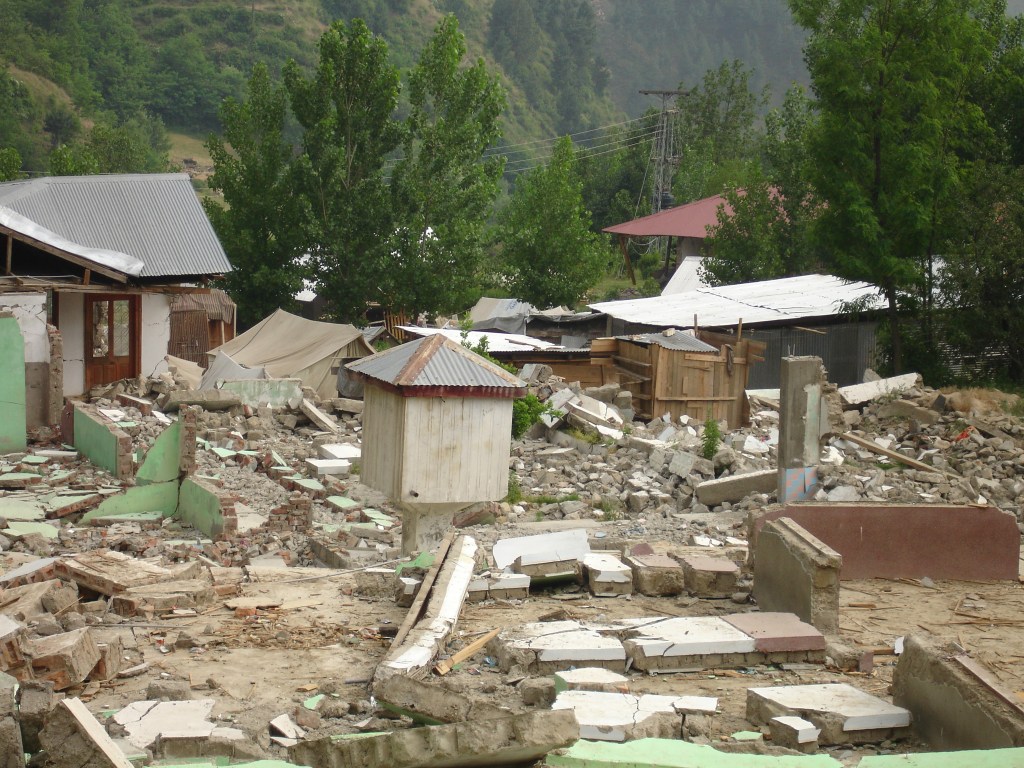
In 2005, Pakistan suffered a devastating earthquake. I was invited by the Pakistani Ambassador to the USA to help with the earthquake relief efforts. Telephone calls followed and two prominent Pakistani businessmen joined me in Pakistan. As guests of high-level Pakistani government officials, we were provided a helicopter, piloted by an Army major, to tour the devastation from above. Our guide was a brigadier general. Our flight took us over the hardest-hit regions, including the India-Pakistan border. 

Afterward, I wrote a report informing them I could not develop a plan to help the victims of such devastation by passing over the area once in a helicopter. It would be necessary for me to meet the people on the ground, face-to-face. On a second trip, two months later, they provided me with a car, a driver, and a guide. 

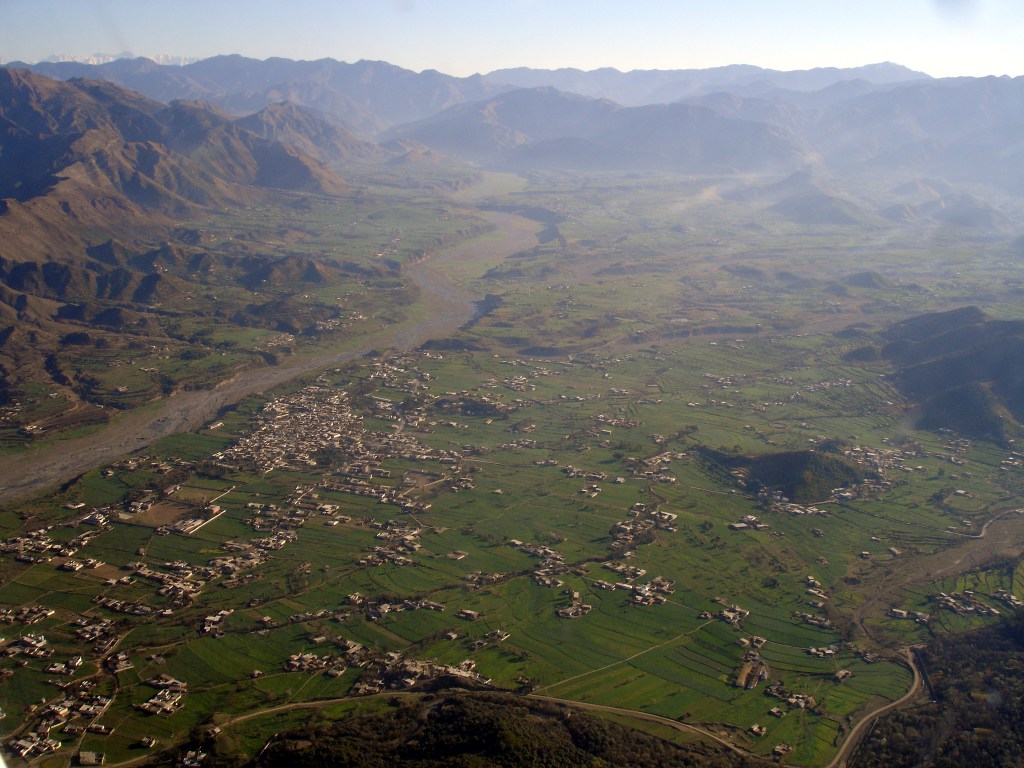
We traveled to seven villages over a widely-affected area. Many scenes were heart-wrenching. In one area, the entire mountain had been split in half, as a cake might be cut down the middle, obliterating the entire population. In another village, all the buildings had collapsed, killing everyone except the few who were out farming when the earthquake occurred. The eyes of these survivors were filled with pathos. One young man showed me the foundation of his small house in which 11 of his family members were killed.

“What am I doing here?” he pleaded. 

We traveled to seven villages over a widely-affected area. Many scenes were heart-wrenching. In one area, the entire mountain had been split in half, as a cake might be cut down the middle, obliterating the entire population. In another village, all the buildings had collapsed, killing everyone except the few who were out farming when the earthquake occurred. The eyes of these survivors were filled with pathos. One young man showed me the foundation of his small house in which 11 of his family members were killed.

“What am I doing here?” he pleaded. 

We all prayed around the foundation of the old mosque that was no longer standing. 

One of the villages was at an elevation of 7,000 feet. The government had arranged for us to have a guide from a nearby area because this was a dangerous part of the country, reported to be infiltrated by the Taliban. Several years before, President Bhutto had tried to visit, but the people stood with their guns pointed at the helicopter in the air. Bhutto had to turn around. A few days before my visit, a Pakistani wedding party was killed by American aircraft. The American government had apologized for it as a grave mistake, but the people were certain it was intentional. Emotions were high. 

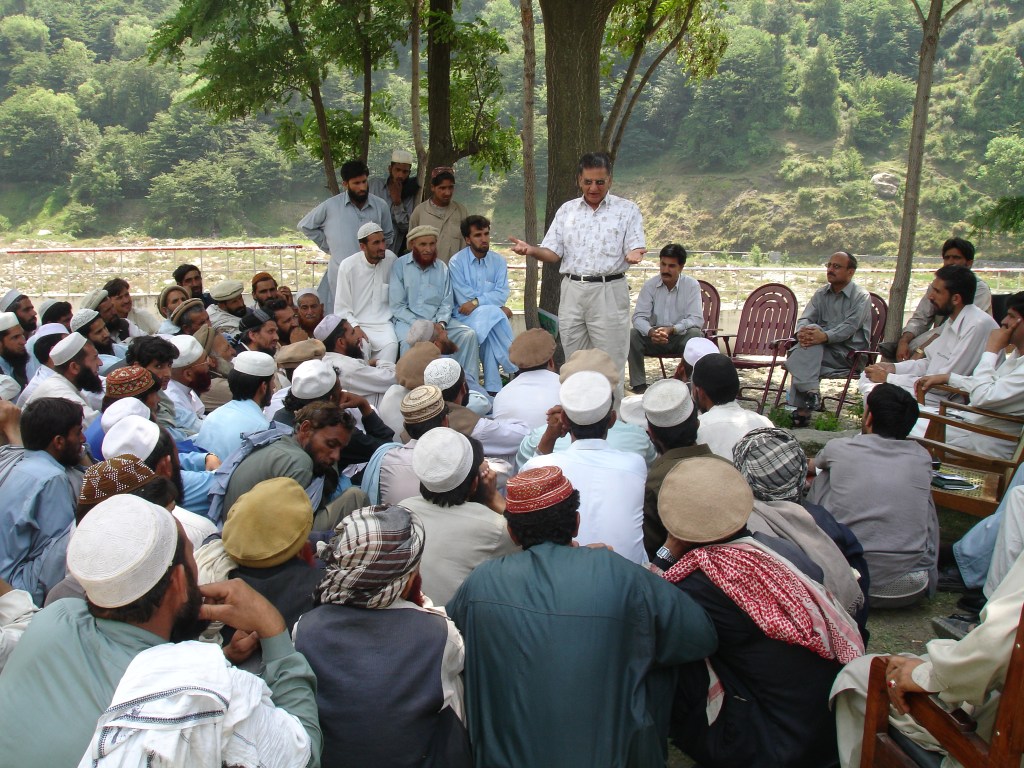
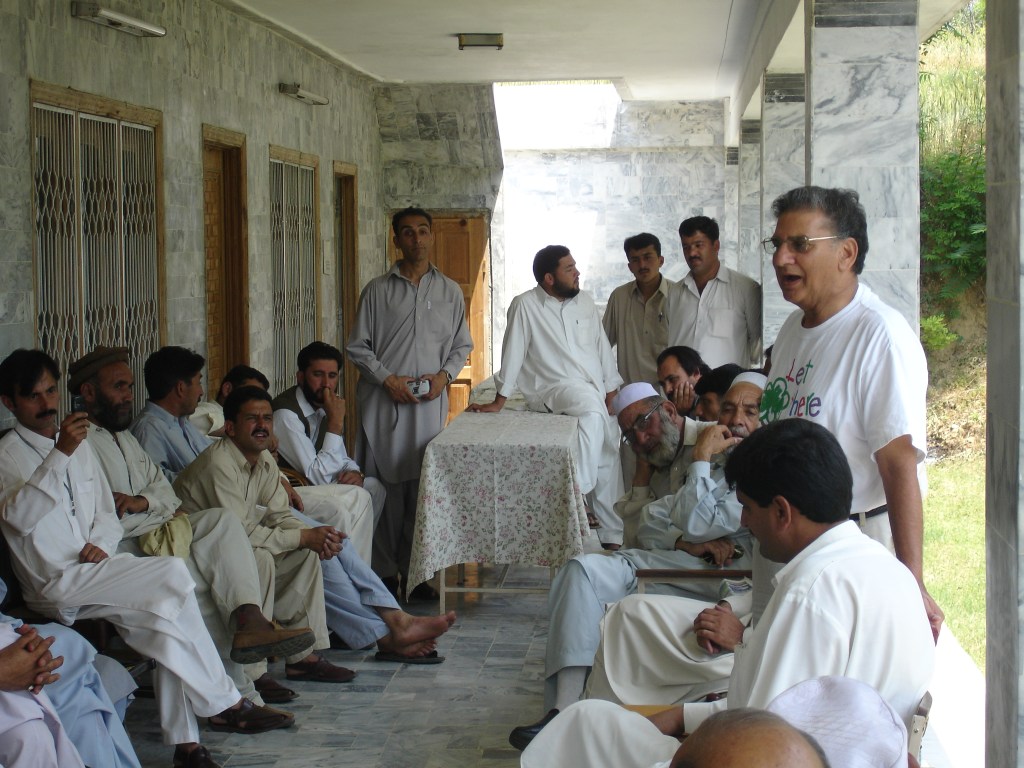
More than 50 men gathered to meet with me. Among these tall, sturdy mountain people was a  thin man, about five feet tall, wearing a black turban. The guide told me he was their Mullah, the spiritual head of the community.

“Whatever he says becomes law,” the guide said. 

I was told I should speak to the people only through the local guide. I was supposed to pretend I was from Pakistan. They didn’t want anyone to know I was from America.  

I refused to go along with that. 

“People can sense deception,” I said. “That would defeat the purpose of my coming all the way here.”

It was a risky move, but I chose to address them directly. I remembered that the source of fear in human interaction is protecting lies. I had to be honest with myself and with them.

“I am a Hindu,” I said, introducing myself. “I lived as a child in what is now Pakistan. I moved to the United States, and I have an American wife.” 

I saw my companions wince. 

“If you are waiting for the government to help you, nothing will happen. In the long-term, you must help yourselves. If you do not, you will always be poor and dependent on the government. If you rely on others to help you, they will give you crumbs. They cannot give you the honor, dignity and respect that you have inside of you.”

It was the same mantra of self-help that I had shared over and over again since the beginning of my work in the Indian villages. 

The message spoke to these proud people and their long tradition of independence. I could see the message connecting.

When I was through, the man in the black turban stood up to speak. 

“We have lived in this area for thousands of years,” he said. “No foreigner knows this area better than us. There is nobody who can give us advice about what we should or should not do. We are survivors. We have overcome many problems in the past, and we shall meet this challenge also.” 

The Mullah’s voice was strong and firm, far larger than his physical size. His tone was defiant. By this time, I was sure I had made the wrong decision, perhaps putting the entire team in danger.

He continued, “But here is our brother from America, who is surrounded by all the worldly comforts anyone could imagine, yet his heart is so touched by what has happened to us that he has come all the way from America, leaving his wife and children, to help us.” 

I thought he was making a parody of my coming there. He wasn’t finished. 

“Allah asks us to listen to people of pure heart. In the name of Allah, we must welcome our friend and pay attention to what he has to say.” 

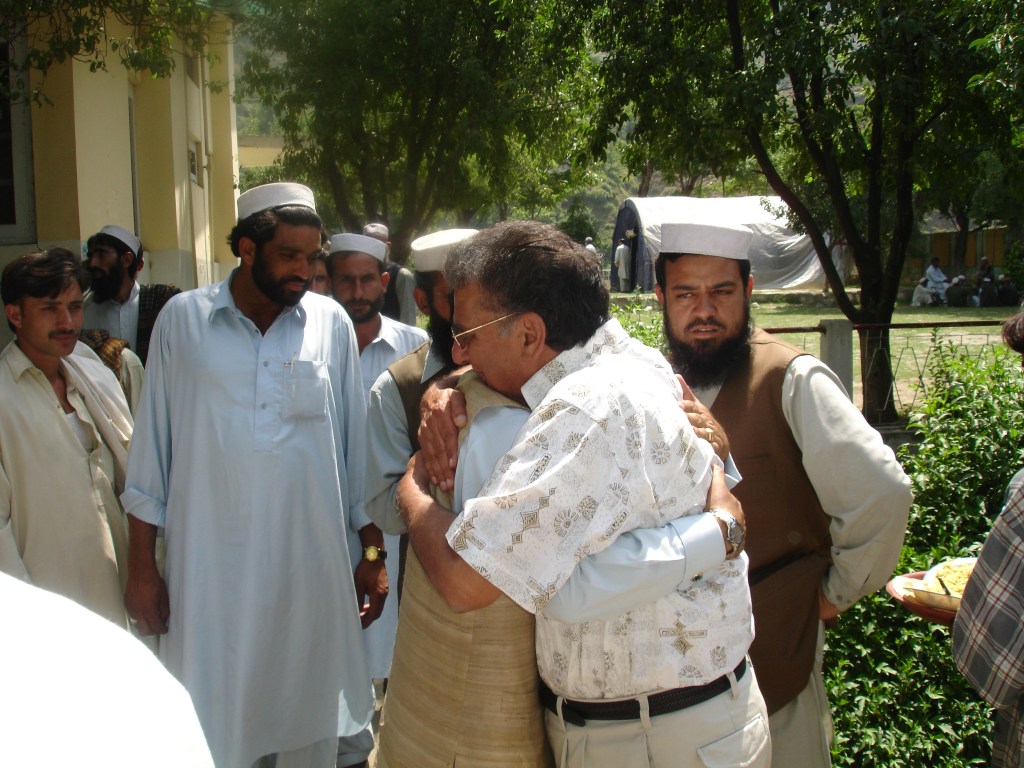
They gave me the closest thing to a standing ovation. Every man, wearing their oversized turbans, got up and gave me a bear hug. The village head insisted that the community put on a feast for me and sacrifice a sheep in my honor. I laughed and told them it was my misfortune because I was a vegetarian.

“In that case, my wife will fix channa daal (lentils) for you,” he said. He was insistent. “When people such as you come, we cannot let them go so easily.” 

If not for meetings I had on my schedule for the next morning in the capital, I wouldn’t have been able to resist that once-in-a-lifetime invitation. After we had driven a few miles from the village, our team, which was now in three cars, made a pit stop. The team members were almost giddy with what had taken place. 

When it was just the two of us, the driver who took us to the seven villages confided his thoughts about the trip. He was born in the area.

“Sir, the moment you leave, nothing will happen,” he said. “I have been a government driver for a long time, and I know how officials make big plans and promise everything under the sun. However, there is no intent behind it and thus nothing takes place. I am witnessing the enthusiasm you have created. Please stay in Pakistan to make sure these things can take place. People will get things done while you are still here,” he pleaded.  

“I cannot stay here,” I said. “I have a wife.”

“Call her here. You cannot leave this place or all the work you have done will come to nothing.”

“It will not be safe for her to stay here,” I said.

“She will stay with my family, and she will be under our protection,” he assured me. 

“Our work is not through the government,” I explained. “We are dealing directly with the people. It is a vision, not a task to achieve. Let’s see what happens from this trip,” I told him. 

On the day before I was to leave Pakistan, the government minister threw a big party for me. There must have been two dozen government officials. They had at least 20 vegetarian dishes made just for me. I was the only one partaking.

A government minister, other than my host, came over to me and asked me to have lunch with him the next day. When we met, he asked, “Mr. Mathur, we are both Punjabi. Be frank with me. What portion of the money do you want from this?”

The purpose of all that wining and dining became clear. They were expecting me to attract large grants from the United States for Pakistani relief efforts, and they wanted to know what my cut would be. In developing nations, a large percentage of monies intended to help people in need go to line the pockets of government officials.

“I have come simply to help my brothers and sisters in Pakistan who need my help,” I answered. 

With that, lunch was over. He left me, and I finished lunch with his assistant.

Three months later, I was back in Pakistan on another matter and paid a courtesy call to the government minister. The same driver who had warned me nothing would change when I left happened to be in the parking lot. When he saw me come out of the building, he started to run towards me from the other end of the lot. He was over six feet tall, a huge man. Against all protocol, he lifted me off my feet in a bear hug. 

“Sir! In those villages, they have started the work. They are not waiting for anybody!” he said. “They are not waiting for anybody!”

He had seen with his own eyes what happens when people feel inspired. He had become a convert.

Finding Your Cockroach

Trees for Life was called to help the village of Tisma, Nicaragua. After visiting the farmers in the village, I received a message from the women. They wanted their own time to meet with me.

Later that evening, when their housework was done, 18 women gathered in one of their homes. They explained how bad their situation was. The official unemployment figure for the village was 60 percent. The men couldn’t afford to get married. The women would get pregnant, have babies, and then couldn’t find jobs because no one would hire them. To make enough money to put two meals on the table for their families, some women had to engage in prostitution. All their stories were depressing. 

After patiently listening, I told them that during my travels around the world I had heard the story of the plight of women everywhere. It made no difference if I was in Asia or Africa or Latin America. The world was caught in the deadly trap of poverty and despair.

“Let me tell you a story,” I said.

There was a young brash king who got angry at his wise old counselor, Ramsu, and ordered him locked in the top of a tall tower to die.

Wailing in despair, Ramsu’s wife came to the bottom of the tower to say goodbye, for no one had ever come out of the tower alive.

Ramsu told his wife there was no need for tears. He asked her to find a cockroach and bring it to the tower.

“A cockroach? Are you crazy?” his wife sobbed.

Ramsu assured her that if she did what he asked, he would soon be free. Still shaking her head in disbelief, the woman found a cockroach. Ramsu asked her to tie a silk thread to it and put a touch of honey on its antennae. Once she had done that, he asked her to put the cockroach on the side of the tower, pointing its head upward. 

The cockroach, smelling something sweet, started crawling upward to reach the honey. When the cockroach reached the top, Ramsu picked it up and untied the thread. He then called down and asked his wife to tie a cotton thread to the silk thread.

Once that was done, Ramsu carefully pulled the silk thread up the side of the tower, till he caught hold of the cotton thread. Then he asked his wife to tie some twine on the other end of the cotton thread.

Again, Ramsu carefully pulled the cotton thread up the side of the tower until he could take hold of the twine. Then he asked her to tie a rope to the twine.

He quickly pulled the twine up until he had the rope in his hands. He secured the rope and climbed down the tower to his overjoyed wife. The old couple happily escaped together.

The outraged king wanted to know who in his kingdom could throw a rope that high. He ordered a contest in which the best and most powerful people in his kingdom were asked to throw a rope to the top. No one could. For the past one thousand years, every year, a contest has been held to see if anyone can throw a rope to the top of the tower. None of the strongest people in the kingdom have been able to match the feat of a tiny cockroach.

I acted out the story dramatically, even standing on a chair to act as Ramsu looking down from the top of the tower. I climbed off of the chair, to act the part of his wife, sobbing and bringing the cockroach. Each sentence was then translated into Spanish. The women sat listening with rapt attention. At the end of the story, they all stood up and broke into the playful Spanish song, La cucaracha, la cucaracha…. There was a shift in the whole dynamic of the evening.

The women started to discuss the implications of the story. They figured that even in the most hopeless conditions there is a way out. They just had to take the initiative and not get discouraged. They had to start small and solve their problems one step at a time.

Once the women reached this collective insight, they decided to address one problem in the village: how to help the street children. Too poor to afford school, such children took to the streets and had no hope for anything better in their future. The women decided that they would start a small primary school for the street children. They would raise funds for the school by doing odd jobs and selling meals at their village fair. 

Their own initiative and determination, plus help from Trees for Life donors, made their dream a reality. Once the dream of the school had been realized, the women decided to create a community library, another dream that came true. They continued to find the cockroach for other problems they wanted to solve. They rekindled the spirit within themselves—and in their community. They began to call themselves Las Mujeres Milagrosas: The Miraculous Women.

Whose Trees for Life?

I learned my lesson from what happened to Trees for Life in India, but not before a similar situation occurred in the U.S. 

I strongly believed that businesses and environmentalists should work together. I had written several letters to various corporations suggesting partnerships. 

One day, I had just received a “No” through a phone call with one corporation when the phone rang again. It was the senior vice president of another well-known, multi-brand, international conglomerate. I assumed the call was a second “No” to my letter. I was in for a surprise. 

“I just came out of a meeting with the chairman. He said we need to be involved in the environmental movement, especially with students, and here is your letter,” he said. “It answers exactly what my chairman asked me to do. Can we meet?”

I told him I was leaving the next day for India for four months.

“Are you going through New York?” he asked.

I had a four-hour layover at Kennedy Airport. I agreed to meet him in the airport lounge. He brought along the corporation’s vice president of advertising. They handed me a check for $25,000 soon after we sat down.

“We want to support you,” they said, enumerating some of their ideas for how they wanted to work with us. “When can we meet again?”

After I returned from India, they came to Wichita. This time they were joined by the vice president of public relations. David Kimble, our executive director, picked them up at the airport in the junker station wagon that had been donated to Trees for Life. The headliner of the car was ripped and hanging down above David’s head. During the drive from the airport, they talked about their cars. One of them had just received a $100,000 car as a company bonus.

Because our office in the church was too small, we scheduled our meeting in the boardroom of a corporation with headquarters in Wichita. The former president of this company had been my professor and a friend, so he arranged for us to hold the meeting there. The mayor of Wichita attended, as well as the vice president of advertising for the local newspaper.

The corporate guests had prepared 20 large posters with artist renderings of the types of pictures that would appear on the covers of the company’s products promoting the Trees for Life message. They said Trees for Life would become a household name. The storyboards were spread out all over the board room. As part of their promotion, they said we could expect up to $8 million to Trees for Life annually.

After the meeting, I had a long chat with a person who had attended the meeting. I needed a sounding board.

“This will kill Trees for Life,” I told him, but I could not articulate my uneasiness. 

“You are having a fear of success,” he said.

“Whatever it is, I don’t have a good feeling about this,” I responded. It was not what I had conceived of for Trees for Life.

The day after our meeting, a reporter from the newspaper wrote an article about the corporation joining hands with Trees for Life. I had no problem with the article. 

A good friend of mine, who understood my motivation for starting Trees for Life, called me on the phone. He was incensed.

“You have sold out to commercial interests!” he said.

I tried to interrupt, but he hung up before I could explain. He never spoke to me again.

After a few weeks, I was invited to meet with management at the corporation’s headquarters. The management put up a grand presentation in their executive conference room. Even divisional managers had been called in to the meeting. Eighteen executives dressed in suits sat around the table. A new set of much improved storyboards were on display. They were well done, except for one added detail. Now, Trees for Life was mentioned as their Trees for Life.

At that moment I knew the reason for my discomfort. For a promise of $8 million a year, they were buying us. Now I would be serving their corporate interests. Our mission was to empower people at the grassroots level. I had left the corporate world to serve the poor, not to be bought by corporate interests.  

After the meeting, I told my host, “I’m sorry, but we are not for sale.”

5-Star Hotels and 7-Course Meals

Unusual events–what I called miracles–kept happening, keeping me in a state of awe. 

A college friend was the chairman of a large international conglomerate in India. During a breakfast meeting, we caught up with each other. I told him about Trees for Life.

“We should be helping you,” he said. “How can my company help?” 

I told him our biggest need at that time was cash. 

“What is your annual budget in India?” he asked. 

I answered,  “300,000 Indian rupees,” which was $30,000.

“Fine, we will give you that,” he said. “What else do you need?”

“We don’t have an office in New Delhi,” I said.

“Ok, you can use my office in New Delhi. It is equipped with everything, including secretarial staff. I use it only when I am there, which is quite seldom.” 

“What else?” he asked. 

“I don’t have transportation,” I said.

“You can use my company cars,” he said. “Just call the office, and they will send you a car with a driver.”

His company owned some of the best hotels in India. He told me his office would also make sure I could stay at any of these hotels as his guest. In our next meeting, I invited him to join our board of directors, an invitation he gladly accepted. During a subsequent meeting, I suggested we strengthen our board by inviting some of his colleagues to join. He brought in the president of a major engineering company and the president of a large tea company. They were delighted to be on our board and participated actively. The equivalent would be having the chairman of Marriott, Bechtel Engineering, and Kraft Foods on our Trees for Life India board. 

Now shortages were rare. There was a fleet of four cars to receive us at the airport or railroad stations. We stayed in the executive suites at 5-star hotels and the guest houses of various companies, and we dined at the best restaurants. Our board meetings were held in their boardrooms, where we were served by waiters wearing turbans and all their paraphernalia. The curtains were parted electronically before the seven-course meals were served. When Treva came to visit me during a long stay at one of the hotels, hot water was filled in the bath tub for us when we arrived. Private planes took us to some of the Trees for Life project sites and landed back at the companies’ private airports. Our work spread quickly, which meant adding more staff, including a country president. This went on for three years, while I continued my frequent trips to oversee the Trees for Life work in India.

This was opposite of who I was and what I wanted Trees for Life to be. Before this, I was eating peasant food with the villagers and sleeping with them under the trees. I was walking for miles and traveling by bicycle. I was helping lead groups of villagers in discussions to identify the crux of their problems to determine how they could solve them. Now I was living in the lap of luxury.

Our new staff members were comfortable with this new style and wanted to proceed in that direction. 

I became uncomfortable. Something had to change.

A powerful dream helped me articulate my problem. In the dream, I was driving a large motorbike at a high speed. After having traveled some distance, I realized I was going the wrong way. With some effort, I was able to turn the powerful bike around and find my way back. I was feeling bad for losing so much precious time because I was on an important mission and time was of the essence. Then a voice told me it was a diversion that I had to take to learn some important lessons. 

After the dream, I requested a meeting with the board.

“Trees for Life has to be a people’s movement, not a corporation,” I told them. “My meetings need to take place under a mango tree in a village and not in corporate board rooms.” 

They were amused. After all, it was their country, and they were providing all the resources.

“How are you going to get the money?” they asked.

That was the least of my concerns. I was on the wrong path and needed to get back on track as fast as possible. At the end of the meeting, they all agreed to resign. That night I had one of the best sleeps in my life. I was back home where I belonged.

Earth Day and a Gypsy King

The tree kit campaign had more than exhausted our financial resources, as well as our tiny staff of volunteers. However, after witnessing its success, everyone at Trees for Life was flush with enthusiasm and felt the need to celebrate Earth Day with an event to let our presence be known in the community.

Though the green movement had been around since the 1970s, 1990 was the first year Earth Day had become a public event. The corporate world was eager to find a place to get involved. We were delighted when the largest grocery store chain in the state, the telephone company, an international soft drink company, and half a dozen other businesses in town joined us. We requested their public relations and advertising people design this event. 

Since we had the best minds pooled together, I delegated the process to them. The theme of Earth Day that year was on recycling, so they decided to put out a call to the citizens of Wichita to drop their empty aluminum cans at a central place. The proceeds from the sale of the collected cans would go to help fund Trees for Life. Some of the sponsors would provide publicity through their own channels.

I was livid when I heard this. 

“You won’t have any cans!” I said to David Kimble, Trees for Life’s Executive Director. “People don’t do that sort of thing today!” 

I could not understand how an eminent group of advertising people did not realize such an event would be a fiasco. My experience had taught me that while people might come to attend an entertainment event, they would not come to drop empty cans. We were now in the age of communications. Before the communications revolution, people went to events. Now the events came to their living rooms on television. Getting people to travel somewhere to drop empty cans would not happen.

But I did not wish to go back to this team and tell them that. Thus, I was looking forward to a big egg on our organization’s face. 

The telephone company erected a huge wire cage near downtown. Sponsoring businesses paid for billboards and advertising. A large stage was set up near the can-collection point. Everything was done. A day before the event, there were just a few dozen empty cans in the cage, dropped by an elderly gentleman. I was perhaps the gloomiest person on this planet. 

Then the phone rang. It was 10 am. 

The man on the other end of the line told me his name and that he owned a can recycling company in Wichita. “You guys are doing something with cans on Earth Day, and I would like to be a part of it,” he said. 

I listened listlessly because I expected him to offer to buy the cans from us, and we had no cans. For me, the negative was starting to manifest itself even before the event. 

“I am also the king of the Gypsies in Wichita,” he said. “We Gypsies don’t get any respect. I want to show that we are a caring people. Would you allow me to participate in the event?” 

I was stunned. “When can we meet?” I asked.

“I’ll come over right now,” he replied.

Dressed in a well-fitted suit, a short, dapper man walked into our office. This man, in his fifties, took off his hat as he entered the room and greeted me. A familiar vibration went through my body. I could tell he, too, felt something. We became instantaneous friends, as if we had known each other all our lives. I wasted no time in sharing my misery with him and we cooked up a plan. 

I asked if he would be willing to put a trailer load of his cans in the cage.

“The cans belong to you and they will be returned to you in 24 hours,” I said.

“Yes! I will do that tonight!” he assured me. “I better get busy, time is short.”

He left within 15 minutes of his arrival, with the assurance that the secret would remain with him. That night I tossed and turned in my bed, doubts creeping into my mind: He is a stranger, and I have no idea if he is for real or not. Does he really own a can recycling company? Will he fulfill his promise? Will I ever see him again? 

Before sunrise, I drove to the site, praying for a miracle but bracing myself for disappointment. I shook my head with disbelief and smiled at what I saw. The wire cage was filled to the brim with tens of thousands of empty aluminum cans. 

I went back home, had my breakfast and read the newspaper, as if I didn’t have a care in the world. 

Later that day, several hundred people showed up for the event. It turned out to be the only Earth Day event in Wichita. Volunteers were guiding the traffic. Speeches were made, songs were sung, a big globe balloon was sent aloft. The president of the telephone company came from Dallas. He and one of our Kansas congressmen were hoisted high in a cherry picker to empty into the cage a large sack of cans collected at the telephone company. The PR people who had designed the event were delighted with the success of their plan and its perfect execution. My friends told me I had worried for nothing, that everything had a way of working out. 

Indeed.