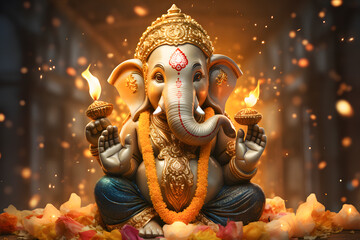
The Dead Snake: A Diwali Story

I grew up in India’s culture of oral storytelling. At the time, there were very few books, and stories were told by word of mouth.They were a living thing. No morals were told with the stories because each person at different times in their life drew different meanings or conclusions from these stories. 

As long as my mother was alive, I looked forward to hearing her tell this story of The Dead Snake during every celebration of Diwali (the Hindu Festival of Lights). My mother had been told this story by her mother-in-law. My mother told it year after year with great reverence and solemnity—not with the lightness that I am going to tell it here. After all these years, this story still remains one of my favorites. 

Once upon a time, a learned man had been out of work for quite some time. As a result, the family had used up all their savings, owed money to shopkeepers, and had to depend upon their neighbors and friends for their daily sustenance. 

Tired and fed up with such poverty, one night the wife insisted her husband go and look for a job the next day. In the morning after the learned man had taken his shower and gotten dressed in his best white clothes, as was the custom of those days, she walked him to the door. 

“Do not come back empty handed; take the very first thing you find,” she admonished him as he left the house. Personally, he had no hopes of finding a job. 

The man had hardly gone a hundred yards from his home when he found a dead snake on the street. 

The man picked up the lifeless snake and brought it home.

“What on earth is this?” croaked his surprised wife, who had just started to get ready for the day. “And what are you doing back home so soon?”

“You told me to take the very first thing I found. Well, I found this snake and I brought him home.”

“Stupid husband of mine, that is not what I meant,” shouted his wife.

The husband quickly changed into his house clothes and settled down to read. 

Exasperated, his wife picked up the snake, took it out to the courtyard and gave it a hard and wild toss. She did not realize that the dead snake ended up on their roof. 

Later that morning, the queen of that land was being readied by her maid servants for a bath in the garden tub. They had just removed her diamond necklace and put it aside when an eagle flying overhead saw her necklace glittering in the sunshine and swooped down to pick it up. 

There was a commotion in the queen’s quarters, but the necklace was gone. The king’s town crier was sent out to make an announcement that the queen had lost her diamond necklace and anyone returning it would be handsomely rewarded. There was no internet or television news flashes in those days, so it took the town crier the whole day to make this announcement far and wide.

Meanwhile, the eagle realized that all that glitters is not food. It saw the dead snake on the roof of the poor couple’s house. The eagle swooped down once again, this time to trade the diamond necklace for the dead snake. 

The roofs in India, where it does not snow, are flat. People often sleep on the roof during summer when it can get very hot inside the house. In those days there was no air-conditioning nor electricity for fans. That night, when the learned man and his wife went on the roof to sleep, they found the glittering diamond necklace. They knew whose necklace it was and were afraid that the king might think they stole it. All night long they could not sleep. 

The next morning, mustering all his courage, the husband  took the necklace to the king and, to his surprise, he was, indeed handsomely rewarded. Obviously, his wife was very pleased with this turn of events. She asked her husband to buy all kinds of food for a celebration and oil for their lights. She asked him to settle all their debts, and she spent the whole day preparing sweets for the friends and neighbors who had helped them during their hard days. 

For months and months, they had had no mustard oil to burn in the diyas. Diyas were small, earthen candle-like lights that burned vegetable oil. During that time there was no kerosene and, of course, no electricity.

That night the couple decorated by illuminating each and every room with diya lights, including a light in the “mori,” a small hole in the wall where it joins the floor. 

On that same night, Lakshmi, the angel of prosperity, went out into the universe to take a stroll and happened to pass by the earth. There she saw darkness everywhere but, in one house, she saw light. Curious, she stopped by and knocked at the door.

“Who is that?” asked the learned man, who was joyously reading by the new lights.

“It is Lakshmi,” came back the soothing voice of the angel.

“Go away,” the man answered. “Material prosperity is fickle. I do not want you. I would rather have knowledge.”

“Let me in; I will not leave you,” Lakshmi assured him.

“You always say that to every person you visit,” the man answered, more determined than ever.

Lakshmi was not used to being rejected. Instead, everyone prayed for her presence and welcomed her with open arms. She was curious to see the person who would reject her offers. She walked around to find an opening to the house. All doors were shut. Then, Lakshmi saw a little flicker of light in the mori opening. She went in through the mori and promised the man that she would never leave their house. 

And, as stories go, the couple lived happily ever after.

XXXX

I’ve picked up a lot of dead snakes in my life! And I’m not unique. 

I invite you, the readers, to share your story of how a small event led to a major change in your life: “What dead snake did you pick up?”

This will be an act of love for which I will be grateful. 

Leave your comments here or send your story to balbir@treesforlife.org.

The Fish Man

A work of fiction by Balbir.

Once upon a time, in a faraway land, there lived a young man named Ramsu. He loved to travel. On one of his travels, he came upon a lake so large its distant shores could not be seen. This lake was filled with fresh water. Beautiful fish of all kinds swam leisurely in the deep, calm waters that reflected the clear blue sky above.

On the shores of this lake lived a tribe whose forefathers had migrated from a distant land where the water source had dried up. Those who survived the long journey and found the lake called themselves the “Lake People.”

In the land of their forefathers, the only food they could grow was cassava. Although these people had come to this land a few generations ago, they still ate only cassava. As a result, their growth was stunted and they were often sick. Many of them died young. 

Ramsu started to catch fish and roast them on an open fire at the banks of the lake. Wondering what this stranger was doing, curious people gathered around, and Ramsu shared the roasted fish with them. They didn’t know that fish could be eaten. In a short time, the health of those eating fish began to improve. 

Their tribal custom had taught them to be kind and hospitable, so they wanted to do something for Ramsu in return. He told them simply, “Teach two other people that they can eat fish.” The word spread, and the number of people coming to Ramsu in hopes of eating the new food increased. Ramsu had to work long hours to feed them all.

Then, one day, Ramsu went back to his hometown. His friends and relatives were excited to see him and hosted a great feast with all of Ramsu’s favorite foods. After many toasts with the best of wines, they asked Ramsu to tell about his experiences, for he had been gone a long time. With great enthusiasm, he told them about his stay with the Lake People. 

Someone raised his glass and offered a toast, “Here’s to the Fish Man.”

Another person asked, “Fish Man, how many fish did you catch?”

“Let’s see,” Ramsu answered. “I caught between 20 and 30 fish each day to feed the people. This I did for at least a year, so I must have caught more than 6,000 fish.” 

“Wow,” everyone gasped.

“How can we help you, Fish Man?” they asked.

“I need some fishing rods so I can teach people how to fish for themselves.” They gladly provided him with all that he could carry, which was only a handful.

Back at the lake, the people were thrilled to learn how to fish. Now they could catch more fish, and more people could be fed. In their generosity, they wanted to do something for the Fish Man, but he insisted only that they just teach two others how to fish.

Catching fish was exciting and there were more people wanting to fish, but Ramsu had been able to bring only a handful of fishing rods with him. So he went back home again. Because the tales of his work had spread and he had become known as the Fish Man, more people gathered to see him. After the feast, one person from the crowd asked, “Fish Man, how many fish have you caught?”

Ramsu explained that he was no longer catching fish; instead he was teaching the Lake People how to fish for themselves. They liked the idea. “How can we help you, Fish Man?” they asked. They had expected to send with him many more fishing rods, but instead Ramsu asked if they knew anyone who could teach him how to plant bamboo.

“Plant bamboo?” they asked, puzzled. 

“So people can make their own fishing rods,” Ramsu explained. The people were disappointed that they could not give him more fishing rods and none of them knew how to plant bamboo.

Finally Ramsu found one old man who knew how to plant bamboo. No one had ever asked the old man for that knowledge before. He was delighted to help Ramsu and even gave him a handful of stock to get a plantation started near the lake. He lamented his old age and said he wished he could have gone with Ramsu.

Back at the lake, Ramsu organized a small group of youth to plant and take care of the bamboo plantation. When the bamboo crop reached a sufficient height, Ramsu went back home again. 

This time there were fewer people at the feast and the quantity and quality of food had diminished. After dinner someone asked, “Fish Man, how many fish did you catch?” Ramsu told them that thanks to the fishing rods, people were now catching their own fish. “I have not caught many fish myself because I’ve been busy planting and taking care of the new bamboo crop,” Ramsu said.

“We thought he was a Fish Man,” Ramsu’s old aunt grumbled to his mother. “Why is he planting bamboo?” 

“Do you need more bamboo stock to take with you?” asked the old man. Ramsu did not need any more because he was teaching people how to multiply bamboo from the shoots of the original stock. Instead, Ramsu wanted to know if anyone could teach him how to make fishing rods. One person knew another person who might know someone who could teach Ramsu how to make fishing rods.

When Ramsu had learned how to make fishing rods, he went back again to the lake, teaching people to make their own fishing rods out of bamboo grown on the plantation. Again, when asked what they could do for him, he told them, “Teach two people how to make fishing rods.” 

It was not long before nearly everyone had his or her own fishing rod. However, they knew only one way to cook fish—to roast it. Ramsu realized that a wide variety of fish recipes would enhance the interest of the people. 

Ramsu went home again to find a chef. This time there was no feast. One passerby in the street asked him, “Fish Man, how many fish did you catch?” There was sarcasm in his voice. Ramsu just smiled.

An old retired chef was glad to take the opportunity to travel with Ramsu. A culinary school was started at the lake. People from all around the lake came to learn. Following Ramsu’s tradition, the chef asked each student to teach two others. 

After some time, Ramsu went back home again. This time he was looking for someone who could explain to people that fish were not only delicious but also good for them because it would make them grow stronger and live longer. 

Those who met Ramsu on the street asked, “Fish Man, how many fish did you catch?” They grumbled, “The Fish Man has become confused and does not know what he is doing. One day he was catching fish but he lost interest in that, then he became a farmer but lost interest in that and became a chef. Seems like now he has lost interest in that also and he is trying his hand at something else again.” Others said, “I bet he has never caught a fish in his life. He just made up the stories.”

xxx

Many years passed and Ramsu became an old man. 

One day, Ramsu saw a young boy fishing on the lake and stopped to watch him. “Good morning old man, would you like to learn how to fish?” the young boy asked. “Don’t be afraid. You can learn it. I can teach you.”

Ramsu smiled. The boy could not have been more than eight years old. Ramsu sat down beside him, eager to learn from the young master.

“When my grandfather taught me how to fish, he told me to teach two others but I teach two people every day,” the boy said. “You are one of the two people I will teach today.”

“Who is your grandfather?” the old man asked.

The young boy pointed to a sign that said Jared’s Restaurant. “He’s my grandfather,” the young boy said proudly. 

Ramsu’s thoughts took him back many years to when he had first come to the lake and started to catch fish and feed children. There was a young boy named Jared who would not come near him. The boy always stayed at a distance, quietly watching. Over the years, Ramsu had seen Jared grow until he became the owner of a small fish restaurant. And now Jared’s grandson was Ramsu’s tutor.

The young man interrupted Ramsu’s thoughts, “My name is Jonathan, what’s your name?”

“Ramsu.” He reached out and shook Jonathan’s hand.

“You will make a good teacher, Jonathan. If you will teach me how to fish, I will teach you how to be a teacher,” Ramsu told him.

xxx

Today travelers from around the world flock to the land of the Lake People to feast on the sumptuous fish delicacies for which they are famous. Roadside stands peddle fried, roasted, and sautéed fish, as well as specialty fish dishes from Europe, Asia, Africa and the Middle East. 

There is always a line of people waiting for a table at Jared’s Restaurant. The taste and appearance of its fine entrées are enhanced by numerous cassava side dishes. The restaurant’s cassava recipe comes from Mama Jared, who got it from her grandmother, who brought it from the Old Country. Mama Jared was one of the first students at the culinary school, and the first cook when her husband started their family restaurant. But all that was more than 150 years ago.

While they are visiting the Lake People, travelers often tour the National University, known for its culinary department and its study of marine life and bamboo species. The Lake People have Dr. Jonathan to thank for founding the university. He is the same Jonathan who once taught an old man how to fish.

The Master and the Cloth 

Near the top of the mountain, I looked down. My two companions and the local guide were waiting next to the black car in which we had crossed three hills and four valleys. I could see them—they looked like mere specks—but they could not see me because of the mighty rocks and foliage around me.

I realized that, for some reason, I had to climb this mountain alone; they could not accompany me. I tried to think of the reason and could not remember, but it did not matter. I was surprised, though, that I had climbed so high.

As I turned my head to move forward, I saw a village. It had not been there a moment ago. I wondered, trying to justify its presence, if perhaps it had been hidden in the mountainside and could not be seen by anyone coming up the hill. It looked like a primitive village that had been frozen in time.

Near the edge of the village I saw a bearded man coming toward me. With him was a donkey loaded with firewood. He passed me on the narrow road without looking at me. I nodded, but he did not pay any attention. His attire caught my eye. He was dressed in several layers of warm clothes, yet he was barefoot.

I had the feeling that the man said something to me, although I did not hear any sound or see his lips move. I looked back to see him disappear around a bend. I had a funny sensation that the donkey was smiling at me, even though I was looking at his rear end. I was sure that I had also heard the wood greet me. Then I realized, “Ah, I am in the Enchanted Land.”

I entered the village through what appeared to be the marketplace. It consisted of a narrow road with shops on both sides. It was a small market, and in a few moments I had walked to its end. There were some dwelling places, but they blended so well into the hillside that they were difficult to see. On the side of the hill was a house from which a little girl watched me. From her vantage point, she could see my every movement. I waved at her, but she did not respond.

I went back to the market. I observed that there was only one shop for each kind of merchandise or service. There was only one grocery store, one barber shop, one potter, and so forth. The shops were relatively well-stocked with goods, but there were no customers. Yet, the shopkeepers were engrossed in some kind of work.

The colorful display of the fabric store caught my attention—the materials were absolutely out of this world. It was obvious that the shopkeeper had not arranged the colors intentionally, but the result was striking.

I felt as if I were being drawn into the colors, as if I were being sucked into the display. I found my attention focused on one piece of cloth. It was perhaps the most intricate design and best-woven piece of material in the whole shop. Yet, there was a layer of dust on the cloth as if it had lain there untouched for ages. I wondered why such a beautiful cloth had not found a buyer. This should have been the first piece of cloth to be sold. Why did it remain on the shelf?

As I wondered, the piece of cloth spoke to me. Somehow I was not surprised. After all, this was an Enchanted Land. The cloth told me the following story.

*****

Many years ago, the people of the realm were preparing for the coronation of a young king. Special fabric was ordered for the coronation gown. As the weaver wove the cloth, he sang this song:

Oh, you common piece of cotton,

How lucky you are!

For you are the one who shall make

The mightiest of the land look even mightier.

For you shall adorn the most adorable.

For you will touch the skin of the one who cannot be touched by any other.

Oh, you common piece of cotton,

How lucky you are!

For you bring me the honor of touching you.

The weaver would sing this song with great devotion. The whole town knew when he was weaving the cloth, and they would rejoice. People stopped by each day to see the progress of the cloth. So, the cloth knew all too well what its destiny was to be.

Then, one day when the weaving was finished, an old man came to buy the cloth that was meant for the king. But the cloth would have none of that. She protested with all her might.

“But, I am the tailor!” explained the old man.

“Go away, old man!” the fabric shouted. “I know your ways. You will cut me into pieces. I am too important to be cut up. Do you realize who I was made for? Only he can touch me.”

Reluctantly, the old tailor bought another piece of cloth and left. This piece of cloth was nothing compared to the first one, but he made do. 

Day after day, the beautiful cloth waited for the king. But he never came.

On the day of the coronation the king paraded through the streets dressed in his royal gown. The beautiful cloth was shocked to see that the other piece of cloth had been made into the king’s gown. “What an outrage!” she shouted. “That was my destiny—mine and mine alone. How could this have happened?”

*****

As the cloth was telling me this story, I saw an old man pass by. His body was hunched over with age. He wore thick, bifocal lenses on wire frames. The skin on his hands was shriveled. Yet, he carried himself with great dignity and radiated an aura of love.

I was not quite sure whether I was really seeing the old man or seeing the memory of the person. It was as if he was made of a fine mist. The street was now filled with fog. I followed the man. He was aware that I was following him, but he pretended not to notice. 

The old man walked a short distance, and then went through a big gate which led into a courtyard. On the other side of the courtyard was a much smaller door and he had to bend low to get through. I followed him. On the other side, the old man was ushered into the presence of the king. I could only get a glimpse of the king, as my view was partially blocked by the tailor. The king did not seem to notice me.

The king was an old man himself, with a long gray beard. He invited the tailor to sit in a place of honor. It was obvious that the king had great respect for the man. This was the man who made the king’s clothes and made him look good. The king called him “Master Sahib.”

I went back to the fabric shop. As I gazed at the beautiful cloth, she whispered sadly, “I was the one who did not recognize the Master when he came.”

Clankety-Clank

In the summer of 1980 or 1981, Treva and I were at a Holiday Inn in Lexington, Kentucky, and there was a museum of horse racing out on Highway 75.

We were leaving that afternoon and had some time to spare before our flight, and we decided to visit the museum. It was a quick taxi ride, not more than a few miles. 

Later, after touring the exhibit, we decided to walk back to the hotel. There was a road that seemed to be parallel to the highway that would lead us back to our hotel. The road, however, meandered in another direction, and we must have walked three or four miles before we realized that we were far away from the hotel.

I became nervous about missing the flight. Now, we were on a totally back-country road in the middle of the woods in Kentucky, with no taxis, and cell phones did not exist at that time, so there was no way to contact anyone.  

Finally, we came to a country road, and I thought our hotel might be due west from that point. Treva and I were hot and tired, so I suggested that we stop there under the shade of a large tree and see if somebody would come by. We both knew it could be an hour or a day—we just didn’t know. 

After a half-hour or so I heard a car coming down the road from the east. I stood on the shoulder and stuck my thumb out in hopes of getting a ride. The driver saw me from a distance and the car gained speed, increasing the gush of dust behind. You could see from a distance that it was a blue-gray Lincoln Continental with a large radio antenna. As the car drove past me, the driver gave me a dirty look. He was obviously a man of wealth and must not have approved of hitch-hikers. He zoomed by. After another 10 or 15 minutes, the same car came back, and again he revved-up the engine and flew by us in the other direction.  

Well, I had picked up hitch-hikers all my life, and I knew that they often wait four, five, or six hours for a ride. By this time, Treva was very tired; we knew we would ultimately make it, but we were beginning to prepare ourselves for missing the flight.

Another 15 or 20 minutes passed, before we heard another car coming down the road. This car was rattling along and making a clankety-clank, clankety-clank, clankety-clank noise as it approached. It sounded like a car a newly-wed couple might drive away from the chapel with cans dragging from the bumper. 

As this car neared, it began to slow down and it stopped right in front of us. I opened the door and told the man I was looking for the Holiday Inn. He motioned for us to get in the front seat. His car was full of junk, and he had to toss material from the front seat to the back—which was already overflowing with stuff—just to make room for us.

We introduced ourselves and he nodded—he was a young man in his twenties. His manner made it evident that he was a man of few words, almost shy, and even though he was glad to give us a ride, he was not eager to talk. We were perhaps a couple of miles away from our hotel, which he covered within the next five to ten minutes.

This otherwise insignificant incident ended up becoming a guiding light in my life. As situations arose, I always had the mental image of those two cars, and I asked myself, “Am I the man inside that Lincoln Continental or that Clankety-Clank car?” For me, one was protecting his wealth and would not help his fellow beings, and the other was willing to share whatever little he had.

The second man was not concerned about me. He hardly noticed me or Treva. We could have been anyone. He was not trying to impress us either. He was not ashamed that he had very little money and practically nothing to safeguard. But he knew who he was. He had to help a stranger standing in the heat on a country road.  

Even though I can’t see his face, I see that character every day in the people that I meet. Again, it’s not about money. It’s about being willing to give someone a ride. Some people are ready and some are not. I have met many wealthy people who are ready to help.

People have asked me what my religion is, and I’ve responded, “If someone is in a ditch, would you lend a hand, or not?” If that person says, “Yes, I will,” then that person and I belong to the same religion. That is my religion.

The Rude Stranger

February 2020

I got up from my chair and said, “I’ll be back in a minute.” Chandni also started to get up from her chair and said, “Let me take you there.”

I had just arrived in New Delhi, and my cousin Chandni had invited me for lunch at their country club, popularly called “The Golf Club.” We were sitting under a large tent which had been erected for people to enjoy lunch outside during the cool winter months. Chandni knew of my macular degeneration and inability to navigate my way properly.

“No, no!” I protested. “I will find my way, thank you.”

Realizing that it was a matter of dignity for me, Chandni settled back in her chair and said, “Go inside and ask the receptionist, and he will give you directions to the restroom.”

The man at the reception desk said, “Sir, take a left, then a right, then a left again.”

The light was dim inside the club, and with my macular degeneration and shaded glasses, the light seemed dimmer than it really was. When I made the first left turn, the light got dimmer. When I turned right, the light was dimmer yet. I started to feel nervous, realizing that I would not be able to tell the difference between the men’s room door and the women’s. I could just imagine the reaction in the ladies’ room if I walked through the wrong door!

My nervousness turned into panic as I made the final left turn, because the light there was even dimmer. To me, it was practically dark. Then, with a great sense of relief, I saw the form of a gentleman about 30 or 40 feet ahead, walking toward me. I pointed to my eyes and said, “Sir, I cannot see properly. Could you tell me which one is the men’s bathroom?” He did not reply. I thought perhaps he didn’t understand me. So, when we were maybe 10 feet apart, I asked again, “Sir, which one is the men’s bathroom? I cannot see properly.” But still there was no answer. I was irritated. But I rationalized immediately: perhaps he is hard of hearing.

We kept walking towards each other. When we were face-to-face, almost a foot apart, I asked one more time, my tone now showing my irritation. No answer. I had asked three times, and no answer. I thought, if this guy isn’t deaf, he’s pretty rude!

Finally, we stood nose-to-nose. And then I realized I was talking to myself in a mirror at the end of the long hallway. I entered the bathroom, taken aback. It was a strange feeling, knowing I had been annoyed with a stranger who turned out to be me. I was glad there was no one else in the bathroom as I broke into gales of laughter!

Hitchhiker Story: On the Road to Bethany

It was a cold day in April, 1987, and I was driving north on I-35 from Wichita to Des Moines, Iowa. The temperature must have been in the 20s, and the wind was strong and gusty. The trees were swaying and cars were moving side-to-side on the highway. Even a few minutes outside was bone-chilling.

About 10 miles north of Liberty, Missouri I saw a man walking on the side of the highway. I stopped to give him a ride. Slowly and steadily he walked toward my car; there was a broad grin on his unshaven face. 

He informed me that he had been walking for the past eight hours—since midnight. He was grateful for the ride, even though he was now only eight miles from his destination.

I had barely dropped him off when I saw another person seeking a ride. He turned out to be a clean-cut, tall, handsome person in his late 20s. His name was Bob. He had driven to Texas to see his girlfriend, ran out of money, sold his car, and was returning to Minnesota. He had walked for six hours that day before getting this ride.

He told me that he had grown up on a farm in Minnesota and had always thought that he would be a farmer. Now, since farming was dead, he was trying to find himself. Not knowing what he wanted to do in life, he signed up to go to Vietnam, where he served as a medic. He was now suffering from Post Traumatic Stress Disorder. Invariably, he told me, he woke up with the same nightmare: His unit arrives at a Vietnamese village where American soldiers have been injured. He rushes to a badly injured patient in need of immediate medical attention. He opens his bag and finds it empty. Then he hears the shrieks of the patient, which wakes him up in cold sweat, realizing that he was the one shrieking. “I can no longer go to sleep during the night, concentrate on anything and form any relationships. That was the reason things did not work out with my girlfriend,” Bob told me.

Bob continued to share some aspects of his life as our car sliced through the cold wind on the plains of northern Missouri. He told me that this was the first time he had hitchhiked. He had never given rides to hitchhikers himself, but this experience had taught him to be far more generous in the future. He repeated that statement several times as if to make sure he would never forget it. This trip had been an eye-opener for him.

In my mind’s eye, I tried to imagine how, racing along in his heated car, listening to the loud noise of rock music and engrossed in worldly thoughts, Bob must have always flown past the hitchhiking “miserable lot.” I wondered if he had ever given them a second thought.

I glanced at Bob. His face was solemn. I felt I had a sense of how he might be feeling. I also seemed to have a sense of how different his feelings would be from only a few weeks ago, when he drove on that very highway toward Texas. He might have said of someone with his thumbs up, “These are lazy bums.”

Bob also must have justified his attitude toward the hitchhikers in the name of security. Do we worship security rather than God? Do we sacrifice our humanity on the altar of safety? Do we fly past the reality of life like blind robots?

As we passed the exit to the small town of Bethany, we saw another person wanting a ride. 

“Would it be OK with you, if we take him also?” I inquired.

Bob nodded his head to give his approval and, as we pulled over, he briskly opened the door to the passenger side and jumped out to help the stranger squeeze his duffle bag in the rear seat.

I was struck with the similarity of Bob’s duffle bag and that of the newcomer. I think Bob was also impressed, for he immediately proceeded to tell the new addition to our traveling crew that he, too, was a hitchhiker and asked him how long he had been waiting for a ride.

The newcomer’s name was Bill. He had received a ride up to Bethany the night before. He had been waiting for four hours on the highway to get a ride. Interesting combination, I thought: eight hours, six hours and now four hours.

Bill continued to tell his story. He had been in a small town in Tennessee when the police arrested him for hitchhiking and locked him up for the weekend. It was the first such experience for him, “being thrown in with cockroaches and all,” he explained.

Upon reaching Bethany, Bill had called the police to find out if he could get some shelter at the Salvation Army. The police officer suggested he spend the night at a local laundromat run by an elderly couple who would not mind. The police officer apologized that there was no other shelter in their small town and told Bill that he wished that the town had some budget to put him up in the motel for the night.

In the morning, the owner of the laundromat woke him up saying, “Son, time to wake up.” Plus he gave Bill a dollar for a cup of coffee.

Upon hearing the story, I felt my eyes had moistened and I had to wipe my nose. I was touched beyond words. Treva had sent a couple of sandwiches and a couple of pieces of fruit with me. I asked Bill to hand me the sack from the back of the car. I offered it to Bill and Bob, who ate in silence until Bob said, “Best meal I have ever had.”

Then he turned around and said to Bill, “I have met more interesting people on this trip as a hitchhiker than I had met all my life on the farm. This trip has been an eye-opener for me.”

On my way back home a couple of days later, I made a point to stop in Bethany. I wanted to meet the owner of the laundromat. Fortunately, he was there when I arrived. He was fixing a machine near the door and saw me drive up. Reverentially, I stood there in silence, for I was in the presence of my hero.

“Car trouble?” he inquired with a broad smile on his face. I simply shook my head to say “no.”

“If you have no troubles, then you won’t stick around here too long.” He said with a mischievous twinkle in his eyes.

I wished I did not have to say anything. I was there simply to touch him. Words stopped in my throat and I could not speak. I tried, but the emotions were choking me. Anticipating that he may not be there, I had written a small note for the owner. And sure enough, this was the time for me to hand over the note.

The old man, dressed in khaki trousers, a jacket, and a baseball cap, looked down with piercing eyes through his lenses of bifocals and read the note quickly. He had nothing to say, as he handed the note back to me. I stood there and looked at him. He sensed my discomfort and tried to make some small talk. “Yes, I remember that young man. He was a good person. Glad he got a ride.”

The interview was over. Neither of us had anything more to say. I extended my right hand and we shook hands. His grip was firm and strong. I handed the note back to him and, as I turned around to leave, I saw that he did not know what to do with it..

As I started back toward the highway, I thought to myself that I had just met The Man and hoped that I would one day meet him again when I, too, am old—perhaps in some inner part of myself.

Soon there was a road sign, reminding me that I was in Bethany. “How appropriate,” I gently whispered to myself.

Lost (and Found) in Kentucky

One day in 1979, I was traveling on Highway 75 from Richmond to Louisville, Kentucky. On the way, I took a short break in the town of London. I struck up a conversation with a man named John, a retiree and widower. Talking with strangers is one of my favorite things to do. That’s why I never used maps. I preferred asking for directions, because I met all kinds of people that way. This was true no matter where my business travels took me. 

I told John I would be traveling through London again and would love to have lunch with him. He invited me to stay with him and said he would show me around.

On my next trip to Richmond, I called John. He repeated his invitation for me to stay with him. Since he lived on a farm about 10 miles from town and had a rural route number for his address, he offered to meet me in London and lead me to his farm—especially since I would be arriving after dark. We agreed to meet at the entrance of a bridge near the Long John Silver’s restaurant on the outskirts of town. I carefully jotted down the instructions and repeated them to him. 

I reached the bridge 10 minutes early. John was not there yet. Half-an-hour passed and still no John. I crossed the bridge. No John. I rechecked the written instructions; I was at the designated place. I made half-a-dozen calls from the restaurant to his home. The phone just rang endlessly. This was a time when there were no cell phones or even answering machines. 

Growing tired of listening to the same news repeated on the radio for the umpteenth time, I said to my rental car, “The universe knows where John lives. You listen to the universe and take me there.” I patted the steering wheel as if the car were a trusted horse. And we started. 

Immediately, upon crossing the bridge, we were on a dirt road with no street lights. It was a moonless, pitch-black night. Driving along the curvy, hilly roads, the car seemed to be flying by intersections and forks in the road. While my eyes were watching the road, the rest of my body seemed to be acutely tuned in to the automobile itself. It was the only thing connecting me to the universe at that time. I could feel the slightest bump and hear the slightest sound. Most notable of all, my fingertips were throbbing. There was some kind of electricity between my fingers and the steering wheel. They were communicating in a code I could not comprehend. I just knew that my task was to be in tune and steer the car as promptly as possible. There could be no delay between the signals and my action. It had to be simultaneous. There were no thoughts or doubts. It was as if I were caught inside a spellbinding, fast-paced movie, and multitudes were watching.

After about 20 minutes of curves, twists and turns in the dark, the automobile lights suddenly turned off and the car came to an abrupt stop. I tried to restart the car several times, but to no avail. The electrical system had died. Panic struck me. I was in the middle of a dark road somewhere in Kentucky, and I had no idea where I was. Even though I had not seen a single car since I started this journey, I could imagine a truck barreling down that country road and mowing me down before it realized it had hit something. The car was dead, beyond hope. 

My logic kicked in: What on earth possessed me to make such a stupid decision? Why was I trying to meet a stranger anyway? I was waiting exactly where he told me to wait for him. Why didn’t I just continue driving to Richmond when John didn’t show up? If I really wanted to meet him, why didn’t I check into a motel for the night and call John in the morning? I had counted on stopping to ask a few people at some local stores or gas stations and continuing my journey if I couldn’t find John. A rental car failing in the middle of a country road was not in the equation! But now I was stuck. I couldn’t get out and walk, because the area was known for having rattlesnakes. How would I ever explain this stupidity to anyone? My mind was racing.

After a few minutes–which seemed like an eternity–the sky suddenly lit up. The source of the light was directly above the car. It felt like floodlights. The shadows were moving, as if something were hovering above the car. There was no sound. Was a flying saucer hovering over the car? My mind was playing tricks! I don’t know if it was the suddenness of the lights or the expectation of some terror that caused me to voluntarily shut my eyes. After a few long seconds, I cautiously opened them. 

It took another few seconds for my eyes to adjust. I could see that on my right was a house, barely two or three feet from the car. That close. What if I had run right into the house?! The source of the light was not a flying saucer, but a bright light over the house. The lamp was swaying with the breeze, casting moving shadows. The door to the house was open ever so slightly, and I could tell someone was peeking out. I imagined a hillbilly farmer with a double-barreled shotgun aimed straight at me. One wrong move and the gun would go off.

I tried to find the handle to roll down my window, but my nervous hands could not locate it. I opened the car door, just a little bit, and apologized to the homeowner for inconveniencing them in the middle of the night. I said I was lost and trying to find the house of my friend John. 

In response, I heard a deep southern drawl: “I’ll be damned.” Soon the lights in the whole house went on, and a figure appeared behind the screen door. He was wearing a sleeveless undershirt and pajama bottoms. His beer belly was accentuated, peeking out below his undershirt. No gun was in his hands.

“Who is this?” he shouted. It was obvious the old man was confused. Perplexed might be a better word. Quickly and loudly, I said my name and where I was from, and I repeated what I was doing there.

“Is that Maatoor?” he shouted back. 

I confirmed.

It took me a few moments to realize I was talking to John, himself! I had only seen him once before and did not recognize him in his night clothes. John walked the few steps over to me. He was unsteady, almost in shock. My body was also a bundle of nerves, and my legs were shaking. When we walked in his front door, the first thing I did was to look at the large grandfather clock in the room. It was exactly 10:20 p.m.

John and I exchanged our stories. As luck would have it, there were two bridges in London, and we had each waited at a different bridge.

“Ah, so you ended up taking the back roads,” John explained. 

He had just returned home, changed his clothes, and had barely tucked himself in bed when he heard someone drive up. Of all the people in the world, he could not imagine it was me finding my way to his house. He was incredulous, asking me over and over again how I got there. “Just luck,” was all I could tell him. Any attempt at an explanation would have spooked John for the rest of his life. 

The sun was pretty high in the sky when I woke up the next morning. John had already laid out breakfast on his kitchen table. After a leisurely breakfast, we went outside. I had not told John that my car had died. I made up some excuse so I could go and try to start the car. It started right up, as if nothing had happened.

“Just leave it there,” John shouted. “It’s OK there.” I knew it was.

John lived in a small, single-story cottage at the top of a hill. Both the inside and outside of his house were orderly and neat. The panoramic view down the hill was picturesque. Or perhaps my eyes were seeing things differently after the experience of the night before. Everything looked so fresh. My nerves had settled, and I felt totally at peace.

Then I saw the long, winding road up from the bottom of the hill and the sharp turn into his private driveway. I could not believe that, in the dark of night, the car had made those intricate choices. In fact, I didn’t even remember being on that road. To make sure my eyes were seeing correctly, I looked at the long, uphill road and the driveway over and over again. I was awestruck.

Standing on top of that hill, I had a feeling I was in some magic land and had just experienced pure magic. There was no other word for it. Gentle vibrations started to pass through my body, and a thought entered my mind: “The experience was the journey.”

The thought blended with the purity and gentleness of the breeze on top of the hill. I could not capture it, analyze it, or share it with anyone else. I could only experience it. At that moment, everything seemed familiar. A strong sense of déjà vu took over. It was as if I had driven those back roads many times. It became obvious that the car had not driven me. I had accidently connected to some kind of knowing. 

What that experience in Kentucky taught me was that my journey was not from point A to point B. It was to be in that space where our common déjà vu exists. For lack of words, I have called that space our psyche. But in my mind, I perceive it as the space where the Earth and Heaven meet.

I didn’t know it then, but my experience finding my way to John’s house would be a reference point for me over and over in the future: When the lights went off, it was not a time to panic but to realize, This is the place.

The Lotus Perspective

Mystics use the lotus flower as a symbol of their mission in life. The lotus flower is born in slimy sludge and deep darkness. With all the power at its command, and with single-mindedness, the lotus rises above its surroundings to enjoy the sunshine. 

The darkness is symbolic of the world we live in, and the sunlight is symbolic of where we are aspiring to go.

From a mystic’s perspective, this world was created by God. In that creation there is no imperfection. All the things we consider bad, such as greed, cruelty, crime, violence, have a purpose. It is a part of the grand design.

The lotus reminds the mystic that his or her task is to rise above darkness, without changing the darkness itself. Consider what would happen to the lotus if the murky water were to become pure and clean.

For eons, the nature of the stars has not changed. Air still performs the same function it did thousands of years ago. The birds still chirp, the sun rises and sets. Similarly, from our short perspective, human nature has basically not changed. Avarice is not new and not peculiar to this age. Thinking that it is new would be like imagining the sun had started to rise only in this age of ours and only in the United States.

For a lotus flower, the effort to rise is a personal one. It is not dependent on what others do or do not do. Similarly, a mystic does not wish to change the world in which she lives. He or she welcomes and loves the world as it is, and makes a supreme personal effort to rise above it.

The Mango Seller

Balbir was asked to contribute a reflection on the question, “Why Save Africa?” His reflection was published in a 2011 book titled “Hope for Africa.”

In the fall of 1982, I was invited to an Africa – America conference hosted by the government of Zimbabwe.

In the early 1980s, America was still fighting communism and our foreign policy regarding Africa was caught in a dichotomy. On the one hand, we were backing the South African government’s apartheid and, on the other hand, we had our eyes on the raw materials and markets of Africa. We didn’t want them to fall into the hands of communists, so we were wooing the newly- emerging African nations.

At that time, Nelson Mandela was still in prison and Robert Mugabe was an African hero.

The top echelon of African ambassadors and politicians was at the conference, along with their entourage. The American delegation included members of the State Department, high-level politicians, and businessmen. I remember names like Senator Nancy Kassebaum, Ambassador Andrew Young, Mayor Tom Bradley, and the colorful Anthony Lewis of the New York Times. But the one who stole the show was Thabo Mbeki, an exiled leader of the African National Congress of South Africa, who later became President after Nelson Mandela.

This was my first trip to the continent of Africa. When I landed in Harare, the capital of Zimbabwe, to me it represented all of Africa. After checking into my hotel, I was eager to explore “Africa,” so I hired a taxi and requested that the driver give me a tour of the city.

“What would you like to see?” he inquired.

“You’re the boss,” I said. “Show me everything.”

The driver showed me the best parts of the city, where the rich and powerful lived. After an hour or so, I asked him to show me where the poor lived. He turned around in total disbelief and told me that it was not a good idea. I could understand his reasoning. Racial tensions in Zimbabwe were very high, and this was not a good time for a foreigner to be cruising around all by himself. But I persisted in my request.

The poor slum area was not far away. It was obvious the taxi driver was not going to take me inside the slum, but I was grateful that I could at least view it from the outskirts. Small shacks with tin or thatched roofs—a symbol of poverty and slums throughout the world—were scattered all around. This was Sunday afternoon and people were sitting around in groups under shady trees or taking leisurely walks.

The scene was a stark contrast to the rich areas I had just visited. There I saw large, impressive British bungalows with manicured lawns. The homes of the Indian business community stood out because of the luxury cars in their driveways, most of which were gold Mercedes. However, there were practically no people on the streets.

Here, in the midst of poverty, there were people outside mingling with one another.

As we drove along a bumpy dirt road, I saw a woman selling mangoes. I expressed a desire to stop and buy some. Again, the taxi driver told me that it was not a good idea. He offered to deliver mangoes to me at my hotel. But to his dismay, I insisted.

The driver parked at the side of the road, and I walked across a patch of bare ground to where the mango seller sat, about ten yards away. Dressed in traditional clothing, she was sitting on the dirt under a tree with a couple dozen mangoes in front of her, a common sight in most developing countries.

By this time, the sight of a foreigner getting out of a taxi and walking towards the mango seller had attracted attention. Several bystanders crossed their arms and eyed me with suspicion, as if to say, “Who do you think you are?”

I threw a glance at the taxi driver. I could see nervousness on his face.

Once she realized I wanted to buy mangoes, the mango seller was delighted to have my business. As I paid her, she stood up and started to sing their traditional “thank-you” song. It was more than just a song—she clapped along and her whole body swayed in a rhythmic motion.

“Wait, wait, wait!” I pleaded in English, and I touched her arm to stop the action. “Please teach me.” She smiled and complied. I tried to repeat her words and motions. I was clumsy. My body was not as supple as her tall, slender body. I was totally butchering the words, and I was out of rhythm. She burst out laughing.

By this time, several bystanders had surrounded us. They all broke into a spontaneous act of mimicking the comical rendition of this clumsy foreigner. Soon we were all dancing and singing, but I was the one leading the butchered version of their traditional dance. While I was not good at imitating my teacher, the crowd was very good at imitating me. Everyone was laughing at me, and I was ham enough to lead them on.

I looked back at the taxi driver again. Now he was laughing his head off.

Finally, the mango seller grasped the hands of this stranger and looked straight into my eyes. She was perhaps in her mid-forties, but the lines in her face indicated that during those years she must have lived a long and hard life. I remember clearly the broad grin on her face and the gentleness and mirth in her eyes.

As the taxi driver and I drove off, I took one last look back at the mango seller from a distance. Everyone was gazing at the departing taxi.

Before that day, for me, Africa was a huge unknown continent. Statistics said it was the second-largest continent on Earth, more than three times the size of Europe. From that day onward, however, that mango seller became Africa for me.

xxx

Not long after that experience, I gave up my international consulting business and started Trees for Life. I have spent the past quarter-century of my life serving people like that mango seller. Thus, I can now better speak from the perspective of that mango seller than from the perspective of the elite “power brokers” like those who attended that conference in 1982.

Which brings me to the question in hand: “Why save Africa?”

From the perspective of the poor and disempowered, this question itself is an enigma. Their perspective is well-expressed in the wisdom of Lilla Watson, the Aboriginal academic and activist from Australia who said:

“If you have come here to help me, you are wasting your time.
But if your liberation is bound up with mine, then let us work together.”

Remember the picture of our planet that the Apollo 8 astronauts took from the moon on December 24, 1968? That image forever changed how we look at our Earth. Before that, we could only see our Earth by looking down. Under our feet we saw this giant clod of brown dirt. But then we looked up, and saw this giant planet as a little blue sphere the size of a soccer ball—a heavenly body, floating serenely in space. And we fell in love.

Of this small heavenly body, Africa is 20 percent of the landmass. Imagine if one-fifth of our own body were on fire. Would we even stop to ask the question, “Why save that part when we still have 80 percent of our body left?”

Africa not only represents 20 percent of our landmass. It is also the place where the human species is supposed to have originated. It is where our roots are. Regardless of how big a tree might grow or how delicious its fruits might be, it cannot survive without its roots.

From the perspective of people like the mango seller—people with great pride and dignity—one has to question the question itself. The question of “saving” Africa misses the point. What people really want are opportunities—opportunities to help themselves, not to be “saved” by the rich and powerful.

Embedded within this question is also a great warning. For several centuries, “missionaries” in one guise or another have been trying to “save” Africa. Missionaries who were trying to save Africa were the forerunners of the slave trade. Now we want to save the people from the mess our “saving” created.

There is a well-known story of a child who sees a butterfly struggling to emerge from its cocoon. The tiny creature seems to be trapped, in great pain. So, the child “saves” the butterfly by removing the cocoon for it. But the child doesn’t realize that the butterfly’s struggle to free itself is essential to its development, strengthening and enlivening its newly transformed body. Robbed of that struggle, the butterfly is crippled and cannot fly, and it soon dies.

So, let me suggest that we not try to “save” Africa, or we will make a still bigger mess out of it. Instead, let us serve the people so they can manifest their own destiny.

Sometimes we can learn the most by turning a mirror on ourselves. There must be a reason why this question “Why save Africa?” is arising at this point in history. Perhaps, in our modern rush of technological progress, we have a sense that Africa could become our savior. As we place more and more value upon machine-like qualities like efficiency, speed, and physical power, these values are reflected in human tendencies to become more robot-like. Perhaps the spirit that shone forth in the song of the mango seller might be what saves us.

The Price of Commitment

One day I received a telegram from a friend in Allahabad saying that my mother had been paralyzed. I called Treva and told her I needed to get to India immediately. 

On such short notice, I knew the price of an airline ticket would be very expensive. I called my brother-in-law in Denver and asked if he could find me a reasonably-priced ticket. 

A few hours later, he called to say he had found me a seat on a Gulf Airlines flight and that it had the requirement that I stay in India for 21 days. Then I called a cousin in New Delhi to help get me a train ticket from New Delhi to Allahabad—which he did. Early the next morning, I was on my way to India.

Once I reached New Delhi, I went directly from the airport to the train station. It was June, and temperatures were around 115 degrees Fahrenheit, so I was grateful that my cousin had been able to get me a berth in an air-conditioned coach on such short notice. 

Upon reaching Allahabad, I found that my mother was not actually paralyzed. She had an accident in which she tripped over the telephone cord. X-rays revealed that her fall had caused a hair-line spinal fracture. Since no cast could be applied, she had to lie very still for weeks.

My friend, who had sent the telegram, was a pharmacist who spoke no English. So, in his concern and rush to get this important information to me, the telegram had read simply: “Mother paralyzed. Come immediately.”    

Of course, I was grateful that my mother was not paralyzed, but because of the extreme heat, it was the worst time of year to be bedridden. Her house was not air-conditioned, and she had to lie in one position under the ceiling fan. I stayed with my mother for almost two weeks, with my bed also under the fan, within inches of hers. She moaned and groaned continuously, and through those cries I could feel her pain, but there was nothing I could do. 

Sleeping directly under the fan gave me a runny nose and flu-like symptoms. Lying there helplessly with nothing to do, my mind began to ruminate. Treva and I had spent all our savings during the last several years to kick-start Trees for Life; however, very few donations were coming, and we were receiving no salary. I worried that, if this continued, either I would have to abandon the vision of Trees for Life or Treva would have to leave me to fend for herself and our children. Both options were abhorrent to me.

While I realized how fortunate my mother was to have a staff of several people to take care of her and to have children who could come home back to help, I, on the other hand, was experiencing fears about what the future held for my family. 

An internal voice chided me, Now that you have started Trees for Life, you have spent your family’s savings. When you grow old, you will not have a home. Your wife and children will abandon you. You will end up with no money, no family, no friends. You are like a drunk who has spent all of the family’s money on booze.

Like a broken record, the voice tormented me relentlessly. There was no hiding place. I felt as if a demon was speaking. I was experiencing how this same voice must have spoken to Jesus when he was being taken to the cross. I was like a vanquished warrior whose giant opponent stood over me with a naked sword against my neck. My fear was intense; my depression severe. I felt as if I might be losing my mind.

I had Trees for Life work to do in New Delhi so, after the time with my mother, I went to my aunt’s home in New Delhi. Within the first hour of my arrival, my aunt received a call from a friend, Dr. Dewan, who inquired when next I would be coming to India. He was surprised to learn I had just arrived and invited me to go with him to the Himalayas for five days. Instantly, I accepted the offer. 

My aunt was furious. She had picked up on the lack of energy in my gait and said, “You need rest before you go back home.” Then she ordered, “You call Dr. Dewan at once and cancel your trip.”

“OK,” I reluctantly agreed. “I will call him in a few minutes.” Several times I sat next to the telephone with the full intention of calling Dr. Dewan, but each time I decided to wait to call him when I had more energy. I never did get enough “oomph” to call him back. Two days later, I was on my way to the Himalayas with Dr. Dewan. 

Unbeknownst to me, Dr. Dewan had invited three others on the trip so there were six of us, including the driver, plus all our luggage in a small car. There was not an inch of space to spare, which made the drive very uncomfortable. 

It was a long journey. We started early each morning and traveled most of the day, going from one small town to the next. At night, Dr. Dewan had arranged lodging at various stops along our route. It was a grueling trip, and I was totally exhausted. 

Over the course of the journey, I became deeply troubled seeing the mass cutting of trees on the mountains and the dynamite blasting of the Himalayas for highway construction. It was reported that silt rushing through the mountains from heavy flooding was forming an island in the Gulf of Bangladesh. 

With my state of depression, concern for my mother, travel discomfort, and flu-like symptoms, I felt as if someone had driven a dagger into my heart and was now twisting the blade. 

On the fourth night, we stopped at a guest house, where we were provided with buckets of hot and cold water for bathing. 

When everyone went to bed, I retired to my large bedroom. The guest house had been built in the colonial days and had high ceilings to keep the rooms cool in the summer. In keeping with my daily practice, I sat cross-legged on the bedroom floor to meditate. I must have been in meditation for an hour when I sensed a presence in the room. There was no click of the doorknob, nor any sound; just a sense that I was no longer alone. 

I did not want to alarm whatever was in the room, but my curiosity was aroused. Slowly, I began to open my eyes. The first thing I saw was a black ball rising from the floor. As it rose toward the high ceiling, I realized the black ball was the hair on the head of a golden figure whose shoulders and then upper torso were emerging.  Light emanated from this Presence and filled the entire room.

By this time, my eyes were wide open. I sat transfixed in a  state of total awe.

At the same time, I had a sense of recognition. I realized this was the Spirit of the Himalayas. Then, the golden figure looked at me and said, “This is all my will.” 

I immediately understood that the Spirit meant that the cutting of the trees and dynamiting of the mountains was not human folly, but the mountain’s will. It was part of a bigger design of Nature, and humans were merely her tools. Nature has its own mind that humans can’t grasp, because our egos blind us. We want to say we are greater than Nature, but we are doing the will of something much larger than us. The same ego that blinds us allows Nature to use us. 

I realized these words were not being spoken, but were being conveyed directly to my mind. It was as if the mountain had the key to my mind and had unlocked it. 

Then the figure conveyed another message: “Courage is knowing the price of your acts and willingly paying it.” 

The Spirit not only knew my concerns about the destruction of the mountains, it also knew my financial and family concerns. In one stroke, it told me that was the price I would have to pay. The question I was asked: “Was I willing to pay the price for what I felt I had to do with my life?”

I felt the Spirit’s message land in my heart. My immediate response was, “Yes, yes, yes!” I felt as if I had made that decision a long time ago and now was being asked to reaffirm my commitment to myself. 

What would or could happen to me in the future was no longer of concern. When one accepts the price of commitment, it moves you forward, despite all fears.

Throughout this experience, the Spirit remained still, showing no emotion about my decision. 

As I reconfirmed my commitment to myself, the image melted into thin air. 

This whole experience was like a soothing balm. I felt very light, like I was floating. I got up and went to bed. 

The next thing I knew, there was a knock on the door and the attendant was bringing me some morning tea. I was thoroughly refreshed.