One of my daily tasks at the Odeon Cinema was to look at the three newspapers that were delivered to the general manager’s desk, to make sure our advertisements were correct.
I had been working at the Odeon for a couple of months when I noticed a brief news article about an American oil man, William Graham, who was traveling through India seeking business partners. It was a small news item buried inside one of the newspapers.
I immediately picked up the phone and called the Imperial Hotel, where I thought he might be staying as it was the best hotel in town. He was there, and my call was put right through to him. I told Graham that I was a businessman and would like to discuss a business proposition with him. He invited me to come over. I told him I was busy in the morning, so we decided to meet at 1 p.m., which happened to be my lunch hour.
Before the scheduled time, I rushed to my cousin’s house to borrow his double-breasted suit. Then I rushed to the hotel and up to the room. Graham himself opened the door. He had two other people from the U.S. traveling with him, and they also stood to greet their expected guest. All three were obviously surprised to see a young person walk in instead of a businessman.
They all remained standing as Graham asked me what I had to propose. I thanked them for inviting me to visit with them and then went straight to business.
“India is on a rapid path to industrialization and will need a large amount of steel,” I told them. “Because of this, India is sending several hundred young engineers to Germany, America, the U.K., and Russia for advanced training. But, we will also need sophisticated marketing people. I have a plan to go to the U.S. to learn marketing at Harvard University and then come back and become one of the major steel industrialists in India. For this purpose, I need to borrow the first semester’s tuition. If you choose to invest in me, you will get your investment back in more ways than one.”
The Americans were seemingly impressed. Even I could tell that what I had said was powerful and right on target. It was not a presentation; it was a clear, succinct statement of my objectives.
Bill Graham, Balbir, and Page Lamoreaux at the Imperial Hotel in New Delhi
There was what seemed like a long silence. Then Graham broke out in laughter. “We were expecting a businessman to do business with! … You know that!? … Do you know any rich people in town?”
That was a totally unexpected response, and I was caught off-guard. I was not from New Delhi and did not have any contacts with people whom the Americans might consider wealthy. For a moment, my mind went blank.
Then, in that blank space appeared an article from the morning newspaper that had quoted Mohan Singh, the managing director of the Punjab National Bank. I assumed that, as managing director of a bank, he must be a wealthy man. I blurted out his name.
“Do you have his phone number?” Graham asked.
“Not on me, but I can get it for you.” I reached for a telephone book, found the number for the bank, and handed it to Graham. “His office number,” I said.
Graham laughed out loud: “Son of a gun! You sure are a pistol. I think you will do well in the States. Tell you what. We will loan you your first semester tuition at Harvard, if you can find your way there.” He was almost bent over with laughter, his red, polka-dot bow tie highlighting his face. Slapping his thighs, he turned to the others. They all were vocal with their consent.
I was then asked to bring my father to meet them, so they could confirm that my family would cover my travel expenses. I informed them that he was in Allahabad, a town 400 miles away. I told them I could ask my uncle, who lived in New Delhi, to come and meet them.
I ran all the way to my uncle Sant Ram’s pathology lab. It was on the second floor of the building, and I flew up the steps two at a time. My uncle was giving instructions to his assistant when I burst in.
“Uncle, please come!” I shouted breathlessly. “I am going to America!”
He asked me to calm down and tell him what was going on. To my uncle’s great credit, he left with me immediately.
Back in Graham’s suite at the hotel, we were invited to take a seat, and my uncle was introduced around the room. One of the Americans took me to an adjoining room and quizzed me in detail about my background, education, and grades. Later, my uncle told me that the others were simultaneously asking him about what type of person I was, my capabilities, my family, my dealings with people, relationships, my uncle’s income, and if he would be willing to pay for my passage to the United States.
The deal was made.
The rest of the day, I told anyone and everyone I saw, “I am going to America!” I even told the pebbles I kicked as I danced down the road.
In due time, my situation at the Odeon Cinema started to improve. Not too long after my meeting with the fired assistant manager, he found a more suitable job and left. The news of my meeting with him and my subsequent meeting with the owner spread through the grapevine. People came to realize that I was not the boss’s spy.
The general manager was soon fired also, after being charged with complicity in thefts of certain expensive materials from the theater. I was never given his title, and did not want it, but I became the sole occupier of the manager’s office.
Even though my salary was only Rs. 150 ($46) a month, the position I occupied was high-profile, and everyone wanted to be in my good graces. It was for one reason only—tickets.
Television had not yet arrived in India. Movies were the main form of entertainment for the masses, and we were the prime theater for Hindi movies. Most of the seats sold out a week in advance, as soon as the box office opened. A substantial portion were grabbed by black marketers. But, four seats were always held back until the last minute, to be sold at the discretion of the manager on duty. For that reason, everyone wanted to be in good favor with the manager. The moment I received my appointment, I was transformed from “nobody” to “somebody.”
During the 11 months I worked at the Odeon Cinema, I helped several people get the highly-sought-after tickets, even to the point of paying for the tickets myself when people did not have enough funds for their family. But I never used my position to benefit myself or favor my friends or family.
For example, one day, I stepped onto the balcony outside my office and looked down at the lobby. It was full of people waiting to buy tickets at half-price for the next Sunday matinee. I watched the inevitable drama: people stood in line, the ticket booth opened, pandemonium broke out, and the black marketers muscled their way to the front of the line.
I noticed one person standing there in the broken line looking totally bewildered. He was the tallest person in the crowd, with a large frame more than six feet tall. He was dressed in a well-pressed, light gray Nehru suit and polished shoes. It was obvious that he was not used to standing in line to buy tickets.
Instinctively, I walked down and introduced myself to him. I offered to procure tickets for him if he would pick them up the next day. He said he needed four tickets for his family and offered to pay me in advance. I told him he could pay me when he came back to pick up his tickets.
The next morning, he showed up at the appointed time and picked up his four tickets. He handed me Rs. 2.50 (80 cents) and offered to pay me something extra for my effort.
“I am simply doing my duty,” I told him. “I am well compensated for my work.”
The stranger asked for my name and said, “Maybe I can be of help to you someday.”
I just smiled. It was a part of my job that I certainly enjoyed. We shook hands, and then, like so many other people I had encountered, he melted back into the universe.
As a newly appointed recruit, I had no idea of the snake pit I had walked into.
The Odeon Cinema was not just one of the five theaters in New Delhi that belonged to the chain, but it was also the corporate office. I had not only the captain of the ship to please, but I was also under the microscope of the admiral and his entire crew.
Several people hated me because I had replaced the fired assistant manager, their long-time cohort. And, practically everyone perceived me as the owner’s eyes and ears. Not a happy prospect.
After a month, the owner called me and told me that my predecessor would soon be returning, having used up his vacation days. “He will tell you a bunch of lies and try to win you over,” the owner said. “I don’t want you to have anything to do with him. Understood?”
“Yes, Sir.”
Each day after that, the fired assistant manager was the first person to come to the office. He was always dressed in a spotless, well-pressed white safari suit, spoke to no one, and ate his tiffin (sack lunch) at his desk. He did not even bring anything to read except the daily newspaper. He just sat there all day, staring off into space, and then dutifully left a few minutes after 5 p.m.
No one greeted him or talked to him. Total ostracism was in force. Though he had spent a good part of his life there, he was now a living ghost in this place where his best friends could not even smile at him. To me, this shunning seemed inhumane, even beneath animal behavior.
Soon I got my opportunity. One afternoon, he and I were the only two on the floor. I listened for any nearby sounds. There was pin-drop silence. I looked all around to make sure no one was there, and then I quickly walked into the assistant manager’s office. I drew up a chair and introduced myself.
“I know who you are,” he retorted solemnly.
I had seen him many times, but this was the first time I heard his voice. It was calm, calculated, and firm.
I explained to him that I had not known the circumstances under which I was hired. I was sincerely sorry that his misfortune had to be the cause of my good fortune. I would gladly resign, if it could get him his job back. I was sorry that circumstances did not permit us to be friends. It was simply a role we had to play, not my desire, I said. I told him I would smile at him each time our paths crossed, so he would know the respect I held for him as a human being.
I told him I was at his mercy since he had been there for a long time, while I was anari (a total amateur). He and his friends could destroy me without him even lifting a finger.
He thanked me for coming to talk to him. He understood that it took a lot of courage on my part. Then he acknowledged my youth and inexperience and proceeded to provide me with some sage advice.
“Trust no one here,” he said. “Even those who are nice to your face will be holding a dagger behind their backs. The walls have eyes and ears. Watch your back.”
We shook hands and parted.
As soon as I slipped back into my office, fear gripped me, and I felt a rush of adrenaline. Standing at the door, I looked around. There was not a single soul on the floor. I kept listening for any sounds … not a squeak. My secret was safe—or so I thought.
The next morning, the summons came. Seth Sahib’s chaprasi (office boy) came to fetch me. From his tone, I could tell there was something wrong.
“Am I in trouble?” I asked the office boy.
“Bahut (much),” he whispered under his breath.
Seth Sahib, the cinema owner, greeted me with fiery eyes and crossed arms. “You promised me you would not have anything to do with the assistant manager. You disobeyed my command and went against my wishes—an unforgivable act!”
“Yes, Sir,” I confirmed without apology.
“What transpired in that meeting?” he sternly demanded.
All my senses were on full alert. I felt alive. With my head held high, I told him exactly what I had shared—except that I did not tell him about the warning, “Even the walls have eyes and ears.” I was now experiencing the truth of those words.
“Why?!” Seth Sahib roared.
“Sir, you have hired me as a manager. In giving me that title, you have assigned me the responsibility to make decisions in your absence. In a way, you have asked me to protect your interests. I shall do exactly that. My job is to clear your path, not to become a thorn instead. By not talking to my predecessor, outsiders may have perceived that there was hostility between us. Even though, on the surface, it may seem that I was not following your instructions, I believe I am doing what you have really hired me to do.”
Those words came to me spontaneously, from somewhere or something I still do not comprehend. Whatever it was, it was powerful. I could only catch a glimpse of it.
Seth Sahib just sat there, looking at me. We had both experienced something. Whatever it was, it was real and deserved attention, including mine. I believe something beyond words took place in that moment. Seth Sahib was staring at me, and I was totally comfortable with his look because it had nothing to do with me.
After a few moments he said, “Thank you, I understand.” Then he nodded his head, a sign that the meeting was over.
As I opened the door, I surprised his office boy, who was sitting on a wooden stool with his ear glued to the door. From the look on his face, I don’t think he expected me to come out alive.
As I was preparing to make my launch to the United States, I decided to go to New Delhi, the capital of India and one of the four major cities where developments were taking place. I prepared myself mentally and emotionally to face stiff competition from the much more sophisticated and connected natives of this city.
My aunt and uncle lived in New Delhi and generously provided me with a place to stay. However, in order to survive, I would have to find a job.
For three months, I applied for every possible opportunity, but I was rejected for each of them for being either overqualified or not experienced enough.
Unbeknownst to me, another drama was taking shape on a nearby stage. A wealthy man who owned a chain of movie theaters had fired the assistant manager of one of his theaters in New Delhi. When the long-time employee filed a lawsuit, the theater owner discussed this legal matter with his lawyer and asked if the lawyer knew of a suitable replacement. The lawyer told him he knew of a young man who was reliable, a good worker, well-mannered and well-educated, with just the right personality to interact with the patrons. The lawyer could personally vouch for him, because this young man was the nephew of his physician, who was also well-known to the theater owner.
That physician, Dr. Sant Ram, was my uncle and my host in New Delhi.
Immediately, a call was placed to my uncle, saying I had been appointed assistant manager of the Odeon Cinema, a top-rated movie theater in New Delhi. I was to report the next morning, and I was expected to wear a jacket and necktie.
I was having dinner with my uncle’s family when he called from his office and told my aunt the news. When she shared the story with the rest of us around the table, there was a prolonged silence. It was unbelievable. Then, everyone erupted in celebration.
There had been no known vacancy, no application, and no interview. And yet, I, a stranger from out of town, had been awarded the job. I had the feeling of being a piece on a chessboard, part of a larger game I could not possibly comprehend. I was in awe. If this was not a miracle, I felt, then what could it be?
The next morning, I reported to the general manager of the Odeon Cinema.
The manager was a tall, handsome, middle-aged man, smartly dressed in a light blue striped suit. His black shoes glistened. His bright, vermilion tika (a religious mark on the forehead) showed that he was freshly showered and had recently performed his morning worship. He seemed to be in good physical condition and took long, brisk strides. He exuded energy and had a disarming smile that put me at ease in the first few minutes. I apologized to him for not being properly attired and said I would order myself new clothes later that day.
The general manager had only received a brief phone call from the owner about my appointment. Thus, he was more curious about me than welcoming. He asked about my background. I had very little to tell. He asked about my experience. I had none. He had presumed that I must be a close relative of the owner, whom everyone called Seth Sahib (“boss man”). But I had never heard of the Odeon Cinema nor its owner until the night before.
The Odeon Cinema, Connaught Place, New Delhi circa 1960
The general manager was bemused, and it showed.
He gave me a quick tour of the facilities and introduced me to whomever was there of the more than 40 employees. I noticed he was introducing me as “Seth Sahib’s man.” He made sure to tell them I was a recent graduate from Allahabad. There was nothing wrong with that, except in his intonation. It would be akin to being introduced in New York as the young graduate from a hick university, with no experience, but hired because he was a friend of the boss. The image was reinforced by the fact that I looked younger than my 21 years, even though I had grown a thin mustache to try to look older. I was dressed in a white, short-sleeved sports shirt, inexpensive trousers, and old shoes. I had been up since dawn and had biked almost an hour to get there. In comparison to the manager, I looked shoddy.
The general manager’s office was relatively spacious, well organized, and tidy. He showed me the office of the assistant manager, which was adjacent to his and nearly one-third the size. It was empty, except for a silent, black telephone on a light-brown wooden desk. The manager told me that the fired assistant manager was still on the payroll until his lawsuit would be settled. During that time, he was required to attend the office daily, but not to perform any duties. He had been asked to first use up all his earned holidays and would be back in a month or so. Once the lawsuit was resolved, that office would be mine. Until then, I was to use a corner of the general manager’s desk.
For a moment, I studied the assistant manager’s office. Somehow, I could not see myself there. That feeling proved to be prophetic.
After the tour, which took some 30 minutes, the general manager did not know what to do with me. So, I was asked to just sit in the office and observe.
At the end of the day, I was summoned downstairs. I moseyed down to the lobby but did not see anyone I recognized.
“Outside, outside!” urged a ticket clerk from inside his cage. I went outside, but I still did not recognize anyone.
The doorman whispered to me, “Seth Sahib,” and discreetly pointed toward a car waiting curbside, some 10 yards away. Still not understanding the situation, I calmly walked over to the car. There sat a gray-haired gentleman in the back seat of the white Ambassador car. “I am Seth Sahib,” he said simply.
Without another word, he looked me over from head-to-toe, as if he were examining a horse for sale. I became self-conscious, especially since I was not properly dressed. And, it being the end of the day, I was looking even more ruffled.
“Were you not told to be dressed in a jacket and necktie?” he asked sternly.
I apologized, “Yes, Sir, but I do not own a suit. After work, I am going to go and order one.” In those days, there were practically no ready-made clothes in India. All clothes had to be tailored individually.
“Tomorrow morning, I expect to see you dressed in a suit,” he said. “You are the manager, you know. You have to command respect.”
“It will be three or four days, Sir, before they can sew a jacket,” I told him.
“Get two, and tell the tailor to rush,” he commanded. I could not tell him that I did not even have money for one.
His tone of voice told the chauffeur to start the car. Nothing more was said. Seth Sahib drove off without even shaking hands with me.
That question led me to seek the formula of power. I became an avid student of history. Throughout high school and college, I read voraciously and studied the lives of powerful individuals. I wanted to know how they could capitalize on the tide of the future—catch hold of the coattails of time—and influence the world in such a powerful way. I studied the lives of conquerors, revolutionaries, captains of industry, political leaders, philosophers, and religious leaders. I was not interested in their theories, but rather their practical formulas. I had to be objective, without taking sides. I studied the life of Christ as well as Karl Marx.
In the summer of 1954, while going to college at the University of Allahabad, I read an essay stating that human development can be divided into two important eras: the first being an age in which humans used motion to create fire (rubbing sticks together), and the second being an age in which fire has been used to create motion (the steam engine). The author concluded that access to the proper tools is essential to allow a group in society to acquire power.
This idea hit me like a thunderbolt. It shook me up. Stunned by this understanding, I walked around the compound of our family home in Allahabad, gazing at the stars. It brought me to a realization: Much of India was in the first of these two stages, still using motion to create fire. If my people were to gain power, they had to be able to use fire to create motion.
I saw that the conquerors in history could use tools more successfully than the losers. In 1954, machines were the tools. I realized my people would be poor and powerless as long as they did not have machines. If I were going to lend my hands to empower them, I had to help them industrialize. And, since steel was the bedrock of industrialization, India would need more steel.
Today, the idea does not seem revolutionary or even original. But at that moment, it had the power of having sprung from some depth I did not know. I had a feeling that the idea was imparted all at once for me to decipher. I had found the “pivot” on which my life could spring into action. I felt the power of a hundred men within me. The cobra of my life was coiled and ready to strike.
Not being an engineer, I knew that my strength would lie in human relations rather than technical abilities. I therefore decided to learn about the marketing and management of steel production. In order to do so, I needed to study with the masters. I was clear about my next step: I had to go to the United States.
My family had no money for such a trip, but my commitment was so strong that it did not allow for me to see any obstacles. I did not tell many people about my plans, including hitchhiking if need be, because the odds were so heavily stacked against me that any mention of it would evoke justifiable laughter. Those few who were told would look at me incredulously and ask, “Going to America?! How do you plan to hitchhike across the ocean?” I would smile and reply, “Haven’t you ever heard of walking on water?”
The fact that I did not know how I would make this move did not matter. I knew it would happen, and, in fact, it had already happened, even though I had not yet experienced it.
With that certainty, I earnestly started to prepare myself for the hike. I knew that there would be many days during which I would not have any food to eat, so I started eating only one meal a day and a handful of peanuts for the second meal. I started to walk ten miles a day to gain strength and stamina. I began sleeping on the floor with no bedding in order to prepare for such an eventuality.
I made a decision that if someone were to give me a ride or a place to stay, I would give them something in return, so that they would remember their act of kindness long after it had passed. I planned to keep some red tissue paper and wire in my knapsack so that I could provide my hosts with a red paper rose, or a bouquet of roses, as a thank-you gift. To entertain my hosts, I also learned a few magic tricks, how to draw cartoons, and palmistry.
All my friends thought I was making things up and that such a plan would never come to be. The one person who knew the depth of my commitment was my mother. “Son, I know you,” she said with motherly concern. “When you make up your mind, you make things happen. What you are doing is so big, and I am afraid that in order for you to make this happen, you may get hurt.”
Hearing her express these concerns and the tone of her voice confirmed for me that my trip to the United States was already written in the stars.
My father paid 50 rupees to purchase the bike from a British family that was leaving India to return home to England. In 1942, even 50 rupees was a lot of money. Most bicycles were imported from the UK and cost in excess of 200 rupees, which would have been a year’s salary for a daily laborer.
Since few people could afford bicycles, practically everyone walked—even great distances. Native ekkas (one-horse carriages) were available for hire, but most people did not have money even for that small fare.
All bikes were a standard size and painted black. But my bike was special: it was a small, child-sized bike, and it was shiny light green. I never saw another small bike like that in the whole city. I acquired celebrity status. People would stop in the street to watch me ride, or come to their windows to see me pass by.
As a result, my showmanship blossomed. For me, it was never just a bike ride. It had to be a performance. I would pedal as hard as my legs would permit and catch up with anyone on a bike ahead of me. I would show off how I could ride with no hands, whizzing past all the pedestrians while precariously balancing on my two-wheeler. Or, I would challenge others to a race.
Those must have been safer times. Not only was there very little traffic on the streets, but I could ride for miles out of my neighborhood without causing any concern for my parents. At one point, I even thought of making a map of the city, but I refrained when I realized I would not be able to draw it to scale.
Not long after I got my bike, my father was commissioned as an officer in the Indian Army, which was part of the British Empire. World War II was in full swing, and immediately after his training, my father was packed off to fight the Japanese in Burma.
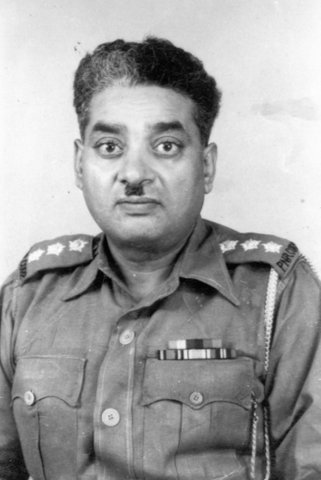
Balbir’s father Umrao Singh in his military uniform
Several months had passed when, early one morning, we heard a knock on the door. To my surprise and joy, my father was there! He was dressed in his uniform, and his left arm was in a sling. He had been injured, and was flown to a hospital in Calcutta. There he had been given a one-day furlough to visit his family in Allahabad, an overnight journey by train.
Along with him was his orderly, the soldier attendant to an officer. Father told me his attendant would like to take a dip in the holy Ganges and asked me to accompany him. For the Hindu orderly, who came from a small village, this was an opportunity of a lifetime.
The trip to the river and back was almost 10 miles, normally a great distance for a 7-year-old boy—but not when he had his mighty green bike! The orderly was in his army uniform and carried his lathi, a bamboo rod, which in those days was the main weapon for people from rural India. As he walked, I would race ahead on my bike and tell shopkeepers on the sides of the road that my father was back and I was taking his orderly for a dip in the Ganges. The orderly was my “show and tell.”
On our way back home, we had gone only a short distance from the banks of the river when two British soldiers rode past us on their bikes. This was bait I could not refuse. Pedaling fast, I caught up with them.
Dressed in their civilian clothes, the soldiers were leisurely riding and talking to each other. They looked at me once and then ignored me. I could tell by their body language that they did not welcome me riding along beside them. I could pick up only a few stray words of their talk. But then, one of them wove the Hindi word “chootia” (asshole) into the conversation.
It was a commonly used word in the local vernacular, but it caught me by surprise that an Englishman would know that word. I grew up in a family where we did not utter such profanity, or the punishment would have been much worse than having your mouth washed out with soap. Until that day, I had never said that word.
Astonished, I looked up at them and asked, “You know ‘chootia?’”
Unfortunately, my first two words were drowned out, but the last word caught their attention. Immediately, I knew I was in trouble.
They stopped, ordered me down from my bike, and cornered me. One of them sternly asked me where my father was. Frozen with fear, I could not utter a word. My throat was as dry as desert sand.
Father’s orderly was some hundred yards behind and running towards us. When he caught up to us, the same soldier asked him in broken Hindi with the deep accent of an Englishman, “Are you his father?”
“No, I am his father’s ardaly,” he stammered, not quite knowing what was happening.
“Is his father an officer?” the British soldier inquired.
The orderly nodded his head, “Yes, Sir.”
“Tell the officer his son needs to learn manners,” the British soldier said.
The other soldier turned his face and moved a step away, as if he knew what was coming next and did not want to be a part of it. That, to me, was a warning of what was coming, but there was nothing I could do. The first soldier cocked his right hand as far back as he could, and with all his might he slapped my left cheek. The suddenness and force of it swung my head to the right and down to my shoulder.
For me, the world stopped at that moment.
It was not just another moment within the endless flow of time. I experienced eternity in that moment. My mind was clear, and I viewed the event as if from several feet above.
I can vividly recall the looks of those two British soldiers. The one who slapped me had a long face and wore round-rimmed glasses. His face was stern and cold, and his hair was combed straight back. The other soldier, who seemed to be younger, had a baby-round face and dark fluffy hair parted on the side, and he would flip his hair to the side with a toss of his head. He also looked to be the friendlier of the two. They were both wearing white, short-sleeved shirts. They were perhaps 18 to 20 years old—but, to a terror-stricken 7-year-old boy, they seemed like giants.
I can still see the faces of the 15 to 20 bystanders who had gathered around us in a semicircle. They are still standing there, unmoving and mute as statues. I can see the wince cross the face of the orderly when I was slapped, even though I was not looking at him at that moment.
I can read the mind of the child, the center of attention. Scared as he was, he had expected to be lectured. He expected to get a chance to explain himself, that he went to a British school and could speak English, that he had meant no offense. As was his nature, he would have made friends with the two soldiers and invited them to his house for a home-cooked meal. He expected to be treated as an officer’s son—certainly not to be slapped in public.
Upon being slapped, he expected immediate action from his protector, the orderly. He expected the orderly to use his lathi, a weapon that stayed frozen in his hands. He expected the surrounding crowd to curse the two British soldiers and beat them up unceremoniously. But neither the orderly nor the others in the crowd could lift a finger against them. Anyone trying to interfere would have been killed instantly, with impunity.
The boy felt shocked and disappointed when the British soldiers mounted their bikes and rode off, without even being confronted.
And then, the child actually got scolded by the orderly. It was obvious that the orderly’s manhood had been challenged and humiliated, and he was irritated at the child for being the cause of it. He threatened to inform the child’s father of the incident.
The rest of the way home, the child biked a few steps behind the orderly, as if in slow motion. Both were in a state of shame, and they could not face each other. They were experiencing the humiliation of helplessness—both personal and collective.
The slap had landed deeper than the child’s face. It had pierced the depth of his psyche.
For as long as I could remember, I had a sense that I was a visitor sent to live with my family temporarily. I felt that I was really from another family, another country. When I was four or five years old, I articulated that feeling to my mother. When she asked where my real home was, I told her, “England,” and that I would be returning there for good at the age of 10. Amused, she shared this with friends and relatives, and soon I was being asked to tell visitors about my “real home.” At first, I willingly participated. But, once I realized that I was being asked to perform, I stopped and refused to disclose any such feelings, even to my mother.
When the British soldier slapped me, it was as if I had expected him to know. He was one of the people I felt close to and with whom I identified. It was a peculiar feeling, as if one of “my own people” had humiliated me in front of these “others” with whom I didn’t really belong. Even more than that, it was as if I suddenly discovered how “my people” mistreated their hosts in their own land—hitting a child for a mere misunderstanding!
When the orderly was leaving with my father the next day, he took me aside at the railroad station and confided that he did not mention anything about the incident to my father. I was relieved. Compared to the British soldier who had slapped me publicly, I considered that poor, uneducated orderly to be much more civilized and cultured. It was clear that I did not want to grow up to be like the person who had slapped me.
With that one thunderous slap, I had grown up. I was no longer just a visitor in India. I was an Indian.
How dare a foreigner insult me in my own country?! I was not going to take it lying down. I was going to avenge it. The incident did not diminish my desire to go to England. It inflamed it. But, now I had to go there to avenge—to kill as many British as I possibly could. I would not be able to kill enough. But, symbolically, I would convey the message that my people were not as helpless as the bystanders around us that day had seemed. There was at last one brave person among them. “My people” and “I” had become one, and my revenge was intensely personal.
Over the next few years, the embers of my humiliation smoldered into anger. My every thought was like a gust of wind that fanned the flames into rage and hatred for the British.
That lasted until the evening of January 30, 1948, when Mahatma Gandhi was assassinated.
Gandhi’s nonviolent approach to driving the British out of the country had appealed to me as a child. At the age of six, I announced to my family that I was a follower of Gandhi. I even declared that I was only going to wear clothes made out of homespun Indian cloth, as Gandhi urged us to do instead of buying factory-made cloth from England.
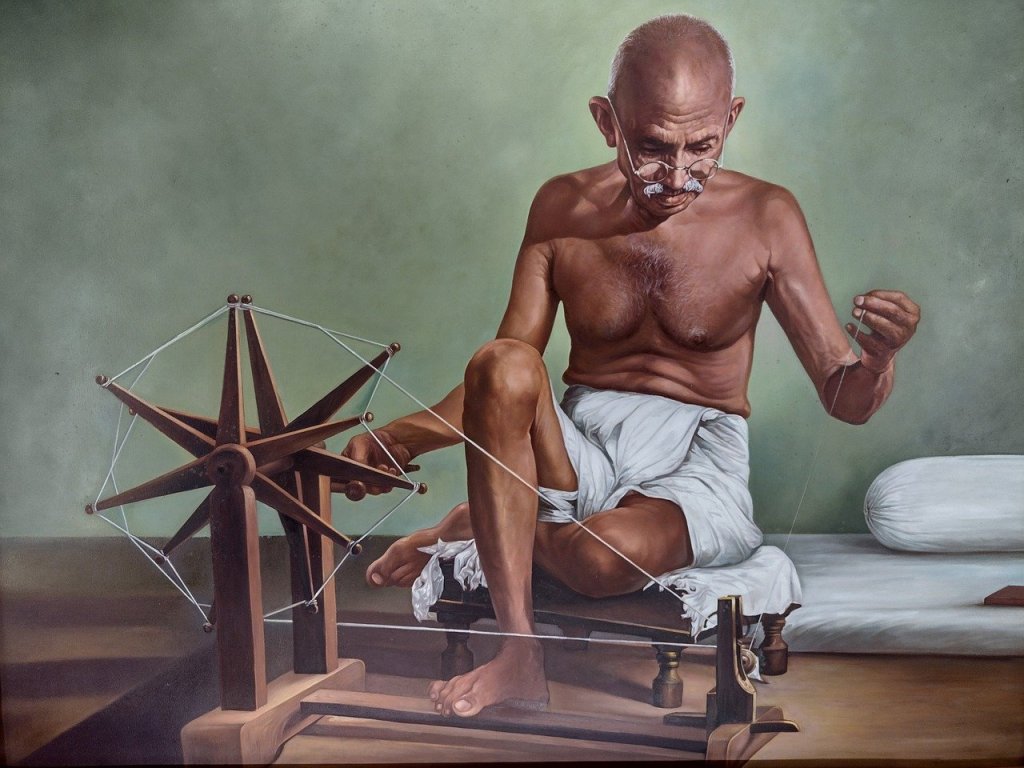
Mahatma Gandhi spinning homespun cloth
Two years later, that one slap convinced me that the British would need to face the barrels of guns to be booted out. I became strongly opposed to Gandhi and his message of “turn the other cheek.” The only thing the British deserved was “an eye for an eye.”
I decided to change my psyche, which was quite gentle. I could not kill even a fly or a mosquito, and for that reason I had become a vegetarian at the age of four in a meat-eating family. But now, I had to learn how to kill. I made up my mind to learn to damage people. I tried to become a bully, to pick fights for no rhyme or reason.
I demanded that my parents take me out of the British school. My father was in the British army, but I insisted that, if I were to continue living in my family’s home, the tricolor Indian freedom flag would have to fly from our house—and it did.
Then, on January 30, 1948, when I was twelve years old, I heard the news that Gandhi had been gunned down. My heart swelled, and I started to cry uncontrollably, tears flowing over my cheeks. My emotion caught me completely by surprise. Stunned and confused, I had no idea why I was crying for someone I opposed.
A large majority of India shed tears at the news of Gandhi’s death, but I wept all night long. My younger sister, ten-year-old Shakti, joined me, and we both sobbed as if our parents had died. Shakti and I were close, and I knew my sorrow alone was enough cause for her to cry.
The next morning, we saw the first rays of sun from our verandah, and at that moment we both stopped sobbing. It was as if the dancing sun rays had brought forth more than just a new day. For me, it turned out to be a new reality—a new life.
Over time, I realized that those drops on my cheeks were no ordinary tears. For me, they turned out to be like holy water that cleansed my psyche. It was a deeply spiritual experience that set me free. And, I had no need to hate the British anymore.
There is a legend in India that angels appear on the banks of the Ganges. I believe it, for it was there that those two British soldiers manifested themselves to awaken me. I thank them every single day.
When I was growing up in India, prayer was an integral part of our day. As we got up in the morning and saw the first rays of sunshine, we thanked God. As we took a shower, before breakfast, and as we got ready to go to school, we prayed. As we ate lunch, we prayed. When we turned the lights on in the evening, we prayed.
I was told that God could see everything. God could hear everything. God knew everything. God was everywhere, including in the trees, stones, bugs, and animals.
When I was six years old, I started questioning things. And so, at a family reunion, one evening I asked my grandmother, “What is this thing called ‘God’?”
My grandmother measured perhaps five feet—and I don’t mean just in height, but also in width. She was round, almost like a ball. When we kids gave her a hug, we would sink into her bosom.
The family story was that Grandma had education only through the 3rd grade. However, behind her back, some family members smirked at that idea, because she could not even write her own name. But she was a great storyteller.
And so it was that all of us cousins were tucked in under her quilt one evening during that family vacation, listening to her stories. That is when I posed the question about God.
In answering my question, she started by asking all of us to imagine a space in which we could see nothing but clean air. She explained that the air was actually filled with particles that were invisible to the eye. If we were able to magnify one of those invisible particles many times, we would see that it was shaped like an egg. And, there would be nothing visible inside that egg, but it would also be filled with specks so small that they were invisible to our eyes. If we were able to magnify one little speck, we would find that it was also shaped like an egg with nothing visible inside it, but we could magnify one little speck.
She described this same process several times, until we could predict the next step—which we did out loud, all in a chorus. We thought it would never end, but she claimed she said it only seven times. Finally, in the seventh egg-within-an-egg, she said that the little speck was our entire known universe.
One of the cousins asked if it would include our house. “Yes,” she responded. Would it include the mountains? “Yes,” she said. Would it include her house, which was in another city? “Yes.” On and on we went, until we established that it included our parents, the moon, the sun, all the stars in the sky, and everything our little minds could fathom.
“But, what about God?” I asked, getting back to the starting point of the story.
“Oh, all those invisible particles contained universes,” she told us. “But God is beyond all of them.”
“Ah! If God is that far away,” I reasoned, “then God cannot possibly see what I do or hear what I say!” My cousins all groaned. However, I was somewhat relieved that I would not have to worry about God anymore.
Grandma didn’t say anything.
The next evening, we were tucked in with her again for more stories. Suddenly I felt a small, sharp pain, and I jumped out from under the quilt.
“What happened?” Grandma asked.
“A bug bit me!” I said.
“No, no, no, sit down,” she said. “It wasn’t a bug.”
When I was tucked in again, she brought her hand out from under the quilt. It was holding a needle. She explained that she had gently poked it in my left arm.
“Why would you do that?” I asked angrily.
“See what happened? I poked a little needle in just one tiny point on your arm, and your whole body reacted.” she said. “In the same way, even the smallest little thing that we do or say affects the whole universe.”
That experience with my Grandma became a vivid memory and the foundation of my concept of God.
I was six years old when I first questioned the meaning of life. I remember the moment as if it were yesterday.
My family was on vacation in the Simla Hills, in a rented cottage with a wide view of the mountains and valley below. That evening, as always, when the sound of the town’s power generator filled the otherwise peaceful valley, my mother and I went inside, where she switched on the light in the front room.
A solitary bulb hung from the ceiling on a twisted wire. The generator barely produced enough power to create a faint glow in the bulb. One could barely make out faces and forms, but no details—not to speak of reading anything. Since the light was so dim, people irreverently called it a “shadow of light.”
My mother folded her hands in prayer, and I followed her lead. It was our custom to offer thanks as the lights came on each evening. I was told that light was a gift from God to illuminate our lives. Without light, life would be unimaginable. I remember the exact prayer we recited, because it was the offering of thanks we gave several times a day in various situations:
Om yogi yati muni dhyan lagawen Sharad Narad sheesh navaven Namoh namoh jai namoh shivaven Sur brahm adi paar na paven Om
My parents had told me the meaning of this prayer was “Oh God, whose mystery none of us can comprehend, and who we all worship by different names, to you we bow.”
My mother turned the light off, and we went outside. Each evening, four metal chairs were set outside around our radio. It was a German-made Gruendig shortwave radio encased in a large wooden cabinet. A German woman who lived in our city in India had left the radio with us for safekeeping when she was interned at the start of World War II. The radio was proudly displayed in our living room and traveled with us in a large, custom-made wooden trunk. At the time, my parents never mentioned that the woman who left us the radio was German, and we never heard from her again.
We were one of the few families in the valley with a radio, so friends would drop by in the evening. The Second World War was in full swing, and everyone eagerly awaited the BBC News.
That evening, one chair happened to be empty, so I sat down with the adults. I could not understand the English broadcast, and I got bored. Afterward, I asked what the news was about. My cousin Padma, who was nine years older than me, cynically told me the British soldiers were “bravely retreating” as the Japanese were advancing.
At that moment, a question arose in my mind. I had recently witnessed the birth of my younger sister, Vijay Laxmi, who was delivered by a midwife in the bedroom of our cottage. Twelve days later, I witnessed my grandfather’s death. Now I was hearing of people killing each other in the war.
I voiced the question out loud: “Why are we born, and why do we die?”
The three adults looked at one another with expressions that said, “Who would like to tackle this one?!” From their momentary silence, it was obvious they had not anticipated my question.
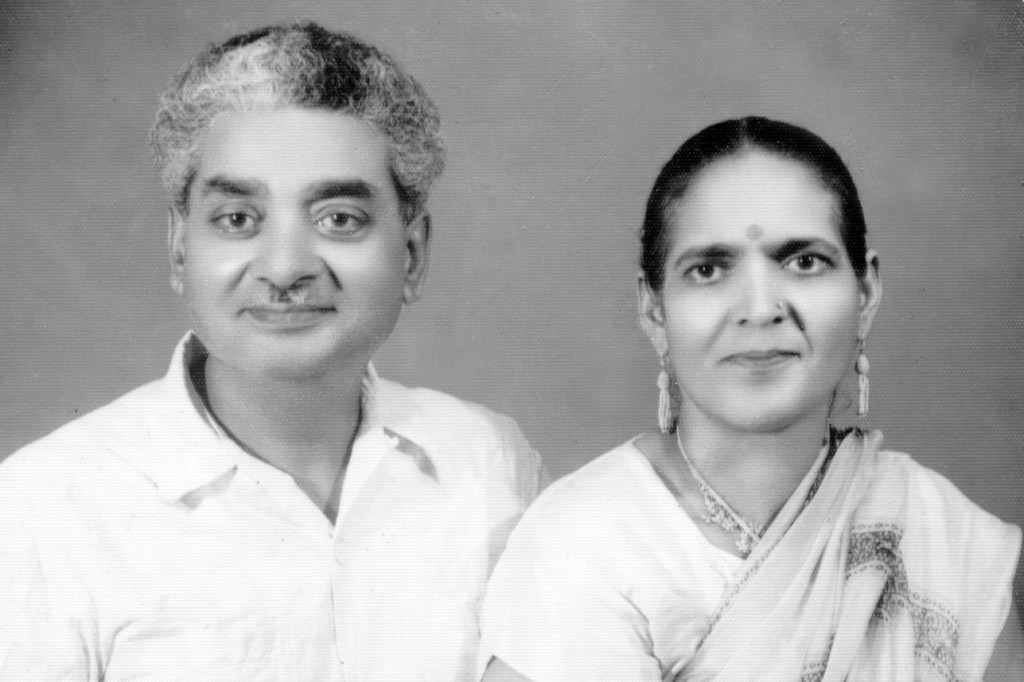
Balbir’s parents Umrao and Sushila
My father spoke first and talked about the journey of life and the will of God. Then my mother tried to elaborate on what he had said. Padma also shared her ideas. They tried to explain that we emerge from God and go back to God, and this life is but an interlude.
I raised another question: “If, after death, we return to God, then why does everyone want to live so long?” I argued that when we travel from one place to another, we try to go by the fastest means possible. “So, why do we take as long as we can on this journey of life?” I inquired.
The answers that followed seemed fuzzy to that six-year-old sitting on a metal chair overlooking the enchanting valley. In the end, I asked in frustration, “If we go back to God after death, then why should I not die now?”
My father tried to answer. He did not rush it. Each of his words was deliberate. He said something to the effect that finding an answer to this question is the purpose of the journey, and each one of us has to find our own answer.
After that, the subject changed, and the adults went back to their own chatter. But I paid no attention to them. I was lost in my own thoughts, in some other world. It was not long before the sun went down behind the mountains, and the valley was engulfed in darkness. One by one, the others went inside, leaving me alone.
I remember very well my pose of deep concentration—lips pursed, shoulders hunched, hands holding tight to the sides of the metal chair seat, body tense and leaning forward, legs dangling and swinging—as I pondered the question, “What is the meaning of life?”
Finally, my mother called from inside: “Son, it is getting dark and cold! You better come in now!”
I did not answer. The cool breeze felt good.
*******
A couple days later, I woke up in the middle of the night with a severe stomachache. When I called out, my mother rushed to my bedside. Writhing in pain, I explained my condition. She set the kerosene lantern on the floor and knelt beside my bed. She clasped her hands together as if in prayer and pleaded, “Son, please promise me that you are not going to will yourself to die.” Her face was lined with deep concern.
I was surprised. I had asked about the meaning of life—I had no intention to die! At that moment, in some odd way, it became crystal clear to me: I wanted to know why I was here, and the answers being provided were not adequate.
Something flickered within me. It was as if I caught a glimpse of movement, but I could not make out what it was. Like seeing a stranger whose form was clear, but the details were indiscernible, shrouded by the “shadow of light,” and I would have to wait for daybreak so I could search and hope that the shadow would reveal its mysteries.
When electricity first came to the neighborhood where I was growing up as a child, our house was one of the first to be wired.
For thousands of years before then, the main sources of light at night were cotton wicks soaked in mustard oil and placed in small ceramic dishes. Kerosene lanterns were also there, but they were still scarce. And now there was electricity.
One of my favorite “show and tell” routines was to ask friends to face away from me, and I would stand on a chair and push the light switch on and off. My friends would stand in awe, mouths wide open, to see the room light up and then go dark again. After a few minutes, they would catch on to what I was doing and then insist on climbing the chair and performing the magic themselves.
When a lightbulb is lit, it is no longer merely a bulb. It becomes the light. A switch and wires are not just parts of the vast electrical network. They are the network. Similarly, during those magical moments, my friends and I were not merely “experiencing” something special. We became magicians. No, even more than that—we became part of the network, part of the magic itself.
My act lasted only a short time, because soon everyone knew the secret, and the show was over. And, as happens with childhood toys, that experience was soon lost and forgotten. Many years later, it took some major life crises and some wise teachers and mentors for me to discover what that short-lived and seemingly insignificant childhood experience had actually taught me.
I came to the realization that, just like all those little light bulbs were connected to the source of electricity, everything in my universe was also connected. We children did not know the theory of electricity or why the bulb reacted to the touch of the switch, but we knew it worked. We knew that a person’s size, sex, race, religion, or wealth did not make any difference; anyone could become a magician by becoming one with the network.
So, even in the darkest of dark moments of my life, I have known that the solution was only a matter of finding the switch.
One summer day when I was four years old, my younger sister, my mother and I were resting after lunch. An afternoon siesta was a custom in India in those days, because the sun would be so blazing hot that no one dared to go outside.
Ours was one of the few houses in our neighborhood that had a ceiling fan in the living room as well as a table fan that we moved from room to room as needed. Such fans were a luxury, and there was no such thing as air conditioning.
As usual, we were lying on the floor because that was the coolest place in the house. My mother was fast asleep, and I was lying quietly on my back, perhaps playing with some toy.
I looked up and thought I saw something on the white ceiling right above my head. It was just an image, not something concrete. I knew it was not real, and yet there it was. My eyes were riveted to it. It was the image of a baby goat—a kid. The figure was light gray, not black like every baby goat I had seen before. Then it spoke to me, and said, “How would you feel if someone killed your parents and ate them?”
I knew the image was not really speaking, but the thought was so profound that it did not matter. I closed my eyes as hard as I could and buried my face in my pillow. I did not want to open my eyes and face the baby goat. I did not want to answer the question. When I did finally open my eyes, the figure was no longer there.
I laid there awake for a long time, my little mind thinking, wondering, and refusing to accept the possibility that the goat had posed to me. The prospect was horrifying. I could not bear to imagine what would happen if my parents were killed. And the very thought of someone eating them was sickening. I glanced over at my mother several times, just to reassure myself that she was alive and well.
That is all I remember of the event, because I must have fallen asleep eventually. I never told anyone about that experience. It was too horrifying a thought for me to even consider speaking about it. But, that evening I told my mother that I was never going to eat meat again.
Several years later, my mother told me that everyone thought it merely a childish whim of a 4-year-old, and that it would last only a day or two. After all, my father had a restaurant famous for its meat cuisine, and I had acquired quite a taste for meat. I even remember some of the tantrums I threw when meat was not included in meals. It was a problem whenever we were invited for a meal by friends or relatives, because we lived in a vegetarian-dominant society.
But when my parents found out that I was serious and determined about not eating meat, they started to get concerned, especially since I also stopped eating eggs. I refused to eat anything I suspected contained eggs, such as cakes, pastries, and even chewing gum. I would not even touch meat or eggs.
The adults around me tried to convince me that I should eat meat. My cousins started to tease me by putting goodies containing meat or eggs in front of my face. But none of it worked. All the temptations and attempts at persuasion never bothered me.



 balbirmathur.com