
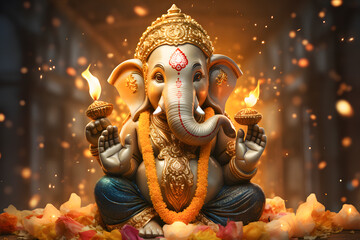
Most mythologies contain one or more figures that are partly human and partly animal. In Hindu mythology there are several such figures, including one called Ganesh. This benign pear shaped body is human but the head is an elephant. Ganesh is considered the symbol of wisdom and good luck, and thus most worship services start by first inviting the presence of Ganesh into the gathering—if wisdom is present, good luck shall naturally follow.
So why is this human figure with a gigantic elephant head the symbol of wisdom? Because it is believed that we humans share four basic needs with the entire animal life: hunger, procreation, sleep, and the fight or flight response. Out of these basic needs emerge the secondary traits, such as the desire to acquire, competitiveness, envy, lust, sloth, and killing.
At the same time, human beings possess traits that are attributed to angels and God. We consider God the ultimate creator. Likewise, humans are highly creative by any standard. We pray to God for solving our problems, yet humans are problem solvers. We associate love, empathy, giving, mercy and compassion with God. Again, we humans possess those qualities in abundance.
We human beings are a unique container filled with opposing, contradictory qualities and attributes. We are highly creative and yet highly destructive. We are filled with mercy and compassion, and yet we participate in the killing of other people. We are generous and give and share our resources, yet we may acquire by force what belongs to others. The list of these contradictory traits is considerable.
Hindu mythology humanizes these contradictory attributes and creates a metaphor of two opposing armies of equal strength engaged in an endless war. The strife is going on internally within us and we, in turn, project it onto the outside world—just like a small slide may be projected onto a giant screen.
So wisdom is the recognition that we are a fusion of both the animal and the angels—just like two wings of a bird. A bird, however, uses both its wings to rise above the surface and chooses what direction to fly.
The surface we have to rise above is the tension caused by this fusion. The differences between the paths that are led by our animal instincts and most angelic aspirations are sometimes very subtle and can confound us mortals. Trying to sort this out is where the human tension lies. Therefore, prayers ask for the wisdom to discriminate between the two and for the courage to follow our noble traits rather than the destructive instincts.
It may also be noticed that, in the figure of Ganesh, the body is that of a human and the head is that of an animal. That, too, has a meaning. Traits such as love, sympathy, kindness, and selflessly helping others are elements associated with our hearts rather than with our heads.
I share the above mythology to point out that irrespective of any beauty that one may end up seeing in this narrative, the war-like dance of the opposing dragons of Yin and Yang remains intact within me.
 balbirmathur.com