
Following my first visit to Mulbar and Sambalpur, I had returned to Allahabad to check on all the tree planting activities happening there and then intended to go to New Delhi and return to the U.S. But my heart was pumping, full of love, and soon I felt drawn to go back to Sambalpur.
I called Munshi Sahu, the brother of my doctor friend in Des Moines, and told him I was coming to Sambalpur the next day. He invited a couple of friends to meet me for breakfast, and they invited a couple of others. Organically, a perfect combination of people came together: a banker, a prominent businessman, an ecologist, a college professor, and a wise older gentleman.
These men were moved by the prospects of improving the quality of poor peasants’ lives by simply helping them plant high-quality fruit trees on their marginal, spare land.
Their unanimous response: “You have come all this way to bring this to our attention. Now it is our job to take it forward. We will do it.”
The wise older gentleman was nominated as chairman, the businessman became the chief executive and spokesperson, and the banker became the treasurer. The doctor’s brother became the secretary, as well as the person responsible to coordinate the committee itself.
The committee went to work immediately.
The monsoon was around the corner. The best time to plant fruit trees was just as the rains started, when the trees would have ample water. Two thousand assorted fruit trees were ordered immediately. They consisted of high-quality mango, jackfruit, guava, papaya, lemon, and coconut trees. I promised to send the necessary funds as soon as I returned to New Delhi. The committee would be responsible for disbursing and accounting for the money.
Although I was initially the guiding spirit who had set out to unleash the potential in the villagers, it was the dedicated volunteers on this committee who did all the work from the beginning. The businessman became a very forceful executor, knowing how much money it would take to do what needed to be done, and who to get for the job. Under his leadership, the committee took strong hold of the reins, managed the details of the projects, and made sure the work was done. As the project evolved, many others enlisted to help.
Everything went as planned. Five hundred families in Mulbar and the surrounding villages planted those trees. In each village where the trees were planted, committees were formed and training was provided on how to plant and take care of the trees.
A few months later, I went back to the village. The trees had been planted and the people were delighted to have such high-quality saplings. Now they wanted to protect their saplings against the coming dry season.
They asked me once again, “How will we provide water for the trees when we don’t have enough water to drink?”
We were meeting in the yard of an extremely poor farmer, just on the outskirts of the village. He did not even have a decent straw hut to live in. At that instant, I had an inspired hunch. It was a flash of intuition, and I acted on it immediately.
“Dig a water well right where I am standing, and you will have water,” I said, stomping firmly on the ground under my feet. “Right here!”
It was a wild claim. There were no deep water wells within a 100-mile radius. It was a widely- held belief that groundwater didn’t exist here.
The crowd gave me a blank look. They could not afford to take such a risk on the claim of a stranger. I went on to assure them I would underwrite the entire risk of the venture. If the water came, they would pay for the digging. If the hole proved to be dry, I would pay. They had nothing to lose. The committee members who were with me assured them they had my funds in hand to back my bet.
The poor farmer on whose grounds we were meeting decided to accept my challenge. It was a gutsy decision. I doubted he had one dollar’s worth of savings to his name. Typical of the active involvement of the Trees for Life committee, the banker from Sambalpur accompanied the farmer to the small local bank, where he vouched for the farmer, agreeing on Trees for Life’s behalf to underwrite a loan of $1,500 to dig the well. The banker told the bank Mr. Mathur had promised to make good on the loan if necessary.
The businessman on the committee then hired the driller and paid him directly out of the loan money.
I was back in the U.S. by the time drilling started on the hole. When I visited the village a few months later, people described to me the tremendous force and height of the water that gushed on the first day of digging. Residents of the village had rushed to see this miraculous event. Word spread and soon people from the adjoining villages also came running.
The man who borrowed the money to dig that first well eventually became one of the most prosperous people in the village. He had no education, but it turned out he was a man who was interested in learning to do things scientifically. He became an inspiration to the village.
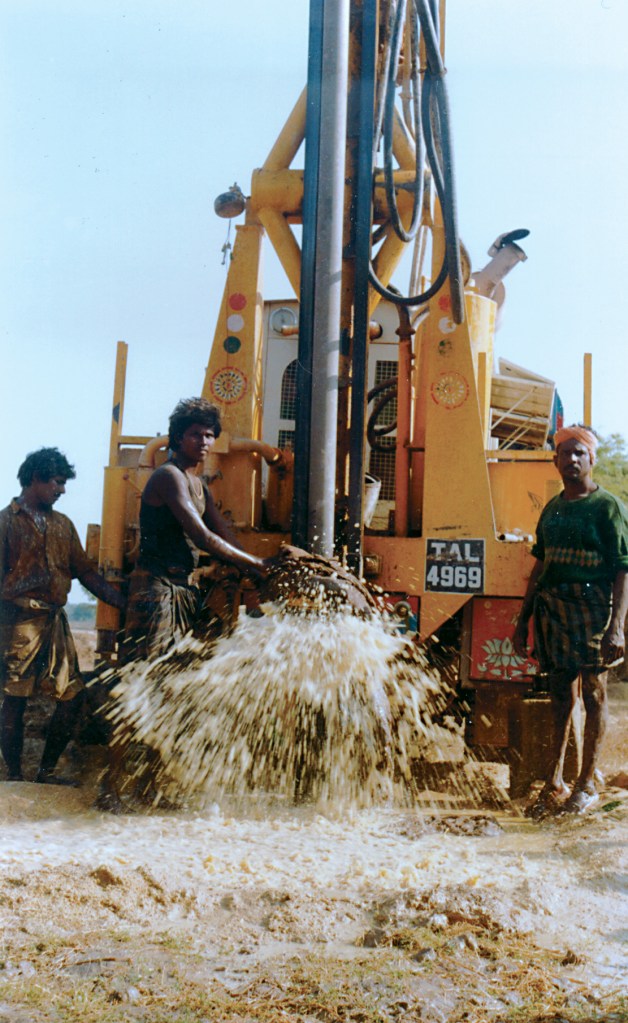
One successful well was good evidence, but not enough to drown out centuries of beliefs and a government report dating back to British colonial times certifying there was no ground water in the area. To challenge this entrenched belief, members of the committee decided to hire experts from an adjoining state to assess the situation. The new study concluded: Yes, there was water under the ground.
Even with the new report and one gushing well, I still had to coax five more farmers to dig wells, promising them incentives if they took the risk. Very quickly after that, everyone wanted wells dug in their villages.
The revolution to plant trees had begun.
 balbirmathur.com
What an inspiring story! Thank you for all you do. Namaste.