
Part 1: The Road to Mulbar
In 1988, I was invited for dinner at a physician’s home in Des Moines, Iowa. During the evening, he told me that he had grown up in Mulbar, a small village in the western part of the state of Orissa, India. This physician, Saheb Sahu, had been impressed with the Trees for Life movement and wondered if I could take that concept to his home village. I was going to be in India the following month, and I agreed to visit the village.
“How do I get to Mulbar?” I asked.
“From New Delhi, you fly to Bhubaneswar, and from there you will need to go to Sambalpur by car. In Sambalpur, my brother will receive you and take you to Mulbar the following day,” he told me. “I will write to my brother to expect your call.” He gave me the contact information for his brother.
When I arrived in New Delhi the next month, unfortunately I left my briefcase in a taxi. So, when I reached Bhubaneswar, I did not possess any of the information I needed — not Dr. Saheb Sahu’s phone number in Des Moines; not his brother’s name, address, or phone number; nor the name of or directions to the village where I was to go.
In Bhubaneswar, I stayed with my friend Anang, whose father had been the chief minister of Orissa (comparable to a governor in the U.S.). After dinner, I asked him to name some villages in the hopes of sparking my memory.
“What do you mean?” he asked. “There are thousands of villages in Orissa.”
Realizing the impossibility of naming the village, I asked him to name some of the major cities in Orissa. When he named Sambalpur, I stopped him.
“Yes!” I said, “that’s where I need to go. The village is somewhere close to Sambalpur. How do I get there?”
He offered to loan me his jeep, but it came with one caveat — it was an open jeep with only a canvas top and no doors. That might have been fine for local travel, but this was to be a 240-mile drive during the month of May when temperatures climb to 115 degrees. I had no other choice and accepted his offer.
My friend’s nephew, Som Raj, was visiting his uncle for summer vacation and was given the task of driving me to Sambalpur. My friend said, “It will give him something to do, and he will get to see a part of Orissa.” His nephew was from Benares, 600 miles northwest of Orissa.
Our journey began at 4 a.m. so we could cover as much territory as possible before the worst of the heat. Som did not know the way to Sambalpur, so his uncle gave him these directions: “Take the highway which runs in front of our house, and it will take you directly to Sambalpur.”
That highway turned out to be a narrow, two-lane road that was being converted into a state highway, so there was construction all along the way. Every mile or two there was a detour, often onto dirt roads full of potholes. At several detours, we asked the road crews which way to go, but the laborers did not speak Hindi and neither Som nor I spoke the native language, so the workers could not guide us.
We did not know where we were going. We would come to a crossing and Som would ask in frustration, “Which way?” And I would say, guessing, “Let’s take that road.” We kept driving like that in the heat of the day, feeling exhausted.
After 10 hours of driving and not knowing where we were, we stopped the jeep in a small village. About a dozen villagers surrounded us. I told them we wanted to get to Sambalpur. Some villagers understood enough Hindi to tell us that Sambalpur was almost 50 miles in a different direction.
After a few minutes of silence, I said, “We are really trying to go to a village where a doctor grew up and later moved to America.”
“Yes! Yes! He’s Doctor Sahu from Mulbar,” someone said.
“How do we get there?” I asked.
They pointed and said, “You go in that direction.”
“Where is the road that will take us there?” I asked.
“There is no road to Mulbar,” the villagers said.
“Is there a path on which people go from here to there?” I asked.
Silently they shook their heads to say, “No.”
“Then how do you go from here to Mulbar?”
They looked at each other as if wondering to themselves, How DO we get to Mulbar?
“No one intentionally travels to Mulbar,” one person remarked sarcastically, as he turned his face toward the crowd. Everyone laughed nervously.
I laughed with them in agreement, as if the joke was on me. Slowly, I looked into the eyes of each man. “Would it be possible for one of you to ride with us in our jeep and take us there?” I asked.
“No,” they said, shaking their heads in unison.
“Why?” I asked.
“It is more than five miles away, and we would have to walk back in this heat.”
Finally, I offered a young man a full day’s wage to ride along and direct us to Mulbar. The rest of the villagers encouraged him to do so. Half-heartedly, the young man agreed to go with us just halfway, and from there he would point us in the right direction to the village.
We drove through unmarked fields and crossed a dry riverbed. If it had been the rainy season, the river would have been impassable and the village cut off.
We reached the village in the late afternoon when the equator sun was about to drop out of sight. We were covered in dust from head to toe. My face looked white from the dust. My hair was standing straight up. Even my eyelids were caked with dirt.
I wondered how in the world the universe had taken us right where we needed to go when we hadn’t even known the name of the village.
Part 2: “Ami Korbo!” (We Shall Overcome!)
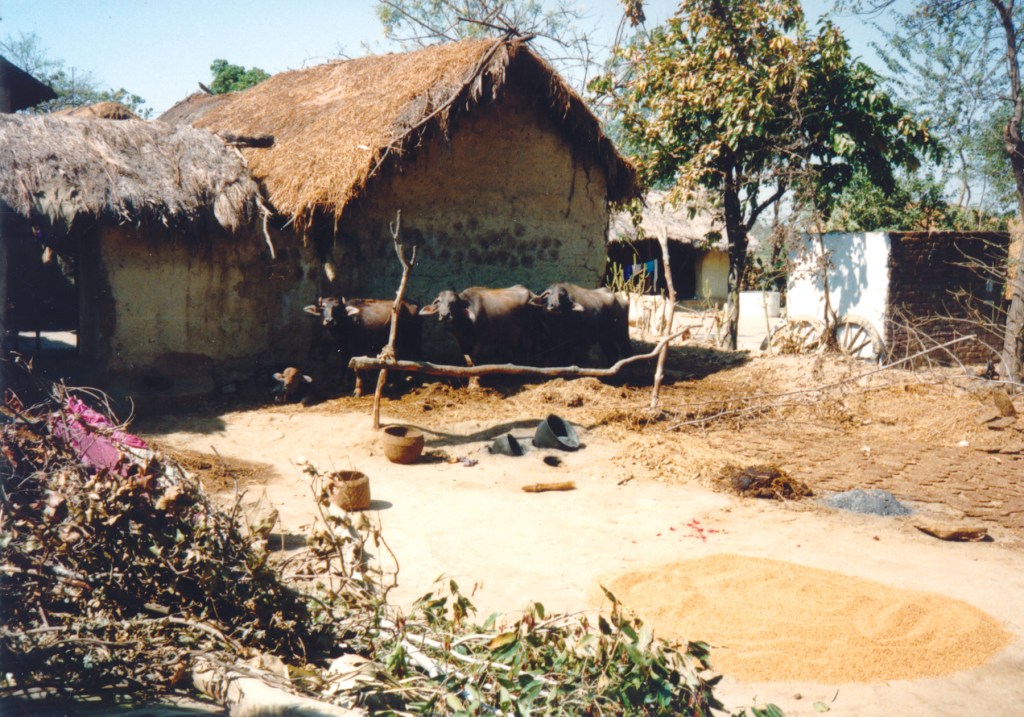
We decided to park the jeep just outside the village. Som was exhausted beyond words and decided to rest in the jeep, while I went to explore. There was no one in the narrow streets. People must have been resting in their mud-built homes. There was no movement. Even the air was still. No life. Only silence.
As I stood in the center of the village, one curious soul ventured towards me. He was adjusting his shirt, indicating he had been awakened from his rest. I told him I was a friend of Doctor Sahu in Des Moines, USA, and I had come at his request.
He looked around to see if there was someone else with me.
“Did Munshi Babu bring you here?” he asked.
“No, I do not know Munshi Babu,” I replied.
“He is the doctor’s brother in Sambalpur. You mean he did not bring you here? How could you find your way here? It is impossible.”
It was obvious that he did not believe me. Briefly, I told him about our trip from Bhubaneswar, and how the folks from the nearby village guided us. He said the doctor was a legend in this area, and everyone knew and respected him.
Soon many of the villagers joined us. As usual, I engaged the people by asking several questions, including their names. However, they were more interested in who I was and what had brought me here. I told them I had emigrated to the United States many years before to discover the secret of what makes some people rich and powerful and others poor and powerless.
I also told them that Dr. Sahu had asked me to come to the village to tell them about Trees for Life. I requested one of the villagers to ask Som to come and join us. As is customary in these small villages, they brought us chai to drink, and we began to share our stories.
They told us the village depended on dry-land farming. During three months of monsoon rains, there is lots of water, but it drains off. This is followed by a period when there is hardly any water. The land, they said, produced very little food, and the cows barely gave any milk. As the population had grown over the years, the land surrounding the village had been stripped of trees. Farmers in the area grew rice and also a few vegetables during the rainy season.
I told them how our Trees for Life movement helped people in villages just like theirs to plant fruit trees.
“But we don’t even have enough water to drink! How can we take care of trees?” one man shouted from the back of the crowd.
“That is why I am here. You will soon see how it works,” I said.
“My great, great grandparents were born in a village much like yours. Many people helped them break out of poverty, and now I am helping to repay that debt by sharing a simple formula for what makes people powerful and prosperous.”
“What is that formula?” one person asked.
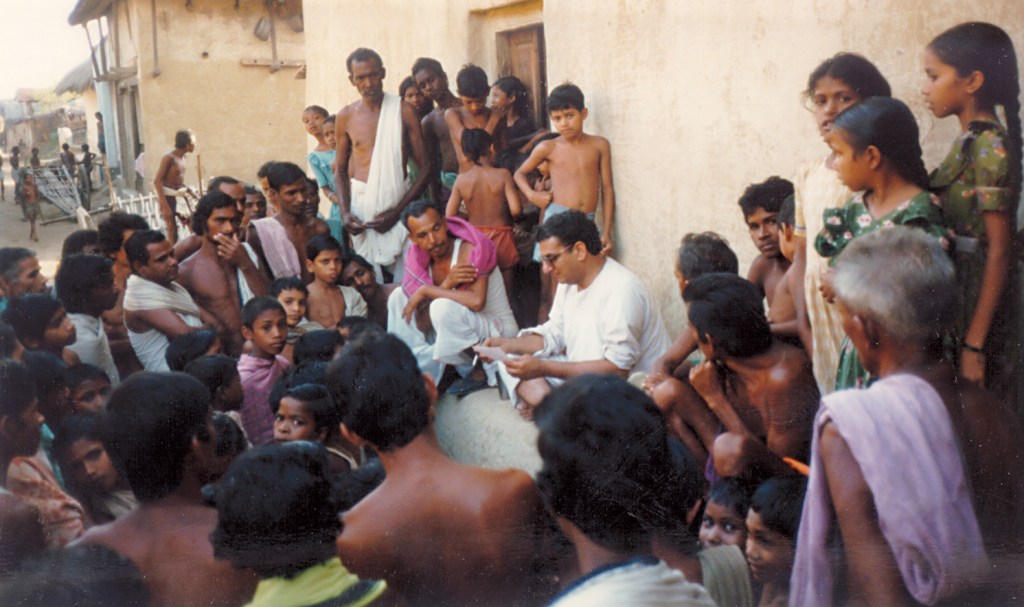
and learned about the Trees for Life formula.
There was a deep silence on my part. Many villagers thought I had not heard or understood the question. So, they repeated the question again several times.
Slowly, I said, “Lakshmi, the goddess of prosperity, comes and dances in the courtyards of those where people are prepared. Just like rice will grow only where first the field has been prepared, there are three steps necessary for this preparation:
“Step 1: There must be a strong determination and commitment.
“Step 2: We must learn the science behind whatever we do.
“Step 3: We must have the discipline and the stamina to follow through.”
There was complete silence in the group. They were listening to me very intently. I asked them several times to repeat the steps back to me.
I said, “Let us start with step one. When the desire of a group becomes so strong that people are willing to pay this price for Lakshmi’s dance, then Lakshmi appears unbidden. Everyone can have a desire, but that is not enough. Desire has to become commitment and determination. So, the people I share this formula with are those who exhibit the determination to dance with prosperity.”
“We are determined,” someone said. Some people nodded their heads in silence.
“If there are a few determined people who can agree to work together and meld their hearts and minds together for a cause, then no force can stop them,” I continued. “This force is called Ekta — when many become one. Where there is Ekta, miracles come unbidden. Even problems that seem totally unsolvable are solved. If water is a problem, and you follow the formula, then water will appear. I do not know how, but I can guarantee you that it will.”
I asked, “Are there some people in this village who are willing to work as one mind and body, so that the entire village can experience such a miracle?”
A murmur went through the crowd. Dr. Sahu’s cousin was the first to volunteer. Then, six others volunteered.
“That’s enough. Let us start with a very small group,” I said. “Just like a mighty tree needs a small seed to start, in the same way, a mighty shift needs a few people to help it get started.
“The question is, will the rest of you help and support these few people, or will you oppose them and create friction among yourselves?”
“We will support them!” they shouted several times.
One young man raised his right fist above the crowd and shouted, “Ami korbo!” which means “We shall overcome!” I looked at that person. He was leaning on a bamboo stick, and I realized that he had a lame leg. A current went through my body, and I quietly started to look over the entire crowd from left to right. The people began to chant quietly, “Ami korbo, Ami korbo, Ami korbo.” The chant became louder.
I could feel the current go through the entire crowd and a shiver go through my body.
Part 3: The Wrong Road
After the meeting with the villagers, Som drove us almost 50 miles in the pitch dark, dodging potholes all the way to Sambalpur to meet Dr. Sahu’s brother.
As Som was parking the car across the street, I went into the Sahu Pharmacy.
“How may I help you?” Manaswi Sahu asked, as he looked up at me through his bifocals from behind the pharmacy counter.
When I introduced myself and Som, Mr. Sahu did a quick double-take. He was expecting an American, and here I was, an Indian in local clothing, covered from head to toe in dust. He took off his glasses, rubbed his eyes, and stared at me.
Munshi Babu, which is what all the local people called him, had a peculiar look on his face. I could not tell if he was laughing, amazed, or angry — perhaps all three.
I apologized and explained about losing my briefcase with the contact information for him and his brother, Dr. Sahu, in Des Moines; the long and bizarre trip that amazingly had taken us to Mulbar; and the meeting with the villagers.
“But you were supposed to have called me from Bhubaneswar, then come here to Sambalpur, and I was to accompany you to Mulbar the next day,” he said. “Now you’re telling me that you have already been to Mulbar, formed a committee, and started the work?!” He was miffed.
Then, finally understanding the situation, Munshi said, “You guys must be very tired. Let’s find accommodations where you can wash up and then we can take you to my home so you can get something to eat.” As he started to lock up his pharmacy for the night, he told me that he had been ready to close when we walked in. If we had come even 10 minutes later, he’d have been gone and his house would have been impossible for us to find.
He took us to the best hotel in town, where only one room remained for the two of us. We were too exhausted from the long day in the blazing heat to eat. The nighttime temperature was still above 100 degrees Fahrenheit. Since there was no air conditioning, we opened all the windows and had the ceiling fan going full blast. Normally, it would have been impossible to sleep in that heat, but both Som and I slept 12 hours in our skivvies.
When I awoke the next morning, I was still exhausted and could only imagine Som’s condition, after driving so many hours filled with detours, potholes, and playing “chicken” with a barrage of oncoming vehicles. He had not complained once. A feeling of admiration and love poured over me like warm syrup on pancakes.
Mr. Sahu picked us up and took us to meet his family. Munshi Babu and his younger brother lived in a joint family with their spouses and children in one house. We met everyone and exchanged our stories, then started back to Bhubaneswar.
The road to Bhubaneswar turned out to be a well-paved highway, without any construction and with fast-moving traffic. Within five or six hours, we were back in Bhubaneswar. That evening during dinner, we shared our adventure with my friend and his family. As we started to describe all the detours we encountered trying to get to Sambalpur, my friend looked puzzled and asked Som, “What road did you take?”
Som pointed in the direction of the road we had started out on at 4 a.m. the day before.
His uncle exclaimed, “Oh, no! You took the wrong road!”
We had taken the road behind the house, not the one in front of the house!
We all laughed and marveled that even though we did not know the name of the village nor its location, and despite all the detours, the Universe had taken us where we really needed to go. What had seemed like the wrong road was really the right road after all. I shook my head in bewilderment.
 balbirmathur.com