
When I first arrived in the United States, I intended to stay for only two or three years before returning home permanently and getting married. I took it for granted that my parents would choose my bride. Even though my parents’ marriage was a “love marriage”, that was unusual, because 99 percent of marriages in India were arranged by family members. Like my parents, I had a sense of firm commitment that I would do my best to make the marriage work, no matter what woman they chose for me.
When I visited India in March 1962, I was neither ready to return permanently, nor to get married. I had started two businesses and I was totally enmeshed in them. My bread and butter came from my import business. Over and above that, I was putting my energies into developing the two-seater car for poor countries and bringing the idea to fruition. I was working non-stop, 10-12 hours a day. My dreams were big.
I had gone to India as part of my trip around the world to explore the potential of this car. My mother saw the perfect opportunity to get me married while I was there. From her perspective, I was of marriageable age at 26, and I should marry an Indian woman to maintain my connection with my country.
Without telling me, my mother advertised for my bride in three newspapers with national distribution, a common thing to do at that time. Since I had made my way to the United States, I was a “hot commodity.” In the 1950s and early 1960s, very few Indians were permitted to emigrate to the United States. At that time, the annual quota for Indian immigrants in the USA was only a few hundred. Mother was inundated with more than a hundred proposals. She and my younger sister, herself of marrying age, labored to screen the number down to 15 or 20. For example, one of the prospects was a dentist, while another was from a wealthy family that promised a large dowry. Many people relied on family connections because that was the proven way to end up in long-lasting marriages.
My father, who had retired as an officer in the Indian Army, was too ill with diabetes to participate in any of these activities. Treatment for diabetes in India during those days was not as effective as it is today. Being diagnosed with diabetes was tantamount to a slow death sentence.
All of my mother’s efforts to select a bride came to an abrupt halt in April 1962 when, a few weeks into my stay, my father died. We were overtaken by sadness and a myriad of activities to settle his estate. During this gloomy and numbing period, some of my family suggested I expedite my permanent return to India to be with my mother. Even though I loved my parents, my returning to India was not a consideration. Instead of a bride, I returned to Kansas with my 12-year-old sister, who planned to attend a school in Wichita.
On the way back to the United States, we befriended an Indian couple in Rome.
“How did they let you escape from India without getting you married?” the husband asked.
“I was just not ready,” I told them.
“How will you find an Indian wife in the USA?” the wife asked, looking aghast.
“Nationality does not make a difference to me,” I said. “When I am ready, I will take a trip around the world and find a wife.”
As it turned out, I didn’t have to leave Wichita. In the summer of 1965, when I was 29, I met Treva June Brown at a post-graduate gathering sponsored by a local church. She was 24 and had just returned home after volunteering two years with a peace and social justice program, which had assigned her to serve in Germany. At a bowling social one night, I offered to drive her home. We started dating soon after that.
Treva was reserved and very private with her feelings. I had a hard time telling how she felt about me. At one point, I started to doubt whether she liked me and I decided to break it off.
I went to her house for that purpose. When I sat down, she surprised me.
“So, you have come to break up with me today,” she said.
“Why do you say that?” I stammered, both shocked and impressed.
“Just a woman’s intuition,” she said.
“No, no, no!” I protested, lying. “That’s not the case.”
I didn’t have the courage to tell her what was on my mind, and now I thank my stars for that.
She was so different from me. She was an American, I was from India. She was a Christian, I was a Hindu. I loved exotic, spicy food, she was a meat and potatoes person who did not use salt and had never tasted spicy foods. I was a swashbuckling adventurer with an endless lust for life, she was an elegant lady who did not use makeup or wear jewelry and made few demands on life. While cooking was a mirthful, adventurous production for me, she used recipes. She was highly organized and kept everything neatly in order. Let’s just say, I was not! Our upbringings were poles apart.
Yet, there was something in common. Even though our religions had different theologies and mythology, we had no difference in our understanding of what it means to be a human being.. We both had a strong sense of loyalty and duty, and each of our strengths was complementary to the other’s weaknesses. We enjoyed each other and, more than anything else, we trusted each other. There was some sort of chemistry, recognition, memory.
Once, before I met Treva, I was given an impromptu question at a Toastmasters Club: “Your son wants your advice on what type of woman to marry. What will your advice be and why?” I answered without hesitation. “Their values must be in common. Everything else can be adjusted. Not values.”
That provoked a debate within myself. As a single man, how would I know the values of the person I marry? And to be able to judge her values, I would need to know my own. The more I thought about it, the more I became convinced I could not make such a decision based on cold logic. It would have to be a gut decision. It would come through knowing, not reasoning. I would know when the time came. I would have to trust myself.
During the18 months of our courtship before we were married, Treva and I had several honest discussions. I had envisioned a house full of children, grandchildren, friends, and guests at all hours of the day. I wanted 12 children. Treva wanted no children. That was an unbridgeable gap for me. It was at that juncture I came across Margaret Mead’s statement that men want many children because of their ego. I read this statement in a hotel room when I was out of town. I got up from the couch and looked at myself. Literally. In the mirror. I could not drive fast enough the 300 miles back to Wichita to admit to Treva that my need for several children was not a part of my values system, but rather stemmed from my ego. We decided to plan a family with two children.
“I am not an 8-to-5 person, wanting to have a steady job like a banker,” I told her. “I seek adventure. I like to explore. I like to do things. I keep a rather hectic pace and you may not be able to keep up with me.”
“Oh, I think I can,” she answered with confidence.
She said I was doing negative selling on the idea of marriage, but I was being very honest. Little did we know at the time how true those statements would prove to be, in ways we never imagined.
If there is a metaphor to describe what quickly became evident about us, Treva is a deep-rooted tree, and I am the wind, and we would build our lives dancing together through all sorts of weather.
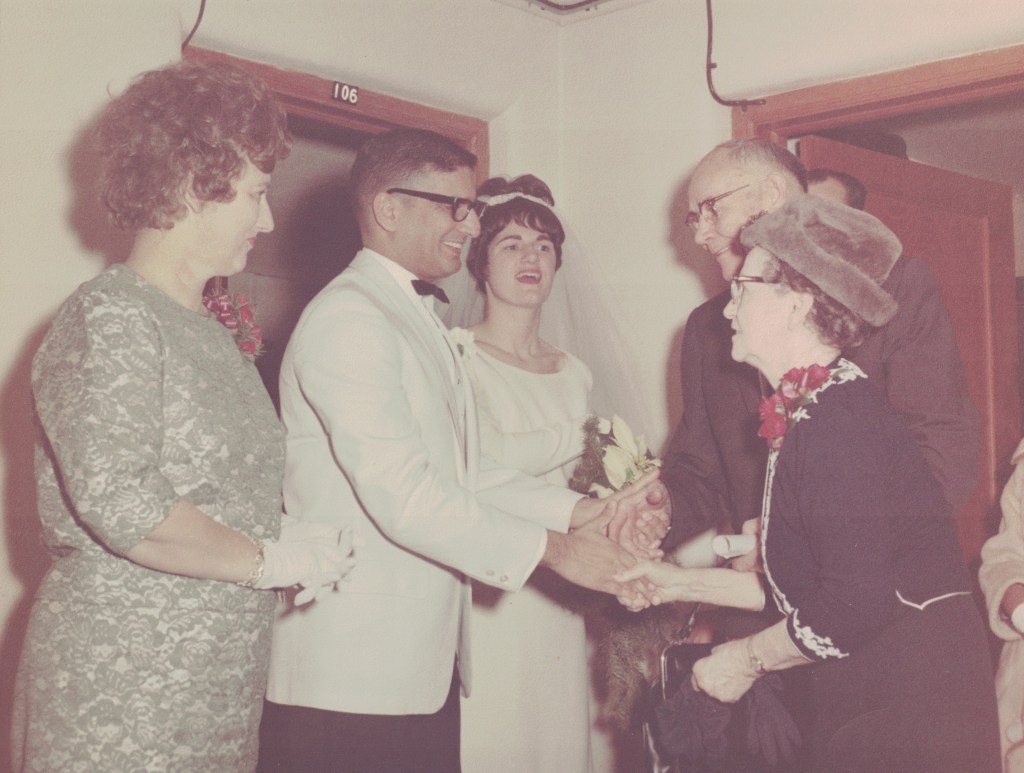
After experiencing the excesses of elaborate weddings in India that caused an unnecessary burden on the bride’s family, I had vowed to have the simplest wedding possible. I suggested a civil wedding ceremony, conducted by a justice of the peace. Treva said her grandparents would be disappointed with such a decision. Realizing I was no longer in India and the weddings in America were simpler, I relented. She made me promise not to surprise her with a diamond ring. She was not the type.
The local newspaper published an article on Wichita’s first known wedding that included one ceremony in the Vedic tradition, to be followed by the other in the Christian tradition. Some people predicted a disaster. Many others kept their opinions to themselves. The minister received a nasty letter implying he would burn in hell for allowing such a dastardly thing in the church. On our wedding night, December 28, 1966, the ground was covered with ice and snow. There was a blizzard that evening, and the city was shivering with record low temperatures. But the church was filled, standing room only. Even a stranger called to request an invitation.
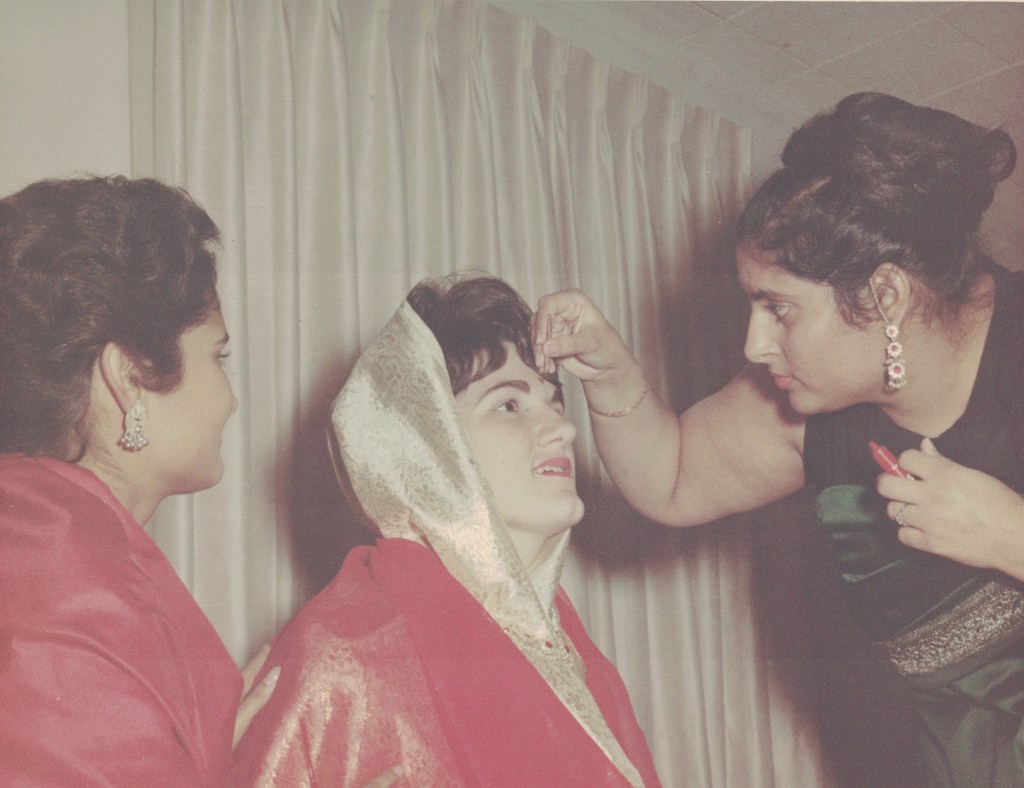
My two sisters dressed Treva as an Indian bride in a sari sent by my mother. We walked around the fire seven times as we took our wedding vows. Treva had never seen an Indian wedding, but she walked as if she had been born and brought up in India. No foreigner could have acquired that gait. At that instant, I knew I was marrying someone with whom I shared common values. A mischievous smile flickered across my face.
I had hit the jackpot.
As I write this, Treva and I have been married for 55 years. We have a daughter, Tara Amy, and she and her husband, Mauricio Franco, have a daughter, Izel Sushila. Our son, Keir Kumar, has a daughter, Ariana Daylene.
During our married years, we have experienced the full spectrum of joys and tensions that come from the union of two strong personalities from two totally different cultures. Those joys and strains became the warp and weft that wove our lives together. Nay, they created a mysterious rhythm to which we continue to dance.
At the age of 86, I wonder how I was able to find such a person amongst the billions of people on this earth. I believe I have to thank my stars.

 balbirmathur.com
This is so touching Balbir! Thank you for sharing this aspect of your lives. Over the years I’ve known you both were very special; this writing gives me a peep into your background and why that is so
I am going to share this real
Live love story with my children
As there are real guidelines they
Can use in their lives.
I am honored and blessed to have experienced the wind and the tree, a perfect metaphor for your amazing and dynamic relationship.
with reverence and gratitude,
Lynn
What a joy to read this story of relationship with Treva..
Though I knew pieces of it and have seen some of the photos, I absorbed your narrative with renewed curiosity and appreciation. Deanna
Loved the story.