
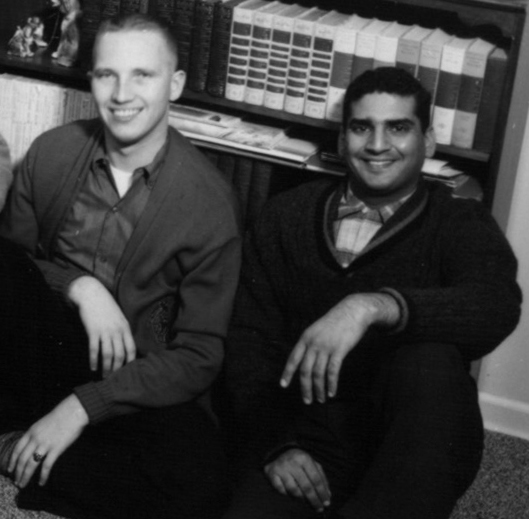
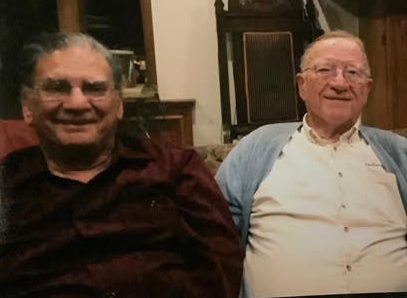
On the day of my arrival at my boarding house, I met fellow boarder, Ken Holmes. He was a freshman at Wichita University from a small town in Kansas, and we became instant friends. He was the first stockholder in my newly-formed company and remained a business partner in all that I did for a very long time. He became like a younger brother to me.
While looking for exporters of handicrafts, Ken and I saw an advertisement posted by an exporter of hand-woven carpets. The carpets were woven in a village near my hometown in India. However, carpets would not fit in the space we were being provided at the Innes department store. So, Ken and I formed a partnership, Mathur and Holmes, and ordered $340 worth of carpets that we planned to sell to our friends.
When the shipment landed at the port in New Orleans, papers were sent to us requesting payment. What I read in those documents made me break out in a cold sweat. I didn’t know how, but I had ordered carpets worth $3,400! I looked at the papers over and over again, unable to believe I had made such a major blunder. Later, I understood that this problem was the result of a difference in the way numbers are written in the USA and India as well as a mistake by the person who filled out the papers. At that time in India, they used a comma between dollars and cents instead of a decimal point. Normally, they would have written thirty-four dollars as $34,00 but they had written $3,400 by mistake. When I saw that, I thought that the carpets were selling at $3.40 per square foot, when in fact they were selling for $34 per square foot!
The carpet exporter, however, had also made a serious mistake. He sent the original documents to us, rather than sending them to the bank. This meant that Ken and I could retrieve the carpets without making any payment to the seller. But we did not wish to take advantage of anyone. If we did that, we asked ourselves, how would we be any different from the New York taxi driver who took advantage of me? This was the first business dilemma of our lives, and we wanted to practice the Golden Rule: “Do unto others as you would have them do unto you.”
First, we had to find a way to get the money. After lots of soul searching and some prodding from Ken, I called my new cattleman friend in Ashland, Kansas, remembering his words to me: “Son, if you ever need any help, don’t hesitate to call me.”
When I called, without hesitation he asked me, “How much money do you need?”
“Fifteen hundred dollars,” I told him. I did not have the courage to ask for the entire sum. He told me to meet him at his bank the next day, where he cosigned a loan for me.
With the money and documents in hand, I went to a local bank in Wichita and requested a loan for the remaining $2,500. The banker understood that, based on the exporter’s mistake, we already had the necessary papers to get the carpets without making any payment. He was impressed by our commitment not to cash in on the supplier’s mistake, and he loaned me the money.
Ken and I were now in debt and delighted with our accomplishment. But we had no time to celebrate. We had no experience selling carpets, so we had to learn fast.
We decided to start at the top and went to the most prestigious carpet shop in town. The owner not only gave us good advice, but he also gave us space to display our carpets in his showroom at no charge, and his sales staff offered to help us sell the carpets.
For the next several weeks, we worked every evening making calls peddling those carpets. In three months, we paid off the loans.
Now we were debt-free, with profit in our pockets. But that was not the end of the story. After we paid off our loan, we delivered one of the carpets to the cattleman who loaned us the money. While he was reluctant at first, he did graciously accept this token of our gratitude.
 balbirmathur.com
A partnership made in heaven!