
I have a vivid and tender memory of when I was three years old. My father and I were walking home from his restaurant one evening. We heard devotional songs being sung on the flat rooftop of a house along the road. My father said we should stop in as a courtesy to the neighbors.
The house was three stories high, with three flights of stairs going up to the rooftop. Even though the stairs were too steep for a little boy like me, I would not let my father help me. I’m sure it took a lot of patience, but he watched as I slowly mounted the stairs, sitting on one step and pulling myself up to the next – one by one, all by myself.
When we reached the roof, we saw about a dozen men singing. We took off our shoes and sat cross-legged beside them. The men were singing in Bengali, the native language of eastern India. Our family was Punjabi, from the north, so it was a foreign language to a small child like me. Very soon, I became bored. I snuggled up close to my dad and asked if we could go home.
With a nod of his head, he advised patience. He whispered that the beauty of the occasion was not in the words but in the people’s devotion. I did not know what devotion was, so I looked again at the men, this time with curiosity.
They were singing at the top of their voices. The night was warm and sultry, and their faces were dark burgundy with effort, perspiration running freely. Their eyes were closed, and their bodies swayed. I watched intently, staring as only a child can do.
They were chanting in Hindi now: “Muthi bandhe aye theye, hath pasare jain gay.” This was a language I knew, but I did not understand the relationship of these words in the context of the song.
I asked my father, “What does it mean?”
He bent toward me and whispered, “When we are born, our fists are closed; when we die, our hands are open.”
“What does that mean?” I asked again.
“It means that when we are born, we bring all the gifts given to us by God, and when we die, we leave empty-handed.”
As I think back, I realize I had no idea what it meant to be born or to die. Those words were not yet in my vocabulary. However, I must have liked the sound, the rhythm, the beat of that particular couplet. I do not remember any other part of that song, nor any other song from that evening. But, that one couplet stuck with me.
In those days, practically every Hindu home in India had a small family “temple” where we would offer thanks in worship. It would be a small corner in the busy house, but that corner was sacred, and each family member would offer their individual prayers there.
The morning ritual was universal: prayers were said after bathing and before breakfast. After the family had been fed and the men had departed for work, women often spent longer times in prayer. During the rest of the day, anyone could go to this spot and offer their obeisance at any time.
In our house, that place was at the top of the stairs that led down to the street. Each time we passed that place of prayer, we would bow with folded hands.
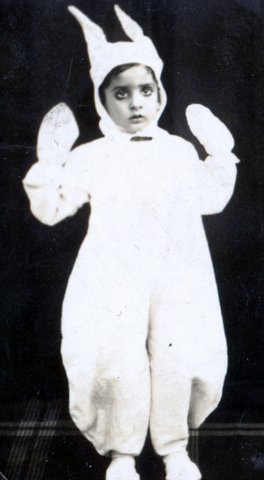
After that night on the neighbors’ rooftop, I liked to sit in that corner temple and sing that couplet over and over again. I would imitate those men, sitting cross-legged with eyes closed, swaying side to side and singing with all my emotion. Today I look at other toddlers and can imagine how comical and animated I must have seemed. So, it was no wonder that my elder relatives would ask me to perform for them. I became identified with that song.
My father had spoken of the “devotion” in those singers. I remembered the men singing with their eyes closed, bodies swaying, their lungs filled, and sound coming out with full power and intensity. So for me, the word “devotion” became synonymous with integrity between our inner feelings and our outward actions. As a child, I was merely imitating the singing. Over the years, devotion turned into intentional practice, and then experience.
Some 40 years later, I had an experience of coming face-to-face with death. In that split second, I realized all the material goods of the world had no meaning. I could not take anything with me. Everything on this earth was to be left behind, even name and fame. The song I sang as a child came alive for me. It became a powerful beam of light that has guided the rest of my life.
On that hot summer evening when I was three years old, I had no idea I would acquire my life’s theme song.
 balbirmathur.com
Thank you Balbir. You illustrate how we are born as formed characters- the main job of parents is to develop rather than damage that beautiful soul.
This is such a beautiful illustration of God’s purpose for our lives. Thank you.
Everything happens for a reason and it is our opportunity to recognize it. Balbir, you make these stories like parables with the hidden meaning recognizable.