
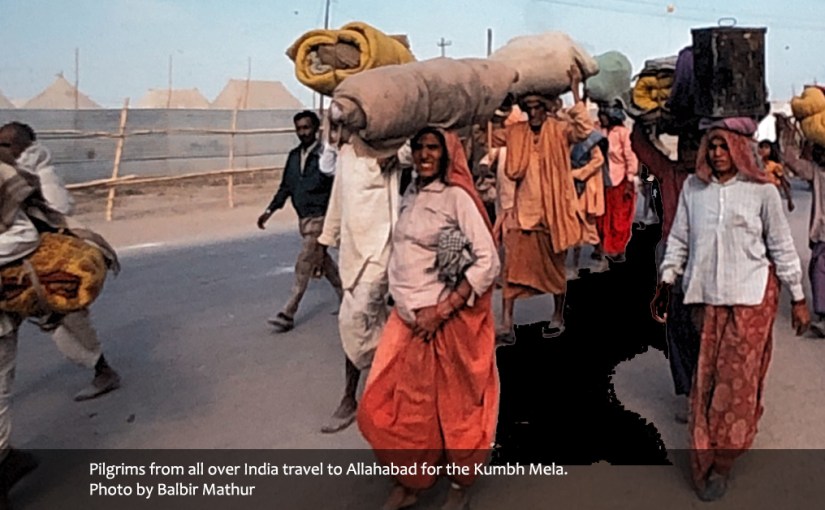
My being at the Mela caused a stir among the foreign journalists.
I should have guessed that representing National Geographic called for being held in special esteem. It made me feel like an imposter. I was neither a journalist nor a photographer. My insecurities also were fed by the fact that I knew very little about the Mela.
For that reason, I reached the Mela grounds a couple of weeks ahead of Mauni Amavasya, the main event scheduled for January 19, 1977, when millions of people were expected to bathe at the confluence of two rivers, the Ganges and Yamuna.
India was the country where I was born and grew up, a country that I once loved and for whose freedom I fought in my own ways. It was also a country I had left in 1958 at the age of almost 23 to discover the ways of the West. As I blended into the throngs of incoming pilgrims, I started to pity those poor, ignorant people who could not adequately feed themselves. What I saw around me fed my intolerance for religions, the breeding ground of superstition and inefficiency.
I had made reservations at a campsite hotel established primarily for foreigners, including journalists from several countries. It was conveniently located and adequate. Each tent was divided into two small rooms and had a toilet and running water. There was a restaurant under a larger tent, which also served as the lobby for guests to get acquainted and hold meetings.
My mother, who lived in Allahabad, also came to the Mela. It was an opportunity of a lifetime for her. She would not have been able to attend the festival if I were not there. She brought her maid servant, primarily to cook, and I hired a young man as an assistant to help me carry photographic equipment. We took two rooms at the campsite.
The campsite was practically empty when we reached it, and some finishing touches were still being added. As the date of the main event approached, foreign journalists began to arrive. I noticed a pattern. At first, they would ignore me as “one of those natives,” a stranger. Gradually, they would find out that National Geographic was covering the event, and that I was their representative, and their attitudes would change. Whenever I was in the restaurant, they would gradually drift over to my table and linger.
One evening, a young new guest appeared. He was having a meal with another American journalist. The journalist spoke to him in a hushed voice, but when I started to see stolen glances and stares from the newcomer, I knew the journalist was telling him about me. Soon, the two walked over to my table, and the young newcomer introduced himself. He was an American freelance photographer.
“This is a bummer. I was hoping to sell my photographs to National Geographic, and now you are here!” he said, unable to hold back his disappointment.
I tried to reassure him that I was a businessman who was randomly assigned by the magazine to be their eyes and ears at the festival. I was certainly not a photographer.
“What about that stuff? Camouflage?” he said sarcastically, pointing to my camera and bag full of lenses and film. My smile was not convincing.
Also in attendance was a Norwegian writer who had several books on Eastern philosophy to his credit. He was well-versed in English and sought me out as a friend. But I spent little time at the campsite. I was at the Mela on a mission, and time was precious.
My workday started early in the morning and continued late into the night. Early on, I would stop by my tent a few times each day to check on my mother, but she quickly developed her own circle of friends.
I reminded myself that, being a novice, I needed to work twice as hard as the professional journalists. It didn’t take long for me to realize that Lady Luck was also smiling on me.
There was a large police force, more than 15,000 strong. This force was being commanded by three elite, high-ranking officers. One of them turned out to be a distant cousin with the same last name as me. The second was an old classmate of mine from Allahabad University. They introduced me to the third officer, who was their boss. He turned out to be an intellectual who admired National Geographic and lamented that, in India, he could not be a subscriber. Like me, he was also an early riser. On several occasions, we had our morning chai together while sitting in the sun.
With the help of these three officers, I was able to put together a list of people I should meet and places I should cover. I was given proper introductions, and sometimes police-driven vehicles would take me to my intended appointments. I now not only had an inside track, but I was also hobnobbing with the VIPs and receiving salutes at police checkpoints. My circle of freshly-minted friends kept multiplying. For them, a man from National Geographic was a good “show and tell” exhibit.
It was evident that an undercurrent of nervousness pervaded the administration. In practically all the press conferences I attended, one question invariably came up: “Record crowds are expected. What is being done to prevent a disaster like the one in 1954?” That was the year my college friends and I attended, when several hundred people were trampled to death and thousands more injured in the stampede. Everyone was still fighting that previous battle. The members of the administration were taking this fight personally.
The 15,000 police were being helped by at least that many volunteers. Army units were on alert in case of emergency. There was a sophisticated control room, commanded by a senior officer with considerable experience in crowd control. Three walls of a hall were covered with blackboards, and police officers on mobile ladders were constantly updating the traffic reports with colored chalk. Information on trains and bus traffic poured in from all parts of the state. Several times, traffic had to be delayed at the outskirts of Allahabad. Days before the start of the Mela, the control room predicted a crowd larger than what was originally anticipated.
The administration had done a mammoth job of laying out the infrastructure for a temporary tent city covering several square miles. The main tents were already erected, along with roads and fresh running water in each area. Plots were laid out for large groups who had rented space to set up their tent complexes, and other areas were designated for pilgrims to set up campsites. The Army Corps of Engineers had erected dozens of pontoon bridges for people to cross the river at convenient points. The whole area was being sprayed for mosquitoes twice a day. For miles around, roads were being sprinkled with insecticides.
As people started flooding into the Mela grounds, a new hubbub began. The campsites started filling with smaller tents. The main streets were soon dotted with restaurants and shops selling traditional souvenirs. There were gaudy neon lights, and loud music blared from many of the shops.
Specific measures had been taken to prevent the previous disaster. On the day of the Mauni Amavasya, pilgrims would be contained in a series of cattle pens. They were to be released from one pen to the next in orderly fashion. Pilgrims would have to go through a snake-like, winding path for several hours before they could reach the bathing grounds.
Hundreds of tall police towers with loudspeakers were erected at fixed distances to monitor any untoward happening. Messages could be communicated to the crowds at specific locations or to the entire body of millions of people at once. Several lost-and-found centers were established where people could be reunited. Announcements were being made constantly.
The administration was well-prepared. There was to be no stampede this time.
 balbirmathur.com